The industrial sector is accelerating the adoption of practical, high-impact AI applications. Based on insights from IIoT World Days 2025, industry leaders focus on scaling these technologies across global operations. From Agentic AI that autonomously manages supply chains to Computer Vision that ensures precision on the factory floor, manufacturers are deploying AI to solve specific, high-value bottlenecks.
Here are the top 15 use cases and real-world examples currently transforming the manufacturing landscape.
Predictive & Prescriptive Maintenance
AI provides prescriptive analytics, delivering exact repair instructions to operators before a potential failure occurs.
- The “Self-Healing” Turbine Workflow: AI agents detect temperature spikes in gas turbines, verify historical data, check Digital Twins for part failure, and automatically query ERP systems to schedule a technician.
- Prescriptive Diagnostics: Using a “layered intelligent stack,” this system identifies specific mechanical fixes (e.g., “replace inner race bearing”).
- Preventing Material Clogs (The Chocolate Factory): InfluxData highlighted a case where AI combined raw sensor data with environmental context (viscosity, humidity). By identifying the specific “clogging conditions,” the plant implements proactive process adjustments
Production Optimization & Quality Control
AI identifies critical patterns within process data to increase yield and ensure product integrity.
- Real-Time Root Cause Analysis: Using Generative AI, manufacturers analyze thousands of log entries instantly. The AI identifies specific errors, like feeder malfunctions, that previously required hours of manual engineering diagnosis.
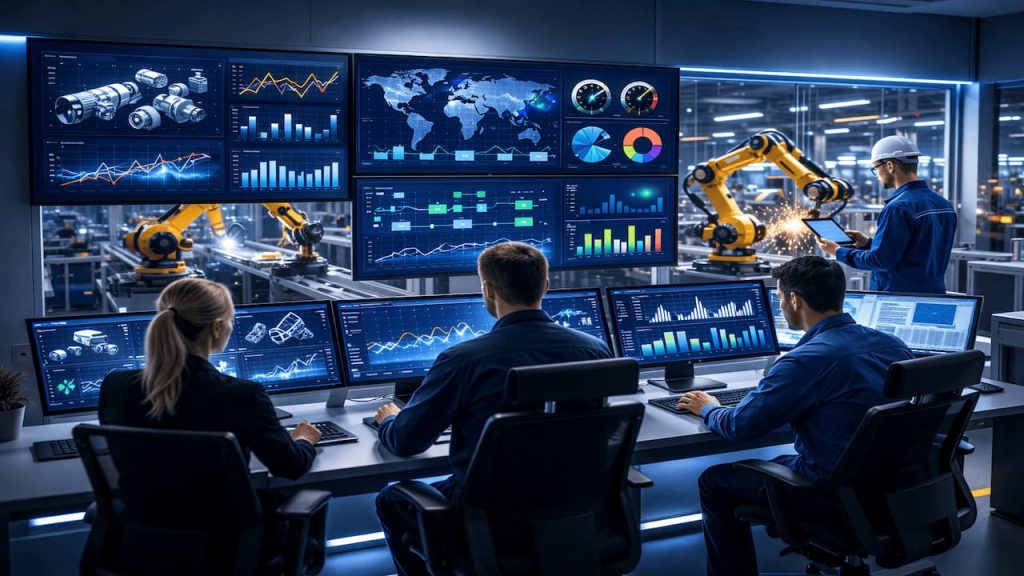
- Computer Vision for Assembly: A medical device manufacturer uses AI to simplify complex tasks. Cameras monitor operators in real-time; if a bolt is missed, the system alerts the worker immediately. This intervention reduced scrap rates by 60% on products valued at $1,200.
- The “Gravity Feeder” Efficiency Fix: One vendor used AI to analyze manual assembly ergonomics. The AI identified that moving heavy parts manually was a primary bottleneck and recommended a gravity feeder, providing a clear ROI and labor savings calculation.
Supply Chain & Demand Planning
AI enables manufacturers to navigate volatile markets and automate complex logistics through data-driven forecasting.
- The “Cannibalizer” Model (P&G): Procter & Gamble utilizes machine learning to predict how a promotion at one retailer (e.g., Costco) affects sales at another (e.g., Walmart), allowing for hyper-accurate production forecasting.
- Automated Shipping & Packing (Milwaukee Tool): AI agents assist shipping clerks by identifying inventory locations, digitally packing shipments for maximum space efficiency, and auto-generating documentation.
- Supplier Risk Scoring: AI models ingest external data, geopolitics, weather, and financial news, to provide early warnings. This enables “dual-sourcing” strategies to maintain stability during supply chain shifts.
Workforce Enablement & Knowledge Capture
AI captures “tribal knowledge” to support the next generation of industrial workers.
- The Automated “Shift Handoff”: AI generates “standup reports” on OEE (Overall Equipment Effectiveness) and inventory at the click of a button, providing specific action items for the upcoming shift.
- Instant SOP Generation: Companies use AI to record experts performing tasks via video, which the AI converts into step-by-step Standard Operating Procedures (SOPs) or AR guides for new hires.
- Natural Language Troubleshooting: Operators use Large Language Models (LLMs) to query equipment manuals. Instead of searching through paper files, the AI provides the exact fix for a hexadecimal error code in seconds.
Energy, Sustainability & Infrastructure
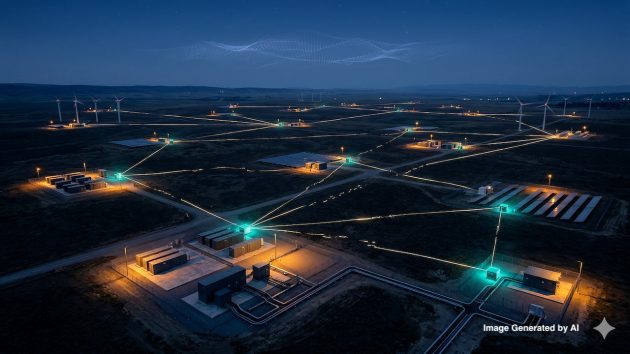
AI manages the complexity of renewable energy integration and optimizes grid stability.
- Virtual Power Plants (Toshiba): Using Digital Twins, Toshiba aggregates solar and battery storage into a “Virtual Power Plant.” This allows small-scale resources to be traded on energy markets, yielding 3x the profit of individual operations.
- Wind Farm Optimization: AI models adjust turbine angles in real-time to account for “wake effects,” ensuring that the entire farm reaches maximum power output.
- Smart EV Fleet Charging: For electric bus fleets, AI analyzes energy pricing and route schedules in real-time to ensure buses charge at the lowest cost while meeting their operational windows.
These insights were collected during IIoT World Days 2025. As we move into 2026, registration is now OPEN for all upcoming IIoT World Days 2026 events. We are also officially accepting Calls for Speakers and Sponsors.
We look forward to continuing our mission of providing world-class, informative events for the industrial community. We appreciate your continued support through the years!
More information about IIoT World Days 2026 events:
Thursday, March 19, 2026
IIoT World Energy Day
Tuesday, May 12, 2026
IIoT World Manufacturing Day/Frontline Operations
September 9 – 10, 2026
Industrial AI 2026 Summit
Smart. Scalable. Secure.
Part of IIoT World Days Series
Wednesday, October 14, 2026
IIoT World ICS Cybersecurity Day
December 8 – 9, 2026
IIoT World Manufacturing & Supply Chain Day
Frequently Asked Questions: AI in Manufacturing 2026
Q: What is the difference between predictive and prescriptive AI in manufacturing?
A: Predictive AI forecasts when a failure will occur. Prescriptive AI goes further and tells the operator exactly what to do, specifying the part, the timeframe, and the action required. Most mature deployments discussed at IIoT World Days 2025 have moved toward prescriptive systems.
Q: Which AI use case delivers the fastest ROI in manufacturing?
A: Based on deployments discussed at IIoT World Days 2025, prescriptive maintenance and computer vision quality control consistently deliver ROI within 3 to 6 months. Infinite Uptime cited a typical 3 to 6 month ROI timeline across 25,000 digitized assets.
Q: What is Agentic AI in manufacturing?
A: Agentic AI systems autonomously execute multi-step workflows without human intervention at each step. In manufacturing, this includes detecting an anomaly, querying ERP for parts availability, scheduling a technician, and generating a work order, all without a human in the loop until the work order is ready.
Q: Can AI work with legacy manufacturing equipment?
A: Yes. Platforms like Litmus and Arch Systems are specifically designed to connect machines from the 1960s through 1980s by managing protocol-level transitions and extracting data without replacing the equipment.
Q: How is AI being used in supply chain management?
A: Use cases range from demand forecasting models that account for cannibalization effects between retailers, as deployed by P&G, to automated shipping and packing agents used by Milwaukee Tool that identify inventory locations and generate documentation autonomously.
This article was written by Carolina Rudinschi, Co-founder of IIoT World