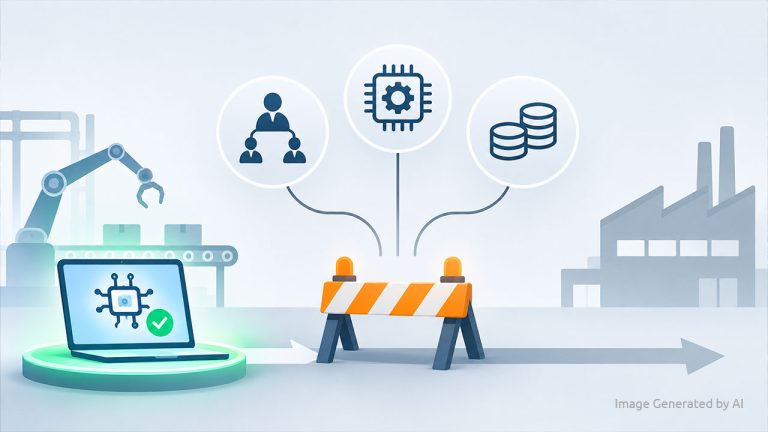

Sixty-three percent of manufacturers had to clean and map their data before beginning AI pilots, and 21% identified inconsistent data formats across plants as their single biggest barrier to implementation, according to the Manufacturers Alliance 2026 Great Acceleration Research. At the Industrial AI Summit 2026, Tim Burke of Arch Systems, Abby Eon of Velotic, Bryce Barnes of LG CNS, and Sahil Yadav of AOI discussed why a working AI pilot in one plant routinely breaks at the second. Clean data is a prerequisite. The layer that fails to travel between plants is operational context.
Why Should AI Readiness Be Assessed Per Use Case?
AI readiness is a use-case question that has to be answered separately for every application. A single plant can be ready for downtime attribution while missing the data sources that quality prediction requires, because each application demands different inputs and different data sources.
One test tells you whether a use case will survive the move: could someone at a different facility, with people who have never worked at the original site, stand it up using only what is written down? If the answer is no, the pilot succeeded on institutional knowledge that does not transfer. Four conditions decide whether it will work:
- The data must be connectable
- Operational context beyond asset data must be available
- The data stream must be trusted to report failures at any hour
- The output must feed into an existing workflow or system
When any one breaks, the AI produces results that no one acts on.
Why Do Manufacturers Confuse Unified Namespace with a Data Foundation?
Most companies believe they have already solved the context problem because they built a unified namespace, but the two operate at different layers of the stack. Unified namespace sits below a factory’s operational systems and moves data between MES, SCADA, historians, and scheduling tools. A unified data foundation sits above those systems and unifies the context needed to interpret that data for decisions. Confusing these two layers is the most common mistake in AI projects across manufacturing today.
Companies building unified namespace believe they are building a unified data foundation because both phrases share the word “unified.” They operate at different layers of the stack. Unified namespace solves data accessibility and transport. A unified data foundation solves what the data means, how it relates to the production route, and what machine state existed when the data was recorded.
| Unified Namespace | Unified Data Foundation | |
| Position in stack | Below operational systems (MES, SCADA, APS, historian) | Above operational systems |
| Primary function | Move data quickly across systems | Unify context for interpretation and decisions |
| What it solves | Data accessibility and transport | Data meaning and relationships |
| AI relevance | Necessary first step | Required for AI to produce trusted results |
Both are necessary. Stopping at unified namespace leaves AI without the context layer to answer operational questions reliably.
Why Does the Second Deployment Die on Semantics?
The second AI deployment typically fails on semantics. Tags exist at the second site but carry different names and slightly different meanings, and the model degrades quietly rather than failing loudly. Silent degradation is worse than an outright failure because it erodes trust without triggering an alarm.
A model that worked at plant one delivers subtly wrong answers at plant two, and operators lose confidence before anyone identifies the root cause. The fix: standardize data contracts and deployment patterns internally rather than waiting for an industry standards body. “The pipeline is the asset, not the model,” said Sahil Yadav, Head of Software and AI at AOI. Every AI recommendation should carry provenance, recording what data produced it and which model version generated the result.
Each factory, each industry, each operation carries unique naming, context, and relationships. AI produces reliable answers when it understands those relationships. Structured, clean data is necessary but insufficient. The relationships between data points need to be captured through an ontology and represented in a graph model, which gives AI the context to work across facilities rather than within a single one.
Some of that context resists automation entirely. A machine operator running equipment at 70% utilization gets flagged by every dashboard and every model as underperforming. What those systems cannot see is that the operator chose 70% because replacement parts are six weeks out, and a breakdown would cost far more than reduced throughput. That judgment lives in the operator’s head. Capturing decisions like that is one of the hardest parts of scaling AI beyond a single site, and the operational context model underneath AI projects needs to be treated as core infrastructure.
This article is based on a panel discussion with Tim Burke of Arch Systems, Abby Eon of Velotic, Bryce Barnes of LG CNS, and Sahil Yadav of AOI, moderated by Jeff Winter of IIoT World, recorded at the Industrial AI Summit 2026 hosted by IIoT World. AI tools were used to help summarize and organize the content. Reviewed and edited by the IIoT World editorial team.
Sponsored by Arch Systems