The Rolls-Royce engine on most commercial aircraft is not owned by the airline. It is rented by air miles flown. Siemens won a train contract by guaranteeing it could move one million passengers between Cologne and Dusseldorf between 8 a.m. and 9 a.m. every morning. Ingersoll Rand pipes compressed air “over the fence” into a customer’s plant from a compressor building on an adjacent plot. Boris Scharinger of Siemens, author of Industrial AI: From Pilot to Profit, Jan Pingel of Ingersoll Rand, and Karthikeyan Natarajan of Infinite Uptime described at the Industrial AI Summit 2026 how manufacturers shift from equipment sales to outcome guarantees, and why the business model change is harder than the technology.
How Do Outcome-as-a-Service Models Work?
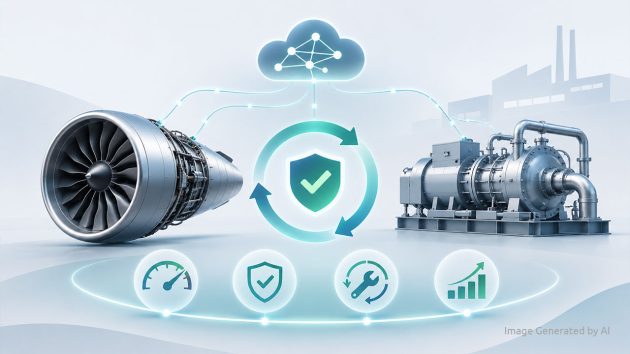
The progression moves through three stages: product sale, availability guarantee, and output as a service. A product sale is fire and forget. An availability guarantee requires the seller to manage a set of risks around uptime and lifetime. An output guarantee transfers the full operational risk from the customer to the provider.
Siemens Energy sells small and medium-size gas turbines into the process industry. The customer grants a maintenance window of 10 days every two years. Everything that needs replacing must happen inside that window. No unplanned outages are tolerated between windows. The analytics behind that offer had to be accurate enough that Siemens’s internal audit department was asked to audit the prediction algorithms, because the financial exposure from a missed maintenance window was large enough to require independent verification.
The compressed air model works differently. “Air over the fence” means the OEM buys a plot next to the customer’s facility, installs compressors in a container or small building, and feeds compressed air directly into the plant. The OEM owns the equipment, pays for the energy, and takes full responsibility for delivery. The customer pays for output, not for machines.
| Model | Who Owns the Equipment | Who Manages the Risk | What the Customer Pays For |
| Product sale | Customer | Customer | The machine itself |
| Availability guarantee | Customer or shared | Seller manages uptime risk | Guaranteed uptime within SLA parameters |
| Output as a service | Seller | Seller manages all operational risk | Delivered output (compressed air, passenger volume, guaranteed uptime) |
What Happens to Revenue When OEMs Stop Selling Equipment?
A company that sold a $100,000 machine and doubled that value in service revenue over 10 years collected the full equipment price in month one. Switching to an outcome model means the first year generates roughly one third of previous revenue. That is a conversation with shareholders that most legacy manufacturers are not ready to have.
In Europe, simply repackaging a capital expenditure as an operating expense does not win deals. What wins is managed customer risk. The customer offloads the risk of equipment failure, maintenance scheduling, and performance degradation to the provider. That transferred risk is what creates margin for the seller.
Startups can build outcome models from day one because they have no installed revenue base to protect. Legacy companies face a multi-year revenue cliff. Many OEMs, rather than financing the transition themselves, bring in finance companies that structure the outcome model and capture the largest share of the resulting profit. The OEM still sells equipment and service, while the finance company earns on the risk transfer.
When Siemens Energy’s prediction algorithms determined the terms of commercial outcome-as-a-service contracts, the financial stakes were high enough that the company’s internal audit team was asked to conduct an independent review of the algorithms. That was the first time the idea emerged that internal audit departments need the capability to audit prediction models, because the financial impact of an inaccurate forecast flows directly into contract liability.
Why Do OEMs Have a Data Advantage in Selling Outcomes?
Guaranteeing output instead of selling equipment requires fleet-scale intelligence: patterns learned across hundreds of thousands of similar machines operating in different environments, temperatures, utilization patterns, and production demands. That intelligence takes years to accumulate and cannot be built from a single customer’s data.
Ingersoll Rand generates 50 to 100 insights per equipment type, such as compressors, blowers, and vacuums, producing thousands of predictions per week. Those insights cover downtime probability (within an hour, a day, a week, or a month), service needs (filter changes, clogged components), and capacity signals (all machines running at 95% indicates the customer needs additional equipment). That breadth of prediction is what allows an OEM to price an outcome contract and manage the risk behind it.
Corporations routinely restrict AI providers from using customer production data to train models for other customers, citing intellectual property and trade secret concerns. A provider agrees to a project but cannot use the collected data to improve models for anyone else. After 20 projects over three years, there is still no reusable product. OEMs with their own installed base hold a structural advantage: they do not depend on customer permission to learn from their own fleet.
Transmitting raw high-frequency vibration data to a customer allows them to build their own detection capability. Transmitting the interpretation, “this is a bearing problem, and at this utilization and energy level, you have 10 to 14 days before failure,” preserves the provider’s advantage while giving the customer something actionable at the system level.
This article is based on a panel discussion at the Industrial AI Summit 2026 with Boris Scharinger, Book Author, R&D Excellence, DataOps and Master Data Management at Siemens, Jan Pingel, Product Leader for Digital Solutions at Ingersoll Rand, and Karthikeyan Natarajan, CEO of Infinite Uptime, moderated by Rob Tiffany, Research Director at IDC. Editorially Independent, Sponsored by Infinite Uptime. AI tools were used to help summarize and organize the content. Reviewed and edited by the IIoT World editorial team.