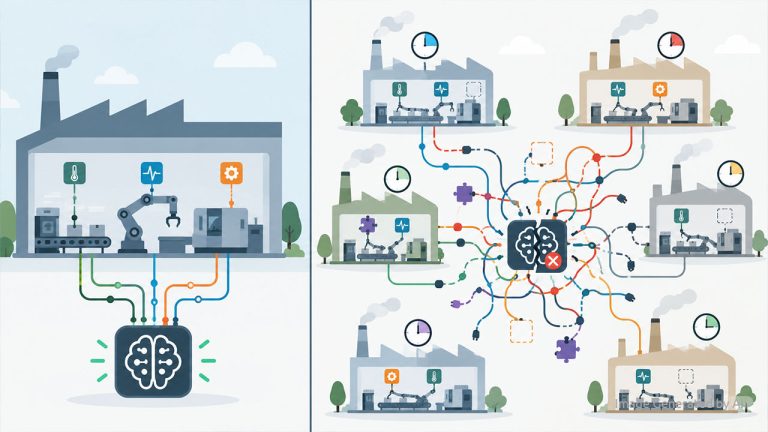

Seventy-two percent of manufacturers have adopted AI in some form, but only 10% have deployed it at scale, according to Parsec’s 2026 State of the Manufacturing Industry Report. The governance gap is even wider: Grant Thornton’s 2026 AI Impact Survey found that 62% of manufacturers focus AI on operations, yet only 7% have tested an AI incident response plan and only 12% believe they could pass an independent AI governance audit. At the Industrial AI Summit 2026, Tim Burke of Arch Systems, Abby Eon of Velotic, Bryce Barnes of LG CNS, and Sahil Yadav of AOI discussed how to measure whether operators trust AI output, what conditions AI must meet before it influences operations, and how soon generative models will make decisions on the factory floor.
When Is a Factory AI Ready but Not Decision Ready?
AI ready means the model can produce an answer. Decision ready means someone will change a production schedule, dispatch a crew, or adjust a quality process based on that answer. Most manufacturers discover the distance between the two when a technically correct AI output sits unused because no one trusts it enough to act.
Before AI earns the right to influence operations, it must be grounded in real data, contextual to the specific operating environment, explainable to someone who did not build it, governed with clear ownership and policies, and bounded so the system’s scope of action is defined in advance. The most important of those five, according to Abby Eon of Velotic, is the ability to signal uncertainty. A system that reports a sensor reading of zero is providing different information than a system whose sensor has failed. A model that cannot distinguish between the two will confidently instruct an operator to do the wrong thing.
“Operators do not trust systems that are always sure,” said Abby Eon. “They trust systems that can say ‘I don’t know right now.'”
Not every problem requires AI. Where the data is well structured and the failure modes are known, AI fits. Where the problem requires judgment that no data set captures, other analytical approaches or human decision-making produce better results at lower cost. Forcing AI into a use case to claim adoption adds expense without adding value.
Which Three Metrics Prove AI Is Trustworthy?
Model accuracy is the wrong number to bring to a VP of operations because it describes how the algorithm performs, when leadership needs to know how the operation performs. Sahil Yadav of AOI proposed three metrics that speak to operational leadership instead.
Mean time to explanation measures how long a human needs to understand why the AI produced a specific recommendation and reconstruct the reasoning, regardless of whether that recommendation proved useful. If the explanation takes longer than the decision window, the recommendation is operationally irrelevant.
Trust-adjusted risk assigns a dollar value to the outcome if the AI is wrong. That value includes reputation damage, supply chain disruption, regulatory consequences, and legal exposure. Presenting this figure forces leadership to quantify what they are risking by following or ignoring the AI output.
Adoption rate tracks the percentage of AI recommendations that operators actually act on. A high-accuracy model with a low adoption rate signals a trust gap that no technical improvement will close.
All three should be baselined before AI is introduced, and the operations leader should choose the test cases. A model that can signal its own uncertainty earns more trust than one that delivers confident outputs with occasional silent failures.
| Autonomy Tier | AI Role | What Must Be Proven |
| 1. Observe | Monitor and display | The data picture is accurate and reflects operational reality |
| 2. Recommend | Suggest actions | Precision against real historical incidents already labeled by humans |
| 3. Act with supervision | Execute with human signoff | Circuit breakers, full audit trails, explainability, bounded blast radius |
| 4. Self-heal | Act autonomously | Sustained proven record, every action reversible, trust-adjusted risk within accepted bounds |
Will AI Make Operational Decisions Within Three Years?
Generative AI will change how operational decisions are selected and presented within the next three years, though the decisions themselves will stay with humans. Large language models guess the next token, and manufacturing control logic depends on deterministic outcomes, so the convergence will take time. As production moves toward smaller lot sizes and more frequent process changes, AI will pick which deterministic workflow should run and present that choice to a human operator.
Tim Burke of Arch Systems said the investment becomes defensible when AI infrastructure attaches to an overall enterprise architecture plan rather than standing alone as a technology project. Align to an agreed architecture, unify one or two systems already deployed, and deliver a use case from that foundation. The anti-pattern is a three-year IT-only data integration project that promises to solve every use case at the end but delivers nothing along the way.
The most experienced engineers were the biggest skeptics at AOI, and what won them over was starting AI on something tedious but not critical, taking a boring, repetitive task off their daily workload so trust could build from there.
When asked for their single biggest barrier to AI scale, the four panelists gave four different answers: organization (Tim Burke), context (Abby Eon), data (Bryce Barnes), and trust (Sahil Yadav). Each named a different use case to scale first: quality root causing, downtime attribution, workflow assistance, and predictive maintenance. And on what is currently overhyped in industrial AI: humanoid robots, co-pilots sitting on messy data, large language models themselves, and autonomous agents on the factory floor.
This article is based on a panel discussion with Tim Burke of Arch Systems, Abby Eon of Velotic, Bryce Barnes of LG CNS, and Sahil Yadav of AOI, moderated by Jeff Winter of IIoT World, recorded at the Industrial AI Summit 2026 hosted by IIoT World. AI tools were used to help summarize and organize the content. Reviewed and edited by the IIoT World editorial team.