Most predictive maintenance implementations stopped at anomaly detection, flagging that something seemed wrong without identifying what or when. Boris Scharinger of Siemens, author of Industrial AI: From Pilot to Profit, and Karthikeyan Natarajan of Infinite Uptime explained at the Industrial AI Summit 2026 why PdM fell off top AI use case lists, what separates real prediction from pattern alerts, and what accuracy threshold keeps operators engaged.
Why Did Predictive Maintenance Start Losing Ground?
Predictive maintenance was the natural first step because it did not interfere with production. Data scientists entering industry and plant teams experimenting with analytics both gravitated to the same comfort zone. The financial returns capped at roughly $12,000 per year for a million-dollar asset, and the use case dropped off top investment lists.
A head of production will resist any AI that introduces probabilistic elements into the stability of a running line. PdM offered a safe entry point: take a data snapshot, analyze machine state, and schedule maintenance windows better. No interference with the primary production process.
The economics, however, limited the ceiling. A rule of thumb circulating across the predictive maintenance industry holds that for a million-dollar asset, eliminating all unscheduled downtime generates roughly $1,000 per month in chargeable value. That $12,000 annual revenue ceiling per asset means a provider needs hundreds of factories and thousands of connected machines to build a commercially viable business.
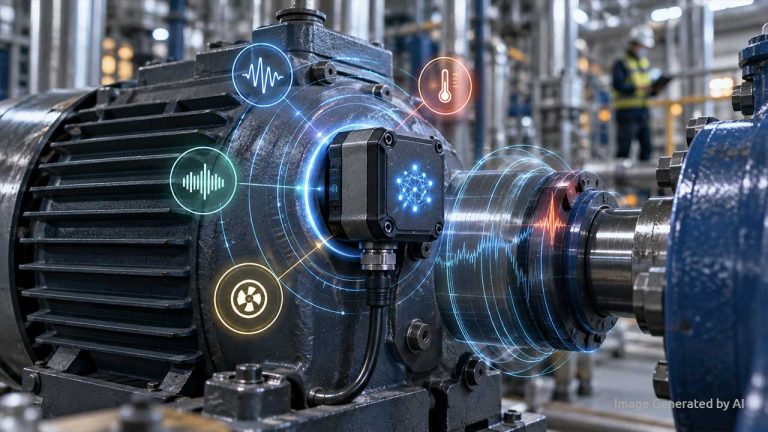
What passed as predictive maintenance in most industrial AI deployments was anomaly detection: “it seems we have a problem, can someone who has some expertise please double-check.” Real predictive maintenance requires heavy classification. It means identifying that a specific bearing will fail and that the operator has 10 days to replace it. That requires vibration analysis, sound analysis, and models trained across a large fleet of different machine types.
| Capability | Anomaly Detection | Prescriptive Classification |
| Output | “Something seems wrong, please check” | “Bearing problem, replace within 10 days” |
| Method | Pattern deviation alerts | Vibration analysis, sound analysis, heavy classification |
| Action required from operator | Manual investigation to identify root cause | Specific prescription with timeline |
| Fleet requirement | Low (does not require fleet diversity) | High (needs diverse machine types for accuracy) |
What Accuracy Do Operators Require From AI?
Operators who receive 30% to 40% false positives abandon the system within a month. Infinite Uptime reports 99.97% accuracy across 55,000 prescriptions, with 95% acted on by operators and 175,000 hours of downtime avoided. The threshold for sustained adoption sits above 95% true positives and below 5% false positives.
Unscheduled downtime costs the manufacturing industry roughly $100 billion. Most systems generate five recommendations where three are right and two are wrong, and operators stop trusting them. A system that fires anomalies and alerts without clear prescriptions, without specifying what needs to be done and when, does not hold operator attention past the first month.
Infinite Uptime built its models over 8 years across 1,000-plus factories in 27 countries. The approach stacks horizontal predictive maintenance with Verticalized AI Shields: 18 unique asset categories contextualized with process data, inspection records (route-based, ultrasound, thermography), maintenance history, and OEM operating procedures. Text, audio, and video inputs from technicians add further context. The vertical AI shield product launched in the last three months, with three shields nearing completion and additional shields planned for steel, chemicals, food and beverage, and cement.
Value must be demonstrable within 3 to 6 months. Of 1,000-plus factories where Infinite Uptime has run implementations, more than 600 are scaling and more than 300 have reached 70% to 80% coverage of critical equipment.
Where Is the Next Value Pool Beyond Prediction?
The next value pool is plant redundancy. Factories carry 30% to 40% additional cost in spare lines, backup equipment stored for 12 to 18 months without use, and thousands of engineers on call. Prescriptive AI that identifies machine state precisely enough to predict remaining useful life can begin engineering that redundancy out of plant design.
That redundancy accumulated because no system could reliably tell operators when a specific component would fail. The only defense was duplication: extra lines, stockpiled parts, and engineers on standby for emergencies that better prediction would prevent.
If prescriptive AI reaches the accuracy and trust levels required to reshape how plants handle risk, the use case comes back. “When we look into forecast five years, we will see that use case becoming one of the top three again,” said Boris Scharinger, Book Author, R&D Excellence, DataOps and Master Data Management at Siemens. The shift moves from optimizing maintenance schedules to redesigning plant infrastructure itself, reducing duplication, reallocating on-call engineering resources, and reconsidering how much spare capacity a production line truly needs.
This article is based on a panel discussion at the Industrial AI Summit 2026 with Boris Scharinger, Book Author, R&D Excellence, DataOps and Master Data Management at Siemens, Karthikeyan Natarajan, CEO of Infinite Uptime, and Jan Pingel, Product Leader for Digital Solutions at Ingersoll Rand, moderated by Rob Tiffany, Research Director at IDC. The session was sponsored by Infinite Uptime. AI tools were used to help summarize and organize the content. Reviewed and edited by the IIoT World editorial team.