I started out as a control systems engineer, working in plants where everything important happened in one place. There was just one site, one control room, and one process to watch. You could stand right in the middle of it all.
The energy systems being built now have none of that. A single operator’s portfolio might combine solar, battery storage, backup generation, EV charging and building systems, spread across dozens or hundreds of locations, with more assets arriving every quarter. And increasingly, each of those assets ships with its own onboard intelligence. The industry has become genuinely good at making individual assets smart. The harder question, and the one that gets far less airtime, is how you make them behave as one system.
Local intelligence doesn’t add up to system intelligence
Most AI in energy today operates at the level of a single asset. Degradation models on batteries. Optimisation routines on inverters. Fault prediction on individual pieces of equipment. All useful. But each of those systems makes decisions with a narrow view of the world.
A battery deciding the ideal moment to charge based on a price signal is behaving perfectly rationally. Five hundred batteries reaching the same rational conclusion in the same instant is a different matter. The aggregate response can produce exactly the kind of swing each individual device was trying to ride out. Local intelligence does not add up to system intelligence on its own. Something has to reconcile the two, and that something is coordination.
Coordination can sound like an abstract concept, but in reality, its absence leads to very tangible problems.
The first issue is time. Distributed control relies on all nodes having a consistent understanding of what has happened and when. In my experience, guaranteeing correct timestamps across a fleet is more important than is often appreciated. I have seen cases where inconsistent clocks have led to real control issues, with events being processed out of order and decisions being made based on a version of events that was not actually correct.
Meaning is the second. Assets from a dozen manufacturers will describe the same quantity a dozen different ways. Before two systems can coordinate, they have to agree on what the data means, and building that common semantic layer across an estate is slow, unglamorous work with no shortcut through it.
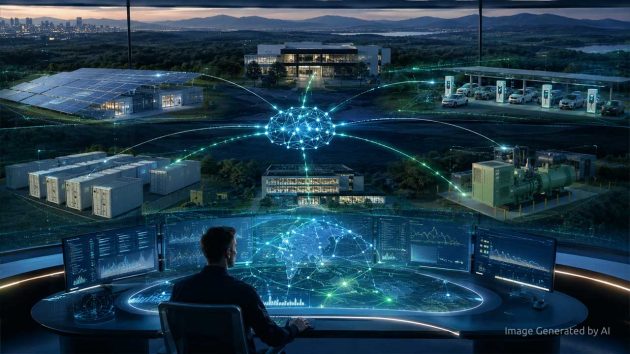
Then there is hierarchy. Not every decision belongs in the same place. Some responses have to happen at the device itself, in milliseconds. Some belong at site level, balancing across the assets behind a single connection point. Others only make sense across the whole portfolio. In some of the larger storage systems I have seen, thousands of low-cost nodes handle data acquisition and feed a smaller number of site controllers, which in turn answer to fleet-level supervision. Deciding which decisions live at which layer is most of the architecture.
And underneath it all sits bandwidth. You cannot stream everything to everyone. Filtering and data reduction determine what each layer of the system genuinely needs to see, and a good coordination design is deliberate about that rather than hopeful.
Connected systems share their mistakes
There is, of course, another side to linking everything together. In an isolated deployment, a model that is not performing as expected is usually just a local issue. However, in a coordinated system, poor outputs can spread more widely. For example, a signal that is slightly out of range at one layer can become an input to decisions at another, and disturbances may spread across systems that were previously operating independently.
That is why coordination has to be designed with boundaries built in. Operating envelopes, limits and interlocks at every layer, so that no single component can push the wider system somewhere it should not go. Deterministic protection keeps ownership of the hard limits. The intelligent layer advises and optimises within them, not around them.
There is one further point worth mentioning. It is not possible to coordinate assets that cannot be interfaced with. Energy portfolios are, by their nature, made up of equipment from multiple vendors. If each asset type requires a custom integration using a proprietary interface, the cost and complexity of coordination increases with every new addition. Open, standards-based interfaces are not simply a matter of preference; they are essential to making coordination economically viable.
The destination is a network of distributed energy resources that support the grid in concert, rather than a crowd of clever devices each doing its own thing. The models will keep improving regardless. Whether the wider system behaves coherently depends on operators treating coordination as an engineering discipline in its own right, not something that occurs naturally once enough smart assets have been installed. In my experience, it never does.
About the author