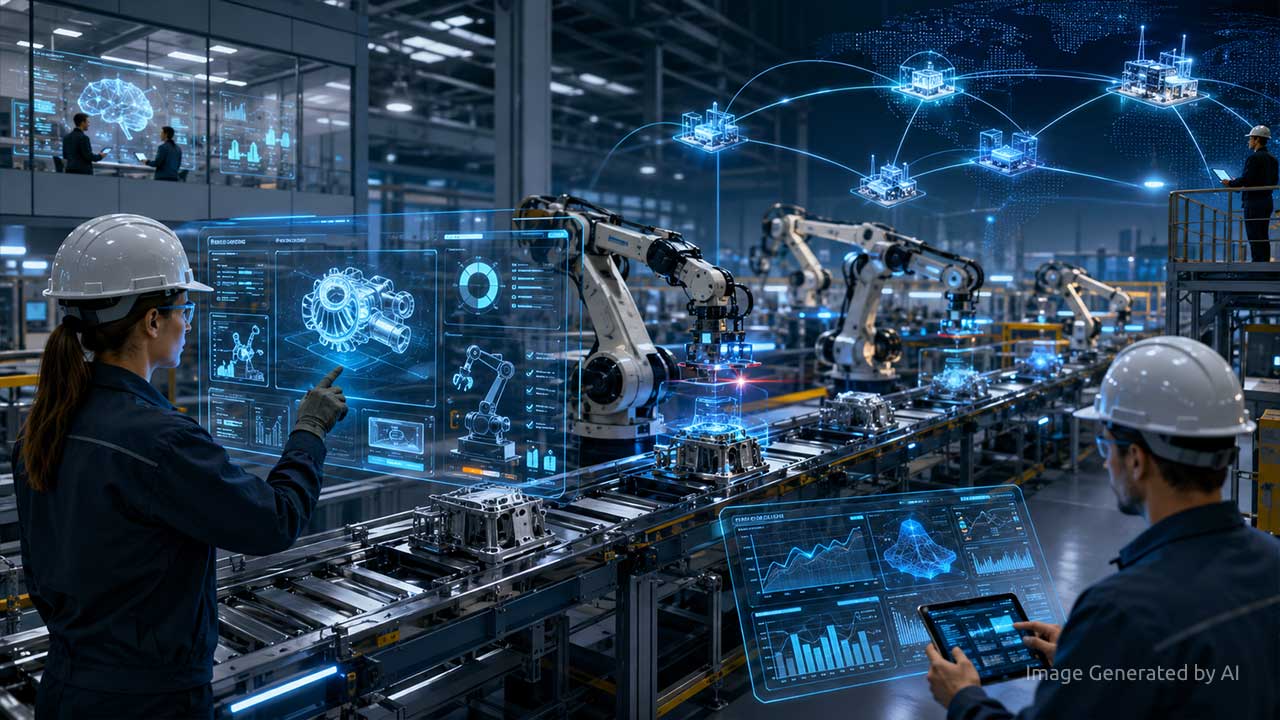
One Avanade client, a global snack food brand, used AI agents to cut inventory by 20%. Another, an electronics manufacturer, recovered $35 million in a year in lost fees. At Hannover Messe 2026, Avanade presented two demos in the Microsoft booth, co-branded with clients Nissha Metallizing Solutions and Kruger, showing how AI agents embedded in real workflows help companies make smarter decisions faster at every level of the organization, across the whole value chain.
How Does AI Help Operators on the Production Line?
For the people on the ground who do the actual work, it is a tough job, and fewer people want to do it because it is stressful. Every manufacturer Avanade works with has the same problem: too few operators, and those they have are retiring soon, taking all their experience with them.
AI agents address this by bringing together all the context an operator needs when a problem occurs on the line: machine parameters, knowledge, and guidance to solve the problem faster.
One capability shown in the demo: machines on the line that adjust their speed based on quality. This runs as a machine learning application on the edge, not in the cloud, because the adaptation happens in real time. The line speeds up as long as quality stays within the threshold. The moment quality drops, the line slows down.
The goal is optimizing the bottleneck process and machine, and sometimes that means slowing down to increase quality. The optimization targets end-to-end business outcomes and product quality.
What Do Companies That Succeed with Manufacturing AI Have in Common?
Three points emerge from Avanade’s client work.
First, it is not magic. There is homework to be done. The companies that succeed with AI today invested previously in technology, in people, and in redefining processes.
Second, board-level commitment. Companies that deliver above-average results treat AI as a company transformation and a competitive edge. Manufacturing has had the same processes and technology for decades. Rethinking that requires endorsement from the top.
Third, bottom-up adoption. When top-down endorsement and bottom-up adoption come together, the results follow. Felix Weindel described what the fastest movers have in common: “Not on top, but embedded into workflows, embedded into everyday life.”
When people see the difference AI makes in their job, they adopt it.
How Close Are Operators to Building Their Own AI Tools?
Building applications has become easy enough that it does not require coding skills. Avanade sees manufacturers adopting this mindset and building what solves their specific pain points. It is part of the democratization of technology.
On the shop floor, quality and security still need to be in place. The balance is between speed, local adoption, and productivity on one side, governance and responsible AI approaches on the other.
How Do AI Agents Help with Supply Chain Coordination?
Supply chain coordination involves people inside the company and from partners. Felix Weindel described it as a team sport, where AI agents improve the communication between them, translating information and providing the right context so people can act efficiently.
Agents also make simulation more accessible. Simulations have been around for years, but they can be hard to communicate. Avanade has an agent that lets users define scenarios in plain language and run a couple of iterations to improve.
Based on a video interview with Felix Weindel, Global Manufacturing and Mobility Industry Lead at Avanade, recorded by Lucian Fogoros of IIoT World at Hannover Messe 2026.
Frequently Asked Questions
1. What are AI agents in manufacturing?
AI agents in manufacturing are tools embedded in real workflows that help companies make smarter decisions faster at every level of the organization, across the value chain.
2. How do AI agents help manufacturing operators?
AI agents bring together all the context an operator needs when a problem occurs on the production line: machine parameters, knowledge, and guidance to solve problems faster. They also run machine learning applications on the edge to adjust machine speed in real time based on quality thresholds, optimizing end-to-end business outcomes and product quality.
3. What do companies that succeed with manufacturing AI have in common?
Three factors: previous investment in technology, people, and processes; board-level commitment that treats AI as a company transformation and competitive edge; and bottom-up adoption where the people doing the work see the difference AI makes and adopt it. Execution, meaning AI embedded in workflows, is the common thread.
4. How do AI agents improve supply chain coordination?
AI agents improve communication between people inside the company and external partners by translating information and providing the right context for efficient action. Agents also make simulation more accessible by letting users define scenarios in plain language and run iterations to improve.
About the author