
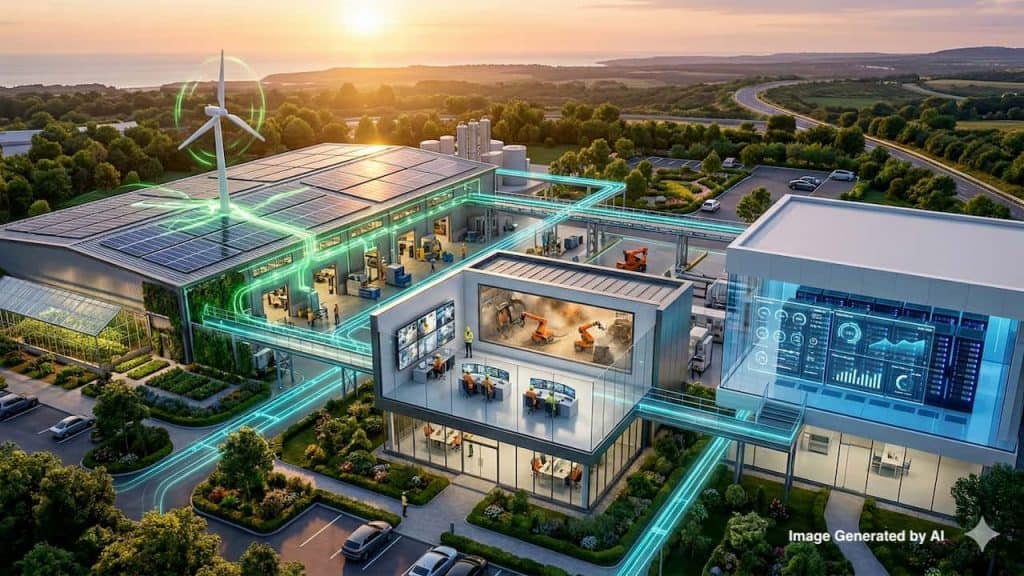
In 2026, global manufacturers are meeting Environmental, Social, and Governance (ESG) goals by transitioning from manual reporting to autonomous sustainability. Key strategies include:
- Environmental: Using Physics-based Digital Twins (e.g., Akselos) to extend asset life and MQTT-based IoT(e.g., HiveMQ) to reduce energy consumption by over 20%.
- Social: Deploying AI Computer Vision (e.g., SAS) and Remote Operations (e.g., ABB) to remove workers from high-risk environments.
- Governance: Replacing spreadsheets with Automated Single Sources of Truth (e.g., Radix, Hexagon) to ensure 100% audit accuracy for CSRD and ISO 14001 compliance.
The global manufacturing sector has shifted from voluntary reporting to data-driven compliance. With the implementation of the Corporate Sustainability Reporting Directive (CSRD) and ISSB standards, manufacturers are using “Industrial Copilots” and IoT ecosystems to prove their impact.
-
Environmental: Achieving Circularity through Asset Life Extension
The most sustainable factory is the one that doesn’t need to be rebuilt. Manufacturers are prioritizing the circular economy by optimizing existing physical infrastructure.
- Physics-Based Digital Twins: Companies like Akselos deploy structural twins that allow operators to safely extend the life of refinery vessels and offshore rigs. This defers the massive carbon footprint of new steel and concrete construction.
- APM-Driven Efficiency: Through Asset Performance Management (APM), Radix and Hexagon have helped petrochemical leaders achieve an 8% reduction in energy consumption and a 13% extension in furnace life, directly lowering Scope 1 emissions.
- Software-Defined Automation: Schneider Electric is leading the shift toward modular, software-defined systems that can be updated and recycled without discarding hardware, reducing industrial e-waste.
-
Environmental: Deep Electrification and Real-Time Energy Management
To meet 2030 net-zero targets, manufacturers are transitioning from combustion-based processes to fully electrified, grid-responsive operations.
- Industrial Electrification: ABB is integrating process and electrical control systems to manage the intermittency of renewable energy. Their solutions are designed to help customers reduce CO₂ emissions by over 100 megatonnes by 2030.
- IoT Energy Monitoring: Automotive giants using HiveMQ’s MQTT-based messaging have reported energy usage reductions exceeding 20%, identifying real-time inefficiencies that were previously invisible in legacy systems.
- Zero-Flare Strategies: In the oil and gas sector, Wood uses digital reliability optimization to eliminate “trip-related flaring,” a primary source of unnecessary methane and CO₂ emissions.
-
Social: Eliminating Hazards via AI and Remote Operations
The “Social” pillar of ESG in 2026 focuses on workforce resilience and the removal of humans from high-risk environments.
- Computer Vision for Safety: SAS uses AI and IoT-enabled cameras to detect safety near-misses—such as missing PPE or unauthorized zone entry—in real-time. This proactive approach significantly reduces workers’ compensation premiums and on-site accidents.
- Autonomous Remote Operations: ABB and Wood are moving personnel from dangerous offshore platforms and mines into safe, remote control rooms, utilizing autonomous robots for inspections.
- Human-in-the-Loop AI: New “Industrial Copilots” (like those from Factory AI) transcribe technician feedback and safety warnings into automated work orders, ensuring safety knowledge is captured before senior engineers retire.
-
Governance: Automating the “Single Source of Truth”
Governance has evolved from annual reports to continuous auditability. Manufacturers now use automated platforms to meet rigorous global standards like ISO 14001 and Energy Star.
- Consolidated Emissions Reporting: Radix recently implemented a centralized data environment for a major North American pipeline operator, ensuring 100% accuracy in air permit reporting and eliminating manual spreadsheet errors.
- Compliance Automation: Hexagon’s EAM modules now automate the collection of utility data and track anomalies against international benchmarks, making “limited assurance” audits significantly faster and cheaper.
- Cyber-Resilience as Governance: Fortinet highlights that cybersecurity is now an ESG requirement; protecting Operational Technology (OT) prevents environmental disasters caused by cyber-physical attacks.
Key Industry Sources (2025-2026)
Reports & Strategic Research
- ARC Industrial AI Pacesetter Report 2026 – ARC Advisory Group
- 2026 Energy Industry Outlook – Deloitte Insights
- 2025 State of Operational Technology and Cybersecurity Report – Fortinet
- CEO and C-Suite ESG Priorities for 2026 – Harvard Law School Forum on Corporate Governance
Technical Guides & Case Studies
- The Roadmap to Autonomous Operations – ABB (2026)
- Software-Defined Automation Guide – Schneider Electric
- Asset Performance Management Solutions – Radix
- Smart Manufacturing Data Sheet & Ford Case Study – HiveMQ
- Evolve Maintenance Management through APM – Hexagon
- Worker Safety Solution Powered by AI and IoT – SAS
Regulatory & Trend Analysis
- 7 ESG Trends to Watch in 2026 – Freshfields Sustainability
- The Safety Revolution Arrives in 2026 – EHS Leaders
CSRD Reporting Guide for US Companies – Good.Lab (2026)
FAQ: Manufacturing ESG & Sustainability in 2026
1. What are the key ESG trends for manufacturing in 2026?
In 2026, the focus has shifted from voluntary reporting to autonomous sustainability. Manufacturers are prioritizing physics-based digital twins for asset life extension, AI computer vision for workforce safety, and automated “Single Sources of Truth” to replace manual spreadsheets for global compliance.
2. How does the ISO 14001:2026 revision impact industrial sustainability?
The ISO 14001:2026 update transforms environmental management from simple compliance into a core strategic priority. It explicitly integrates climate resilience and biodiversity into the framework, requiring manufacturers to use real-time IoT data to prove their environmental impact throughout the entire product life cycle.
3. How are manufacturers using AI to meet CSRD requirements?
Manufacturers are deploying Industrial Copilots and centralized data platforms (such as those from Radix and Hexagon) to automate the collection of emissions and utility data. This eliminates manual reporting errors and ensures 100% audit accuracy for the Corporate Sustainability Reporting Directive (CSRD) and ISSB standards.
4. Can IoT and Digital Twins really reduce industrial energy consumption?
Yes. Case studies from 2026 show that companies using MQTT-based IoT ecosystems (like HiveMQ) have reported energy usage reductions exceeding 20%. Similarly, physics-based digital twins allow operators to safely extend the life of heavy infrastructure, deferring the massive carbon footprint of new construction.
5. How does AI improve the “Social” pillar of ESG in factories?
he “Social” pillar now focuses on workforce resilience. AI-enabled computer vision (e.g., SAS) detects safety near-misses in real-time, while remote operations (e.g., ABB) move personnel from high-risk environments into safe control rooms, utilizing autonomous robots for dangerous inspections.
About the author