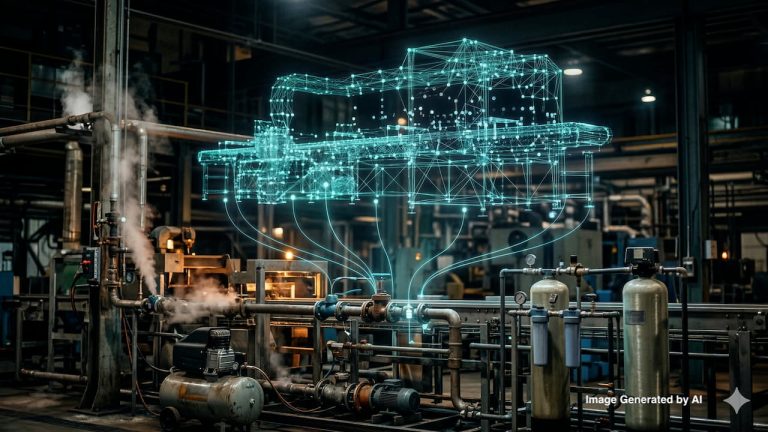

Agentic AI in manufacturing does not require a multiyear overhaul to deliver value. According to Arch Systems, the fastest path is to start at the human-machine interface (HMI): let the AI assistant read what operators already read, such as HMI views, SCADA trends, shift notes, and SOPs, and provide guidance in advisory mode from day one.
How does advisory mode work for agentic AI?
Advisory mode means the agentic AI recommends actions but never acts without human approval. Set-point authority stays with PLCs and existing interlocks. Every suggestion comes with citations: screenshots, log snippets, and SOP step numbers. This transparency is what quality, safety, and compliance teams require before trusting an AI assistant on the plant floor.
What does agentic AI do at the HMI?
Starting at the HMI means the agentic AI reads the same screens operators already watch and converts that information into immediate, actionable guidance. No new control infrastructure is required. The assistant groups alarms, drafts root-cause briefs, guides checklist completion, and pre-fills work orders, all from data that already exists in the plant.
How do you expand agentic AI across systems?
After the assistant proves useful at the HMI, widen its read access to MES, quality systems, and inventory. Existing tools keep their roles: MES, CMMS, and SCADA continue doing their jobs while the agent reads state, assembles evidence, proposes next steps, and opens tickets for well-understood, low-risk events. Safety-critical actions remain human-approved throughout.
What guardrails keep agentic AI safe in manufacturing?
Safe deployment of agentic AI in manufacturing requires three guardrails: advisory-first sequencing, full audit logging, and human-in-the-loop design. A recommendation is only promoted to auto-action after it meets accuracy thresholds across shifts, products, and seasons. Every prompt, input, output, approval, and actor is captured so decisions remain explainable during audits.
As Andrew Scheuermann puts it:
“You’re not taking away work: you’re automating what people wish they had time to do.”
What results does HMI-first agentic AI deliver?
Plants that follow the HMI-first approach see measurable improvement in the metrics that matter most: faster alarm response, higher first-time-fix rate, lower mean time to repair (MTTR), cleaner shift handoffs, and fewer engineer hours lost to data chasing. As Andrew Scheuermann of Arch Systems states: “You’re not taking away work: you’re automating what people wish they had time to do.”
When should manufacturers standardize AI data signals?
Manufacturers do not need complete data uniformity before starting agentic AI deployment. Introducing a handful of common signals, specifically state, speed, scrap, and energy, that look the same across lines and sites accelerates scaling later. Starting at the HMI delivers quick wins immediately while building the evidence and momentum needed to standardize what matters next.
Source: “Agentic AI & Integrated Data Workflows: Extracting Value from Existing Manufacturing Systems” (AI Frontiers 2025), sponsored by Arch Systems and Litmus.
Related articles:
- How Much Prep Work Do Trusted AI Agents Really Need on the Factory Floor?
- Prescriptive AI That Respects Reality: Recommendations You Can Actually Execute
For the latest 2026 deployment data including ROI benchmarks from Siemens, Honeywell, and Rockwell Automation, see Agentic AI in Manufacturing: ROI vs. Reality.
FAQ
1. What is agentic AI in manufacturing?
Agentic AI in manufacturing is an AI assistant that reads operational data sources such as HMIs, SCADA views, historian trends, shift notes, and SOPs, then provides operators with real-time guidance. Sponsored by Arch Systems, this approach keeps the agent in advisory mode, requiring human approval for every action, so existing control logic and interlocks remain in place.
2. How does agentic AI improve alarm management on the factory floor?
Agentic AI improves alarm management by grouping noisy alarms into a single event, identifying the two most probable root causes, and pointing to the supporting HMI trends and past fixes. This reduces the cognitive load on operators and speeds alarm response without requiring changes to PLC control logic or existing SCADA infrastructure.
3. Advisory AI vs. autonomous AI: which is safer for manufacturing?
Advisory AI is the recommended starting point for manufacturing because it keeps humans in control of every decision. The agent recommends; the operator accepts, edits, or rejects. Autonomous actions are only introduced after a recommendation meets accuracy thresholds across shifts, products, and seasons. This staged approach, outlined in the AI Frontiers 2025 session sponsored by Arch Systems and Litmus, reduces deployment risk significantly.
4. How do you scale agentic AI across multiple manufacturing sites?
Scaling agentic AI across sites starts with a small set of common signals, specifically state, speed, scrap, and energy, that look the same across lines. Full data uniformity is not required before starting. The HMI-first approach from Arch Systems generates quick wins and operational evidence at one site, which then provides the momentum and justification to standardize signals and expand to additional facilities.
Related Reading
How UNS Prepares Manufacturing Data for AI