According to BMW Group, the automaker runs virtual replicas of more than 30 production sites where employees test layout changes before a single physical tool moves. Unilever and Accenture reported in June 2026 that AI-enabled digital twins across five manufacturing sites in four countries delivered site-specific results including 20% waste reduction at Raeford, NC and 30% quality defect reduction at Gandhidham, India, with plans to build more than 40 new twins over the next 18 months (Unilever Press). PepsiCo achieved a 20% throughput increase at U.S. facilities within weeks of deploying Siemens’ Digital Twin Composer, per Siemens Press. Grand View Research values the global digital twin market at $49.47 billion in 2026, and MindInventory industry analysis reports 38.7% CAGR growth and 92% of adopting companies achieving ROI above 10%.
What a Factory Digital Twin Actually Does
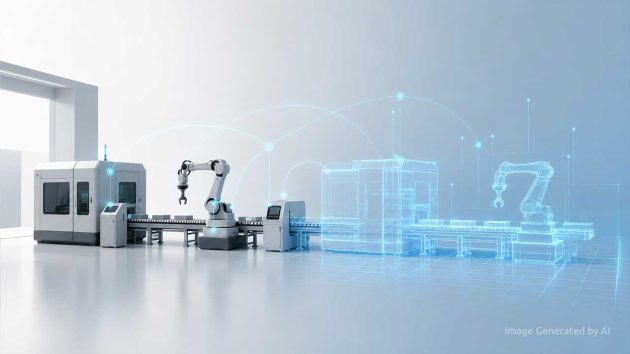
A factory digital twin is a continuously synchronized virtual model of a physical production environment. Sensor data from PLCs, SCADA systems, historians, and IoT devices flows into the digital model through OPC-UA, Modbus, or REST API connectors (Maintenance Online). The model reflects real-time equipment states, process variables, and material flows, then feeds optimization recommendations back to the physical plant.
This closed loop distinguishes a digital twin from a static 3D model or a dashboard. A static visualization shows what happened. A digital twin simulates what will happen, then acts on it.
Gartner predicts that by 2030, semiautonomous AI agents will orchestrate 10% of key production operations, quality control, and maintenance use cases, up from 2% today. The path runs through digital twins as the data context layer that feeds those agents.
Case Studies: Hard Numbers from Three Deployments
| Company | Scale | Key Result | Timeline |
| BMW | 30+ sites | Up to 30% planning cost reduction | Ongoing (iFACTORY program) |
| Unilever | 5 sites, 4 countries | 20% waste reduction (Raeford); 30% defect reduction (Gandhidham) | Scaling to 40+ twins |
| PepsiCo | U.S. facilities | 20% throughput increase | Within weeks |
BMW built its Virtual Factory on NVIDIA Omniverse using OpenUSD and a custom FactoryExplorer application for planners, according to NVIDIA. Virtual collision checks that previously required up to four weeks of physical testing now complete in three days (Assembly Magazine). BMW Group reports the company is integrating 40+ new or updated vehicle models into production by 2027, with every integration planned and validated digitally first.
Unilever partnered with Accenture to deploy AI-enabled digital twins across five manufacturing sites in four countries. A deodorant line in Raeford, North Carolina predicts 95% of process flow restrictions, delivering 20% waste reduction and 10% capacity uplift. A mayonnaise line in Poznan, Poland cut minor stoppages by up to 20% and waste by nearly 30%. A Dove soap site in Gandhidham, India reduced quality defects by 30% over four years. Unilever plans to build more than 40 new digital twins over the next 18 months (Unilever/Accenture Press).
PepsiCo deployed Siemens’ Digital Twin Composer, unveiled at CES 2026, to modernize its U.S. manufacturing and warehouse facilities with plans to scale globally, according to Siemens Press. The platform combines Siemens’ engineering data with NVIDIA Omniverse simulation libraries to create physics-accurate 3D models. Within weeks, teams optimized and validated new configurations, delivering a 20% throughput increase on initial deployment.
How to Build a Factory Digital Twin in 10-14 Weeks
A minimum viable twin does not require a greenfield site or a seven-figure budget. Maintenance Online’s implementation framework outlines a 12-week MVP structure, with iFactoryApp reporting Phase 1-2 investment of $80,000 to $230,000 for 10-20 pilot assets.
Week 1-2: Asset selection and data audit. Map your current technology stack, including sensors, historians, CMMS, and SCADA systems. Identify your highest-value pilot assets and define success metrics before writing a single line of configuration: unplanned downtime reduction, maintenance spend decrease, or energy cost recovery (iFactoryApp).
Week 3-4: Data integration. Use existing sensor and historian data first. Most factories already generate the telemetry needed for a baseline twin. Maintenance Online recommends connecting through OPC-UA for SCADA data, Modbus for legacy equipment, and REST APIs for CMMS and EAM systems.
Week 5-9: Model development and CMMS integration. Build on your most critical assets. Maintenance Online’s framework targets 70% or higher accuracy as the model development baseline in weeks 5-7, followed by CMMS bidirectional integration in weeks 8-9. Twins that automatically generate work orders achieve 85% operator adoption, compared with 20-30% for twins requiring manual interpretation (Maintenance Online).
Week 10-14: Pilot testing, validation, and launch. Measure results against your predefined success metrics. iFactoryApp reports first anomaly alerts within 4-6 weeks and validated predictive alerts within 8-12 weeks of deployment. Add sophistication only where it demonstrably improves outcomes.
Platform Comparison: What to Evaluate in 2026
XD Innovation’s 2026 enterprise platform comparison evaluates 11 platforms, including Ansys Twin Builder, Dassault 3DEXPERIENCE, GE Proficy, IBM Maximo, and SAP Digital Twin. The table below highlights four widely deployed options across different ecosystem types.
| Platform | Core Strength | Best For | Key Integration |
| Siemens Xcelerator + Digital Twin Composer | Physics-based simulation | Complex manufacturing with Siemens automation | NVIDIA Omniverse, OpenUSD |
| NVIDIA Omniverse | Real-time 3D simulation, GPU-accelerated physics | Foundation layer (used by BMW, PepsiCo) | OpenUSD, multi-vendor |
| Azure Digital Twins | Graph model (DTDL), Power BI/Dynamics 365 | Microsoft enterprise environments | IoT Hub, Dynamics 365 |
| PTC ThingWorx | 250+ protocol drivers (Kepware), AR overlay | PLC-agnostic brownfield sites | Vuforia AR, Creo CAD |
AI-Powered Twins and Autonomous Operations
The next phase of factory digital twins moves from monitoring and simulation to closed-loop autonomous control. PatSnap’s 2026 digital twin technology report describes an emerging capability where closed-loop twins operate at sub-10-millisecond latency, with digital twins that can actuate physical systems and autonomously adjust production parameters.
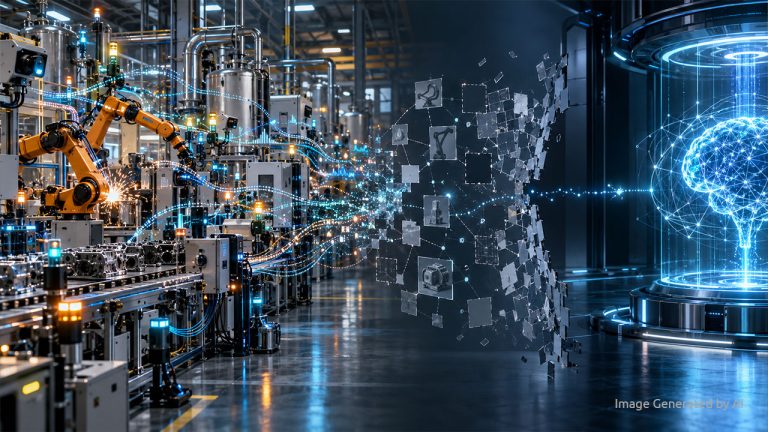
Siemens’ “AI Brain” concept at its Erlangen electronics factory demonstrates this direction. According to Siemens, the system uses software-defined automation and NVIDIA Omniverse to continuously analyze digital twins, test improvements virtually, and turn validated insights into operational changes on the shop floor. The approach represents where predictive maintenance is heading: from reactive analysis to closed-loop optimization.
PatSnap also reports that LLMs and generative design tools could automate twin model construction from engineering drawings and sensor data, reducing the setup time that has historically been a barrier for mid-size manufacturers. As agentic AI matures, twins will increasingly move from advisory to autonomous operation.
The main barriers remain practical: data integration at brownfield sites, OT/IT cybersecurity concerns, simulation skill shortages, and ROI uncertainty for manufacturers that lack the scale of a BMW or Unilever. Starting with a minimum viable twin tackles that last constraint.
FAQ
1. How much does it cost to build a factory digital twin?
iFactoryApp reports Phase 1-2 investment of $80,000 to $230,000 for 10-20 pilot assets, covering sensors, platform setup, and integration. The payback period averages 12-18 months (iFactoryApp). MindInventory’s industry analysis shows 92% of companies achieve ROI above 10%, with approximately 50% exceeding 20% returns.
2. What makes a factory “smart” compared to a conventional automated plant?
A smart factory maintains a continuous data loop between its physical operations and a digital model. Sensor data flows into the twin, the twin runs simulations and optimization models, and the results feed back into production decisions. This closed loop, rather than any single technology, is what distinguishes a smart factory from one that simply uses automation or dashboards.
3. How long before a factory digital twin delivers measurable ROI?
Timelines vary by scope and industry. PepsiCo demonstrated a 20% throughput gain within weeks of initial deployment, per Siemens Press. MindInventory reports that the typical positive ROI timeline falls between 12 and 36 months for broader deployments. The minimum viable twin approach (10-14 weeks) is designed to prove value before committing to full-scale rollout.
4. Which digital twin platform should a manufacturer choose in 2026?
The answer depends on existing infrastructure, per XD Innovation’s platform comparison. Siemens Xcelerator suits plants already running Siemens automation. NVIDIA Omniverse works as a foundation layer across vendors, as BMW and PepsiCo demonstrate. Azure Digital Twins fits Microsoft-centric enterprises. PTC ThingWorx is strongest at brownfield sites needing broad PLC connectivity.
5. Can a mid-size manufacturer with limited IT resources build a factory digital twin?
Yes. The minimum viable twin framework specifically targets this scenario: start with existing sensor data and focus on your highest-value pilot assets. iFactoryApp reports first anomaly alerts within 4-6 weeks and predictive alerts validated within 8-12 weeks. The 10-14 week timeline (Maintenance Online) assumes a small cross-functional team, not a dedicated digital twin department. MindInventory reports maintenance cost reductions of 25-55% and operational efficiency gains of 15-42% across implementations of varying scale.
Related from IIoT World
- Where to Put Intelligence: Edge AI for Factory Maintenance
- Top Smart Factory Technologies 2026: Agentic AI and UNS
- What Is a Unified Namespace and How Does It Work in Manufacturing?
Sources
- Digital Twin Market Statistics 2026 (MindInventory / Grand View Research)
- Siemens Digital Twin Composer at CES 2026 (Siemens Press)
- Siemens Digital Twin Composer U.S. Launch (Siemens News)
- BMW Virtual Factory Scales to 30+ Sites (BMW Group Press)
- BMW Virtual Factory Details (Assembly Magazine)
- Unilever Scales Digital Twins Across Global Manufacturing Network with Accenture (Unilever Press)
- Digital Twins: From Concept to Implementation (Maintenance Online)
- BMW Group Virtual Factory on NVIDIA Omniverse (NVIDIA)
- Digital Twin Manufacturing Guide (iFactoryApp)
- Enterprise Digital Twin Platform Comparison 2026 (XD Innovation)
- Gartner Manufacturing Predicts 2026 (Gartner)
- Digital Twin Tech Landscape for Manufacturing 2026 (PatSnap)
- Siemens and NVIDIA Expand Partnership to Build Industrial AI Operating System (Siemens Press)
AI tools were used to help research and organize the content. Reviewed and edited by the IIoT World editorial team.