Most factories are sitting on a goldmine of machine data that never reaches the people who need it, because the middleware stack between the PLC and the dashboard takes a full quarter to configure. In this IIoT World article based on a Hannover Messe 2026 interview, Hugo Vaz (CEO, Coreflux) explains how an MQTT broker with built-in Lua scripting cuts that timeline to one week. Coreflux, a startup based in Porto, Portugal, consolidates the typical five or six integration tools into a single MQTT broker running its own programming language, cutting that timeline to roughly one week.
Why Does Factory Integration Take a Full Quarter?
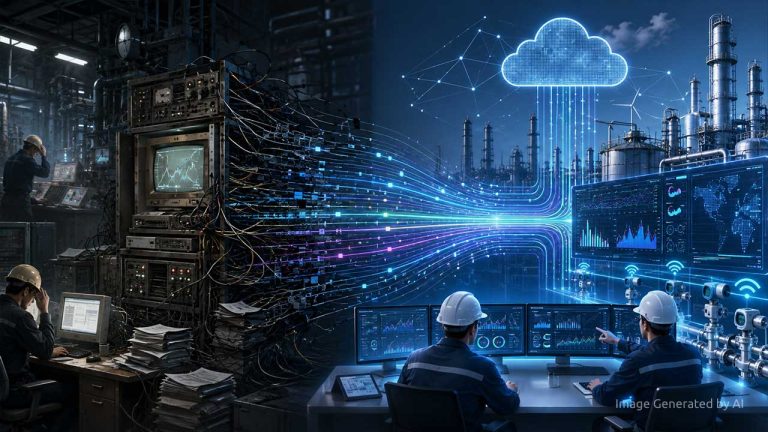
Factory data integration is slow because every data point has to pass through multiple software layers, from PLCs through protocol translators, middleware platforms, historians, and visualization tools, before anyone can act on it. At each step, a systems integrator has to manually map the variables to their business meaning, deciding that this signal is a production counter while that one is an alarm, and every interface between layers demands its own configuration.
This middleware maze is where factory digitization projects stall. A single plant integration can take 90 days or longer just to define the mappings, and each new data source typically requires its own dedicated effort on top of that.
How Does One Broker Replace Five Middleware Tools?
Coreflux built a domain-specific language called Language of Things that runs directly on an MQTT broker, following a similar principle to what SQL did for relational databases. Where SQL standardized how developers query and manipulate structured data, the Language of Things standardizes how engineers query, route, and transform industrial data on the factory floor.
MQTT already serves as one of the most widely adopted protocols in industrial IoT, moving messages between devices and applications through a central broker. A standard MQTT broker, however, just passes messages along without doing anything with them. The Language of Things adds programmability: query capabilities, action definitions, data models, and system-to-system connections called routes, all running on the broker itself.
The practical effect is that an engineer handles data translation, variable mapping, and system routing all in one environment, turning the broker into what serves as the central nervous system of the factory and a single source of truth, rather than configuring five different platforms separately.
From a Quarter to a Week
When all integration logic runs in one place, the mapping work that traditionally stretches to 90 days reduces to writing routes on a single platform, bringing initial deployment down from a full quarter to roughly one week.
The more significant shift, however, is what happens after that first week. Traditional digital transformation runs as a wide-scope project where everything is defined up front, built over months, and then maintained as a static system, an approach that keeps the process complex and the integration layer the central struggle on the shop floor.
With a single-broker architecture, digital transformation becomes incremental instead. A factory might start with production order tracking, then add a compliance check that triggers an alarm when orders fall behind, then connect scanners for traceability and cameras for quality inspection, with each new capability added as a route on the broker that builds on the routes already running. The factory’s digital infrastructure grows step by step rather than in quarterly project cycles.
“Instead of having something that at least takes a quarter to define on a company, we’re able to make it in a week and in a couple of days,” said Hugo Vaz, CEO of Coreflux.
| Aspect | Traditional Middleware Stack | Single-Broker Architecture |
| Tools required | 5-6 separate platforms | One MQTT broker |
| Integration timeline | ~90 days | ~7 days |
| Adding a new data source | New integration project | New route on the broker |
| System evolution | Quarterly, project-scoped | Daily, incremental |
| Data unification | Spread across multiple layers | Single source of truth |
See It Live at Hannover Messe 2026
Coreflux will be at Hannover Messe 2026, Hall 14, Stand L66. While Vaz chose not to disclose details of the demo ahead of the show, he confirmed it runs on real systems rather than a simulation and that visitors will see how the broker interacts with physical equipment including PLCs, historians, and MES platforms.
This article is based on an interview between Hugo Vaz, CEO of Coreflux, and Lucian Fogoros, IIoT World co-founder, as part of the CxO Series ahead of Hannover Messe 2026. AI tools were used to summarize the interview and structure the article. Reviewed by the IIoT World editorial team.
Sponsored by Coreflux.
Frequently Asked Questions
1. What is the Language of Things?
Language of Things is a domain-specific programming language developed by Coreflux that runs directly on an MQTT broker. It adds query capabilities, programmable actions, data models, and system-to-system routing on top of the standard MQTT publish-subscribe protocol, turning a message broker into a full integration platform for factory equipment and enterprise systems.
2. Why does traditional factory integration take so long?
Factory data integration requires connecting PLCs, historians, MES platforms, ERP systems, and dashboards through multiple middleware layers. Each connection point requires manual variable mapping by a systems integrator, a process that takes at least a full quarter to define and configure for a single manufacturing site.
3. How does a single MQTT broker replace the traditional middleware stack?
The Language of Things adds programmable logic directly to the MQTT broker, so data collection, translation, variable mapping, routing, and transformation all happen in one place. Instead of configuring interfaces between five or six separate tools, engineers write routes and actions on the broker itself, eliminating the mapping work between layers that accounts for most of the integration timeline.
4. What does incremental digital transformation look like in practice?
Each new capability, whether production order tracking, traceability, or quality inspection, is added as a route on the broker that builds on existing ones. The factory’s digital infrastructure grows incrementally rather than in quarterly project cycles, turning digital transformation from a one-time effort into a continuous practice.