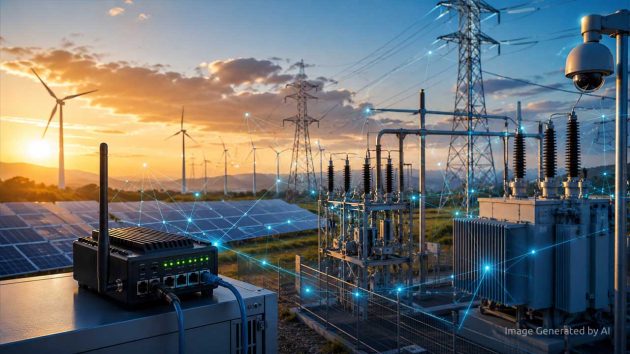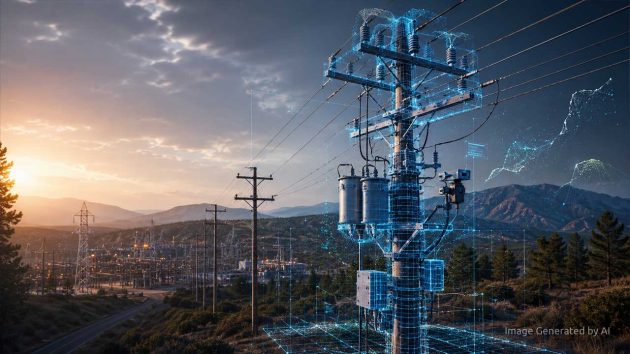
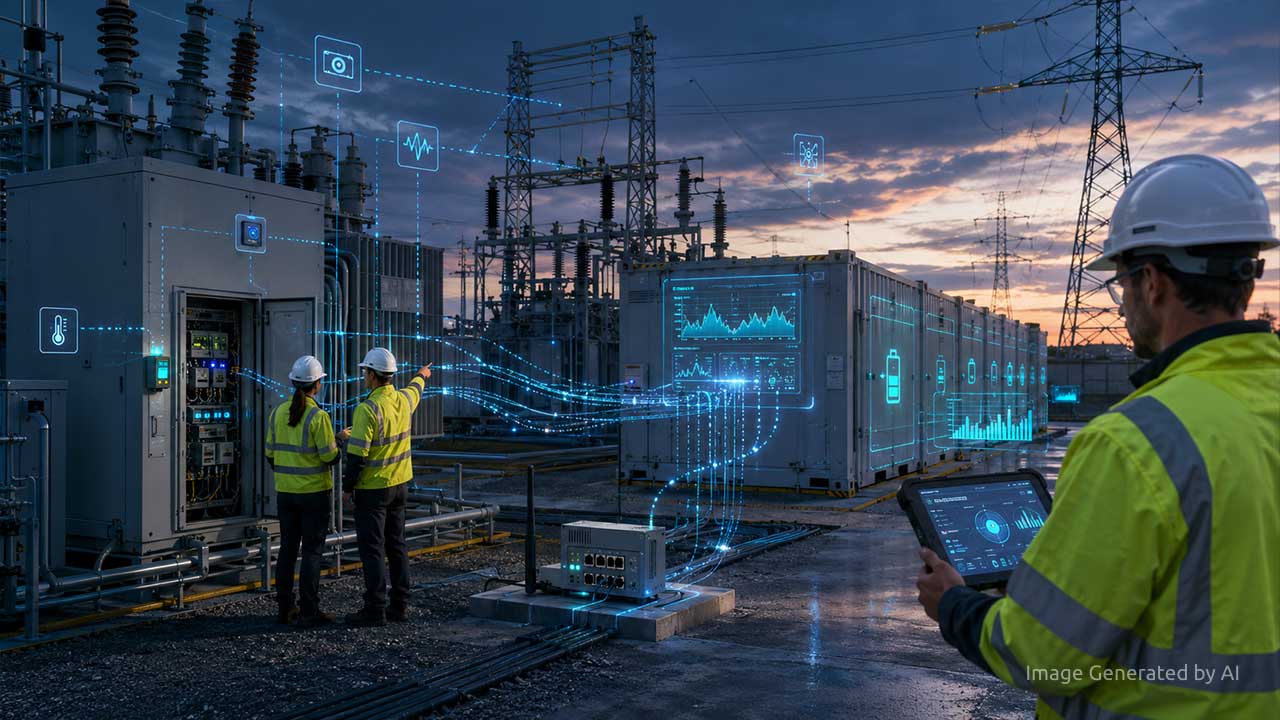
Close to 80% of power generation deployments in ABB’s global electrification and power install base run on-premise at the edge. That figure, shared by Cody Falcon of ABB Energy Industries during IIoT World Energy Day 2026, is not an aspiration. It is the current state of how power gets managed. The reasons are practical: battery systems that must respond in 150 milliseconds, air-gapped sites with no cloud connectivity, and data volumes growing too fast and too expensively to ship off-site.
Latency Sets the Floor
Battery energy storage systems need to switch the whole system on and off, manage it, and provide power to or draw power from the grid within 150 milliseconds. The grid requirements are strict, and they can change over time. That kind of response time leaves no room for a round trip to the cloud.
At the edge, the decision-making window drops even further. “Sub-one-second decision making for optimization, for safety, for even things like market participation,” as Andrew Foster of IOTech Systems put it. Hybrid architectures that include a cloud layer still exist, with the cloud handling coordination across fleets of grid assets. But the real-time work stays local.
Air-Gapped Sites Have No Cloud Option
Latency is one constraint. Connectivity is another. Many grid sites operate as air-gapped systems with no cloud access at all. In those environments, every piece of processing, control, and decision-making happens locally.
That means operators need infrastructure that lets them push models trained in the cloud down to the edge, run inference on-site, and then send only the results back when connectivity is available. Store-and-forward capabilities and local controls become the backbone of the architecture. The ability to have intelligence on the edge is not a nice-to-have in these environments. It is the only option.
The Cost and Volume Math Is Shifting
Even where cloud connectivity exists, the economics are changing. The volume of data generated by grid assets is growing on an exponential basis. For both cost and security reasons, shipping all of that data to the cloud is becoming impractical.
And the edge-cloud boundary is not fixed. What gets processed locally versus what gets sent to the cloud is a moving target, as Brenna Wood of EDF Power Solutions North America pointed out. As operations evolve and new requirements emerge, that boundary has to shift with them.
Legacy Assets Do Not Need to Be Replaced
Most grid work happens in brownfield environments. Control systems and electrification systems are designed for 20 to 30-year lives, which means the majority of installations already have aging equipment in place.
The approach that works: do not modernize the asset. Modernize the data layer around it. “If I think about a 30-year-old transformer, it’s not a firmware upgrade. It needs a smart sensor and an edge gateway that makes it look to an AI system like any other data-producing asset,” Cody Falcon of ABB said. The AI model does not care whether the equipment is 30 years old or two months old, as long as the data layer presents it consistently.
The practical playbook is brownfield instrumentation first: retrofit where possible with vibration sensors, thermal imaging, and current signatures. The asset stays unchanged, but the edge gets smart.
The future of grid intelligence, as the panel discussion made clear, is not a single brain in the cloud. It is thousands of brains running on edge.
This article was written based on the “Turning Industrial Data into Energy Insight: Scalable Edge Solutions for Modern Grids,” session that was part of IIoT World Energy Day 2026, sponsored by IOTech Systems. We thank all panelists for their insights:
- Andrew Foster, Product Director, IOTech Systems
- Brenna Wood, Senior Group Product Manager, EDF Power Solutions North America
- Cody Falcon, Global Digital Portfolio and Technology Leader, Energy Industries, ABB
- Janko Isidorovic, System Architect, Fluence Energy
Moderated by Hamish Mackenzie, Advisory Board Member, IIoT World.
This article was written based on the transcript of the live panel session at IIoT World Energy Day 2026. AI tools were used to help summarize and organize the content from the discussion.
Sponsored by IOTech Systems