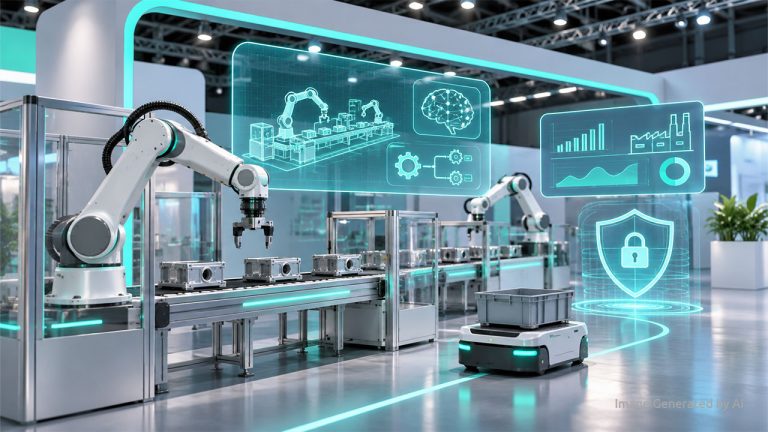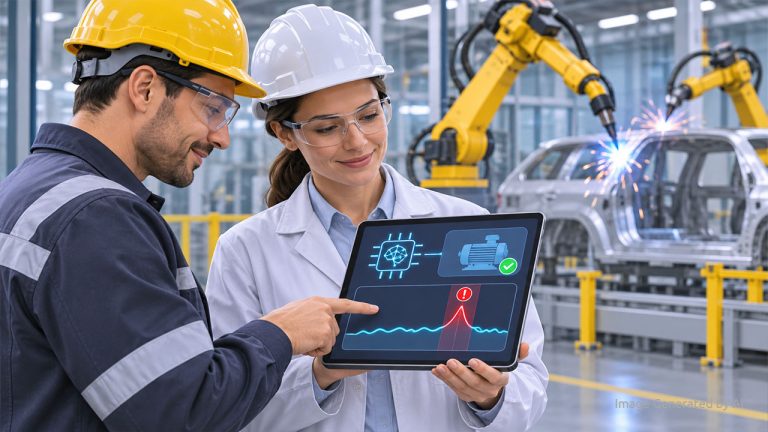

Generative AI in manufacturing differs from consumer applications in fundamental ways: it must interpret technical drawings rather than natural language alone, produce results reliable enough to guide production decisions, and work with scarce, proprietary data sets that exist nowhere on the public internet. A panel discussion at IIoT World Manufacturing Day 2025 with executives from Siemens, Databricks, and Retrocausal addressed where generative AI delivers measurable returns in manufacturing today and where foundational work remains.
What Makes Industrial-Grade AI Different from Consumer AI?
Industrial-grade AI must be reliable, trustworthy, and explainable in ways that consumer-facing models are not. Consumer LLMs process natural language; engineers work in technical drawings with tolerances and process specifications. Every AI recommendation that influences a production decision carries consequences for physical safety, product quality, and material costs, which demands a higher standard than consumer chatbot accuracy.
A large language model speaks English, German, and Spanish fluently. It can translate dialects and generate text on virtually any topic. But the working language of an engineer is not prose. It is a technical drawing with tolerances, bill-of-materials references, and process specifications. Consumer LLMs interpret a drawing the way they would a painting, looking for artistic intent rather than dimensional precision. Industrial AI must read that same document as a set of measurable parameters and actionable constraints.
Explainability carries equal weight. Black-box systems face a structural barrier in engineering-driven organizations: if a model recommends a process change but cannot show how it reached that conclusion, engineers will not use it. Every recommendation that influences a production decision, where physical safety, product quality, and material costs are at stake, must have a traceable reasoning chain. Siemens refers to this standard as “industrial-grade AI,” a term that parallels the way industrial hardware must operate reliably at temperature extremes where consumer electronics would fail.
Why Is Data the Biggest Barrier to AI in Manufacturing?
Meeting that standard requires training data that matches the precision of the output. Yet data governance, not ethics or workforce resistance, represents the primary barrier to AI adoption in manufacturing. A National Association of Manufacturers study found that fewer than 4% of respondents cited ethical concerns or workforce bias as their top challenge, while more than two-thirds of executives identified data governance, access, format, privacy, and integration as the real obstacles.
Manufacturing plants generate vast amounts of data, but that data is misleadingly narrow in operational range. A process plant may run for years or decades, yet it operates within 1 to 2% of its full operational range during steady state. The data is abundant, but it captures only a sliver of what the equipment can actually do. Training a model on narrow-range data produces a model that has never seen startup sequences, edge cases, or equipment degradation patterns.
Data fragmentation adds a second layer of difficulty. Every vendor, every automation system, and every legacy controller uses a different format. Industrial information sits behind firewalls in proprietary structures, disconnected from systems that hold complementary context. Foundational model improvements are slowing as the world exhausts publicly available training data; the most valuable industrial data will never appear on the internet, making the ability to extract intelligence from small, proprietary data sets the core technical challenge.
Manufacturers spent a decade hearing that “data is the new gold,” which encouraged them to lock it in a vault. Raw data has no inherent value. It is zeros and ones that become valuable only when combined, shared, and aggregated into a data set large enough to train a model. No single company holds enough operational data across enough conditions to train a model that generalizes across its industry.
How Do Video Language Models Change Manual Operations?
Where structured sensor data is scarce, video of manual operations offers a faster path to usable AI. Video language models collect process data from manual operations in minutes, replacing work that traditionally required days or weeks of manual observation and analysis. The technology records an operation, runs the footage through an AI model trained on manufacturing processes, and automatically generates time studies, spaghetti diagrams, and from-to charts that previously took industrial engineers to produce.
For high-mix, low-volume environments where processes change weekly, the system can decompose recorded operations into individual steps and create visual work instructions displayed at the workstation. Instead of a ring binder full of diagrams and arrows, operators watch a video of exactly what they need to do, clicking on individual steps if they need clarification.
The system does more than document. When it understands what an operation should look like, it guides operators through complex assembly in real time: illuminating the correct bin, specifying the number of parts to pick, highlighting insertion points, and providing immediate feedback when a step is missed.
One medical device manufacturer had a 30% scrap rate on a product worth $1,200 per unit. Operators performed detailed work under a microscope, and the task complexity made errors frequent. After implementing AI-guided assembly with real-time feedback, the scrap rate dropped by 60%, saving millions of dollars.
In another case, a manufacturer believed it had an optimized mixed automation-human line with five operators. Video analysis revealed that operators were working ahead, skipping standard procedures, and that material was not available when needed. Rebalancing the line based on the data produced a 5% operational improvement worth hundreds of thousands of dollars.
Where Is Generative AI Producing Measurable Results?
These video-based deployments fit into a broader pattern of where generative AI produces returns today. Text-based applications are where manufacturers start before it reaches the shop floor. Customer support and field service engineering offer the fastest time to value because they operate on unstructured text, documentation, and technician notes, all formats where generative AI excels. Visual process analysis through video language models represents the next tier of deployment maturity.
| Application | What GenAI Does | Reported Result |
| Customer support | Trains agents using documentation, manuals, and product videos | Handles demand surges without proportional hiring |
| Field service engineering | Classifies technician notes and extracts root causes for recurring failures | Faster troubleshooting at ExxonMobil, John Deere, Ford Direct |
| Manual process analysis | Generates time studies and process breakdowns from video | Data collection in minutes vs. weeks |
| Operator guidance | Provides real-time step-by-step assembly instructions | 60% scrap reduction on $1,200 medical device parts |
| Line optimization | Identifies hidden waste in mixed human-automation lines | 5% operational improvement worth hundreds of thousands of dollars |
| Predictive quality | Detects defects before products reach customers | Automotive glass defect detection at Corning |
Contact centers serving manufacturing companies face the same talent shortage as production floors. High turnover and slow training cycles mean that a surge in call volume requires hiring people who do not exist in the labor market. Generative AI trained on product documentation and support videos allows organizations to absorb demand spikes without proportional staff increases. ExxonMobil, John Deere, and Ford Direct have applied similar approaches to field service, where reliability engineers work with large volumes of unstructured technician notes that vary enormously in terminology even for identical equipment. Generative AI classifies this text at scale, identifies root causes for recurring failures, and cross-references them against technical manuals, so engineers start at step seven rather than step one.
Traditional machine learning remains impactful alongside generative AI. Defect detection, soft sensor monitoring, and predictive quality control at companies like Corning are areas where conventional models deliver strong results. Generative AI handles unstructured text and video; traditional ML handles structured sensor data and classification tasks.
What Leadership and Workforce Changes Does AI Require?
Choosing the right tool for each problem requires a type of organizational literacy that most manufacturers have not built yet. Data literacy across the entire organization, from executives to plant operators, determines whether AI investments produce returns or become expensive experiments. Automation and AI require different evaluation frameworks, and manufacturers need leadership that understands when to apply each technology and how to assess the results.
Automation handles straightforward, repeatable processes that do not depend on sophisticated data analysis. AI is cognitive: it extracts insights from data to support decisions in unique, non-repeatable situations. A plant tour at an automotive glass manufacturer in Indiana revealed minimal human presence on the shop floor, evidence of how far automation has already progressed. But automating repetitive tasks and deploying AI to support complex decisions are fundamentally different investments with different prerequisites.
Dow Chemical has invested in improving data literacy across all management levels, building the capacity to understand how AI decisions are derived and when to trust them. “The most important class you can take in the age of generative AI is statistics,” said Shiv Trisal of Databricks. “If you don’t understand statistics, you’re dead to rights.”
Strategic prioritization follows a specific test: which use cases combine proprietary data with a distribution advantage unique to the company? A chatbot that interacts with employee manuals is a commodity function to purchase off the shelf. AI that extracts intelligence from data only your company holds, and that you can distribute at scale in your industry, is a competitive differentiator worth building internally. Leaders who cannot distinguish between the two will overspend on commodity AI and underinvest where it creates competitive separation.
What Foundation Do Manufacturers Need Before Deploying AI?
Even the right strategic priorities deliver nothing without the infrastructure to support them. Connectivity, data integration, cybersecurity, and centralized asset management form the prerequisite infrastructure for any AI deployment on the shop floor. Many production lines remain completely offline with no external access, and every automation vendor uses proprietary data formats. Without these foundations in place, even the most capable AI models have nothing to work with.
Production lines that operate behind physical and network barriers satisfy basic security requirements, but they prevent AI from accessing the operational data it needs. Establishing secure connectivity to OT equipment, managing assets centrally rather than through manual site visits, and implementing over-the-air patching capabilities are preconditions that most manufacturers have not yet completed.
Data integration adds a parallel challenge. Every PLC manufacturer and legacy control system stores information in proprietary formats. Until that data is contextualized, standardized, and accessible through documented interfaces, the raw numbers remain unusable for model training or real-time inference.
The panel’s closing advice: start now. Evaluate whether generative AI, traditional machine learning, or simpler automation fits a given problem. Prepare the data foundation so that when the right application arrives, the infrastructure is ready. Manufacturers who complete their homework in connectivity and data governance will be prepared when someone asks to deploy AI on their shop floor.
How Will Industrial Foundation Models Change Manufacturing?
Beyond individual deployments, a larger shift is forming. Industrial foundation models, trained on domain-specific data through cross-company collaboration, aim to accelerate product development by enabling virtual testing of designs that were previously impossible to evaluate outside the physical world.
Building these models requires a departure from the instinct to protect all data at all costs. Collaboration with trusted partners is necessary because assembling data sets that capture the full range of industrial conditions exceeds any single company’s capacity.
Digital twins represent a parallel opportunity. Combining physics-based simulation models with data-driven statistical models creates hybrid twins more capable than either approach alone. A system behavior that resists mathematical description but has real-world data behind it can be modeled as a data-driven component within a physics-based framework, allowing manufacturers to explore operational scenarios and predict failures in virtual environments before committing physical resources.
The timeline varies by application. Text-based generative AI for customer support and field service is production-ready today. Video language models for manual operations are in early deployment. Industrial foundation models and AI-driven product design acceleration remain, in the panel’s assessment, still “ways away” from broad adoption.
This article is based on a panel discussion at IIoT World Manufacturing Day 2025, featuring Mathias Oppelt of Siemens, Tim Coleman of Retrocausal, and Shiv Trisal of Databricks, moderated by Hamish Mackenzie. The session was sponsored by Retrocausal. AI tools were used to help summarize and organize the content. Reviewed and edited by the IIoT World editorial team.
Additional Sources: NAM AI Whitepaper 2024