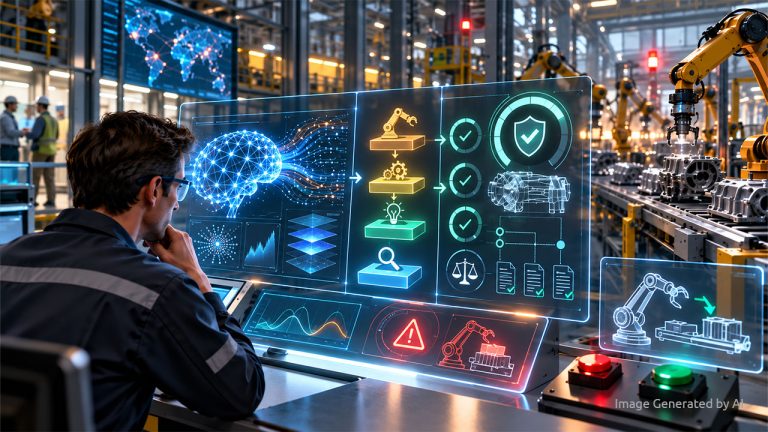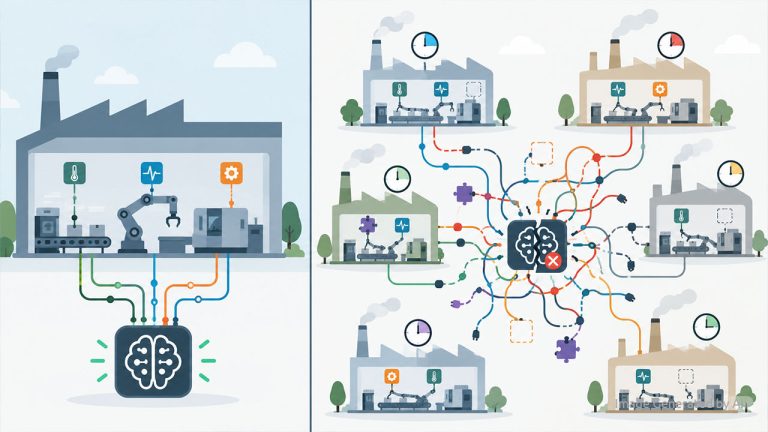
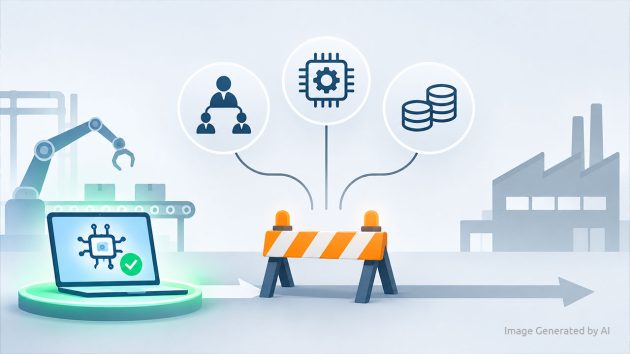
A $20,000 AI pilot runs on a spreadsheet someone hands over, connects to one or two APIs, and operates in a controlled scope. The operational environment underneath that pilot includes cybersecurity requirements, legacy equipment running different software versions, production lines with unplanned downtime, and a workforce that may resist the change. At the Industrial AI Summit 2026, Benson Chan of Strategy of Things compared this gap to an iceberg: the pilot is the small visible tip, and the operational requirements are the mass hidden below the waterline. Flemming Kongsberg of Siemens, Maddie Zeng of NeoAI, and Jonathan Weiss of Cumulocity each identified the structural problems that sink AI projects between a successful demo and a production deployment.
What Hides Below the AI Pilot Iceberg?
A pilot tests whether an AI system works at all, so the scope stays narrow by design: data arrives pre-cleaned in a file upload, integrations are minimal, and the team takes shortcuts because the budget covers validation only.
The operational environment strips away every one of those simplifications. Equipment runs on different software versions across the same plant floor, security policies govern what connects to what, and integration with existing MES, ERP, and scheduling systems requires sustained engineering. Operators call in sick on the same shift a machine goes down for unscheduled maintenance. Governance, risk management, and training requirements stack on top of each other.
Most companies that run a successful pilot underestimate how much more the production environment will cost and how much longer it will take. The pilot budget buys a proof of concept, and scaling that proof of concept into a governed, secure, integrated production system typically costs multiples of the pilot investment while surfacing requirements that no one anticipated. Companies that defer the question of scaling readiness until after the pilot discover too late that they need to modernize infrastructure, retrain staff, or redesign workflows before production is possible.
Why Does Data Readiness Determine AI Readiness?
The clearest readiness test for an industrial AI use case: is someone already using the data? If a human team collects information from an ERP, email, field notes, and documents, and that workflow is cumbersome but functional, the data exists in a form AI can work with. The task is connecting those sources and standardizing the format, which current AI tools handle well.
If the data does not exist at all, the project is a modernization effort that needs to happen before any AI deployment. Some facilities have 16 to 20 machines with none connected to any system, run by operators with 25 years of experience who have never recorded data. In those environments, scrap gets measured by visual inspection of the waste bin at the end of a shift.
Three questions determine data readiness for any AI project:
- Is the data available? Connected machines, sensor feeds, and digital records exist.
- Can the data be trusted? Someone has been collecting it consistently, and the numbers reflect reality.
- Is someone already using it? An existing workflow depends on the data, even if that workflow is manual and slow.
If the answer to all three is yes, the foundation for AI exists. If the team is still arguing about whether the data is correct, the organization needs data infrastructure work before it needs AI, but waiting to modernize everything first is a project that may never finish. The more productive approach: select the use case where data already flows and build from there.
What Structural Problems Kill AI Projects After a Successful Demo?
Unclear ownership kills more AI projects than technical failure. When no single business owner is responsible for the metric the AI project is supposed to improve, no one has a personal stake in moving it from pilot to production. An AI project that spans design, manufacturing, and operations touches three different organizational functions, each with its own leadership, and without one owner whose livelihood depends on the outcome, the project stalls at the boundary between departments.
The other recurring pattern is relying on generic AI models for competitive differentiation. A company using a general-purpose model from a major AI lab for its manufacturing processes gets the same capability as every competitor using the same model. Until the company adds its own operational data, its own domain knowledge, and its own process-specific training on top of the base model, it has no competitive advantage from AI. Generic models work for marketing copy and internal communications but do not produce differentiated manufacturing output.
Organizations also confuse a quick prototype with a production-ready system. A working demo built in a code assistant or chatbot session is not enterprise-grade software, and scaling that prototype into a compliant, governed, integrated system still requires substantial engineering. Companies that treat the prototype as the product discover the gap between demo and deployment the hard way.
How Do Brownfield and Greenfield Plants Face Different AI Challenges?
The assumption that brownfield sites are too old for AI and greenfield sites are ready by default is wrong on both counts.
| Factor | Brownfield Reality | Greenfield Reality |
| Equipment connectivity | Sensors commoditized; retrofit options affordable for machines without PLCs | Even new facilities have variations in PLC brands and MES software within one plant |
| Data standardization | Data scattered across formats and systems, but often used by existing teams | Standardization expected but rarely achieved, even with modern controllers |
| Cost of connectivity | Lower than a decade ago; adapters exist for serial ports and legacy interfaces | Looks simple on paper; integration still requires significant engineering |
| Readiness perception | Teams assume legacy = impossible, which is often incorrect | Teams assume new = ready, which underestimates internal variation |
Brownfield connectivity has changed significantly because sensors are now inexpensive and retrofit options exist for equipment that was never designed to stream data. Adapters for serial ports, USB, and other legacy interfaces let manufacturers pull data from machines that are 40 to 50 years old, making the barrier lower than most organizations expect.
Greenfield plants face a different version of the same problem. A new facility with modern Siemens or Allen-Bradley PLCs pumping MQTT data sounds ideal. In practice, even the most mature manufacturers operate multiple systems within the four walls of a single plant. Standardization of PLCs and MES across an entire facility remains rare, and the variation creates integration challenges that look different from brownfield but cost similar engineering effort.
Neither brownfield nor greenfield should discourage manufacturers from starting. The variable that matters is whether data already exists and someone is using it, regardless of how old or new the equipment is.
Frequently Asked Questions
1. How much more does production AI cost compared to a pilot?
Pilots typically run on budgets of $10,000 to $30,000 with simplified data, minimal integration, and narrow scope. Production deployments add cybersecurity requirements, full system integration, data governance, workforce training, and legacy equipment compatibility. The operational phase costs multiples of the pilot investment and takes significantly longer.
2. What is the fastest way to assess AI readiness in a manufacturing plant?
Ask three questions about the target use case. Is the data available? Can the data be trusted? Is someone already using the data, even manually? If all three answers are yes, the use case has a viable foundation. If the organization is still debating whether its own data is accurate, data modernization work should come before AI deployment.
3. Why do AI projects fail when they cross departmental boundaries?
AI projects that span design, manufacturing, and operations require an owner responsible for the outcome across all three functions. Without single-point accountability, each department optimizes for its own metrics, and no one drives the project through the integration, governance, and change management work needed for production deployment.
4. Can manufacturers with 40-year-old equipment still deploy AI?
Sensors and connectivity adapters are now commoditized enough to retrofit machines that predate digital controls. The key is whether operational data from those machines is already being collected and used by someone. If it is, even legacy equipment can support AI use cases like predictive maintenance or quality monitoring.
This article is based on a panel discussion with Benson Chan of Strategy of Things, Flemming Kongsberg of Siemens, Maddie Zeng of NeoAI, and Jonathan Weiss of Cumulocity, moderated by Yash Titus of Strategy of Things, recorded at the Industrial AI Summit 2026 hosted by IIoT World. AI tools were used to help summarize and organize the content. Reviewed and edited by the IIoT World editorial team.