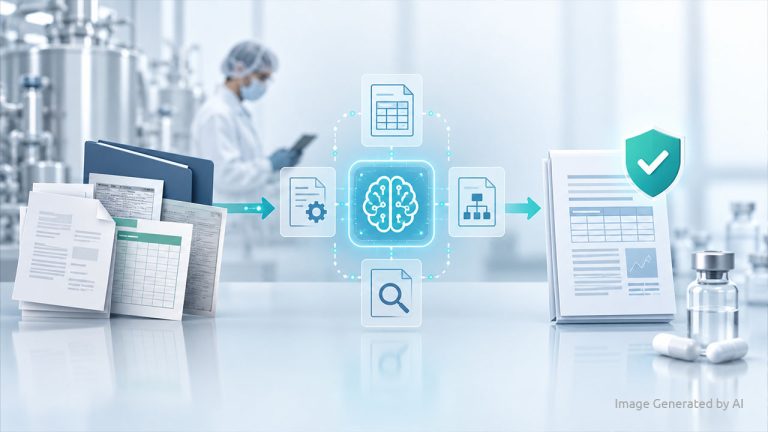
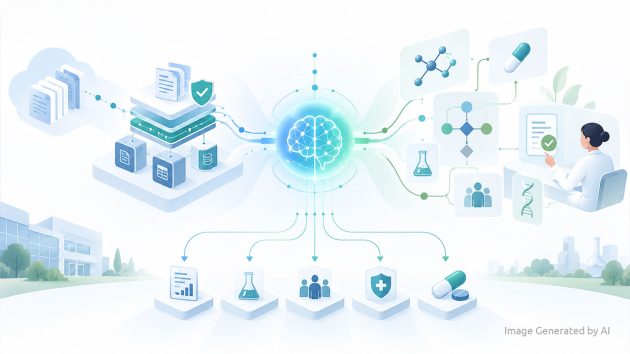
Should pharma build or buy AI explainability? Can you prove a source document was not altered? How do human reviewers keep up with AI output? Adam Procopio of Merck and Kristen Sauter of Adlib Software address these audience questions from the “You Closed the Sensor-to-Decision Gap. FDA Will Ask You to Explain It.” session at the Industrial AI Summit 2026.
Should You Build Explainability In-House or Work With a Vendor?
The original audience question: “We are navigating the requirements for explainable and defensible AI output. Would love your input on how you would approach this challenge. Is this a functionality you build in-house or work with a vendor to help shape what gets built? Which approach have you seen most successful?”
Adam Procopio, Scientific Associate Vice President at Merck:
We generally prefer leveraging vendor platforms for core AI infrastructure, but we view explainability, evidence traceability and scientific defensibility as areas where significant customization is required. The most effective approach is typically a hybrid architecture where commercial capabilities provide a foundation while internal teams build the domain-specific reasoning, traceability, and governance layers necessary for scientific and regulatory decisions.
Kristen Sauter, President and General Manager of Life Sciences at Adlib Software:
Adam described the architecture well from the buyer side. From the vendor side, I’d add specificity about where that foundation layer actually sits and what it provides. The document accuracy layer (the infrastructure that normalizes, structures, validates, and traces documents before they reach any AI model) is the part of the stack where domain-specific knowledge matters enormously but shouldn’t be rebuilt by every organization. The rules for what makes a batch record processable, what a supplier CoA must contain, how a deviation log should be structured for retrieval, those are not proprietary to any one company. They’re industry patterns. A vendor who has processed these documents across dozens of pharma organizations brings pattern recognition that an internal team building from scratch will spend eighteen months rediscovering. What remains internal: the scientific judgment layer, such as what the evidence means for your specific program, your regulatory history, your risk tolerance. That’s where internal teams should build, because no vendor can replicate the institutional knowledge that goes into a regulatory decision. But the infrastructure that makes the documents trustworthy enough to reason from in the first place, that’s the piece that benefits from specialization.
Can You Prove the Source Document Was Not Altered?
The original audience question: “Auditability gets us back to the source. But can you prove the source was not altered? Which downstream AI decisions depended on it? Can we prove the document we traced back to is still the original, authentic, unaltered source?”
Adam Procopio, Scientific Associate Vice President at Merck:
We have made significant progress on auditability by requiring source citations, provenance, and traceability back to authoritative records. However, citation alone is not the same as proving authenticity. Ultimately, authenticity must come from the underlying quality and document management systems through version control, audit trails, and approved records. The next challenge is what I would call decision lineage. It’s not enough to know which document informed an AI answer. We increasingly need to understand which downstream analyses, recommendations, submissions, or decisions were influenced by that document. While the industry is making progress on provenance and data lineage, comprehensive impact tracing and automated reassessment when source information changes remain important gaps and active areas of development.
Kristen Sauter, President and General Manager of Life Sciences at Adlib Software:
Adam drew the right distinction: citation is not the same as authenticity. The piece I’d add is rendering fidelity, the ability to show that what the AI processed was a faithful, complete representation of the approved document, not a degraded or partial version created during ingestion. When we process a document, we lock a version-specific rendering at the point of intake. That rendering is what the AI sees, and it’s what’s preserved in the audit record. If someone asks three months later “what did the model see when it made this recommendation?”, the answer is not a reconstructed approximation, it’s the actual input. That’s the technical foundation for the authenticity claim Adam described. The document management system owns the approved record; the processing layer owns the proof that the AI saw that record and not something else.
How Can Human Reviewers Handle the Volume AI Produces?
Adam Procopio, Scientific Associate Vice President at Merck:
I don’t think the long-term answer is having humans review every piece of AI-generated content. AI can create information much faster than people can read it. The scalable approach is risk-based oversight: let AI handle routine tasks and content generation, while humans focus on higher-risk decisions, exceptions, conflicting evidence, and areas that require scientific judgment. Perhaps the question should be: Should humans be reviewing the AI’s content, or the AI’s reasoning and evidence? For low-risk work, reviewing the content may be enough. But for scientific, quality, and regulatory decisions, the real value of human expertise is in evaluating the evidence, assumptions, logic, confidence level, and recommendations behind the output. Ultimately, we don’t want scientists spending their time proofreading AI-generated text. We want them applying their expertise to make better decisions. The goal isn’t AI-supported editors. It’s AI-supported decision makers.
These questions were submitted by attendees of the “You Closed the Sensor-to-Decision Gap. FDA Will Ask You to Explain It.” session, at the Industrial AI Summit 2026. Answers provided by Adam Procopio of Merck and Kristen Sauter of Adlib Software. The session also featured Maya Schushan-Orgad of Teva Pharmaceuticals, and it was moderated by Rick Franzosa of Tech-Clarity. The session was sponsored by Adlib Software.
Related from IIoT World