There was a time when “real-time” in energy operations meant something measured in minutes. A SCADA poll every few seconds. A historian recording values at fixed intervals. An operator watching a dashboard and making a call when something looked off. For the grid as it existed ten or fifteen years ago, that was fast enough.
However, it is not fast enough anymore.
The grid that utilities operate today bears little resemblance to the one those systems were designed for. Distributed energy resources are proliferating across distribution networks. Battery storage systems need to respond to market signals and grid conditions in fractions of a second. Solar and wind generation create variability that did not exist when load profiles were more predictable. EV charging is creating new demand patterns that shift faster than traditional monitoring can track.
In that environment, instant data processing is not a performance enhancement. It is a baseline operational requirement. Without it, the systems that are supposed to make the modern grid work simply cannot keep up.
The gap between “fast” and “fast enough”
Most utilities have invested heavily in data infrastructure over the past decade. Historians, cloud analytics platforms, enterprise data lakes. These systems are valuable for long-term analysis, trend identification, planning, and reporting. They were never designed to support the kind of decision-making that distributed energy operations demand.
When a battery storage system participates in frequency regulation, the relevant time window for action is measured in milliseconds. When a fault occurs on a feeder with high DER penetration, the protection and control response must happen before the next cycle. When a fleet of distributed assets needs to be coordinated for grid support, the data from each site has to be current, not five minutes old.
Cloud-based analytics cannot close those loops. The physics of moving data from a remote site to a cloud environment, processing it, and returning an instruction causes latency that is incompatible with these use cases. It does not matter how powerful the cloud platform is. The round trip takes too long.
This is not a criticism of cloud architectures. They do important work. But they are the wrong tool for operational decisions that need to happen at the speed the grid now requires. That processing has to happen at the edge, close to the assets, close to the data, and close to the point of action.
Volume is the other half of the problem
Latency gets most of the attention, but data volume is an equally significant driver of the shift toward edge processing.
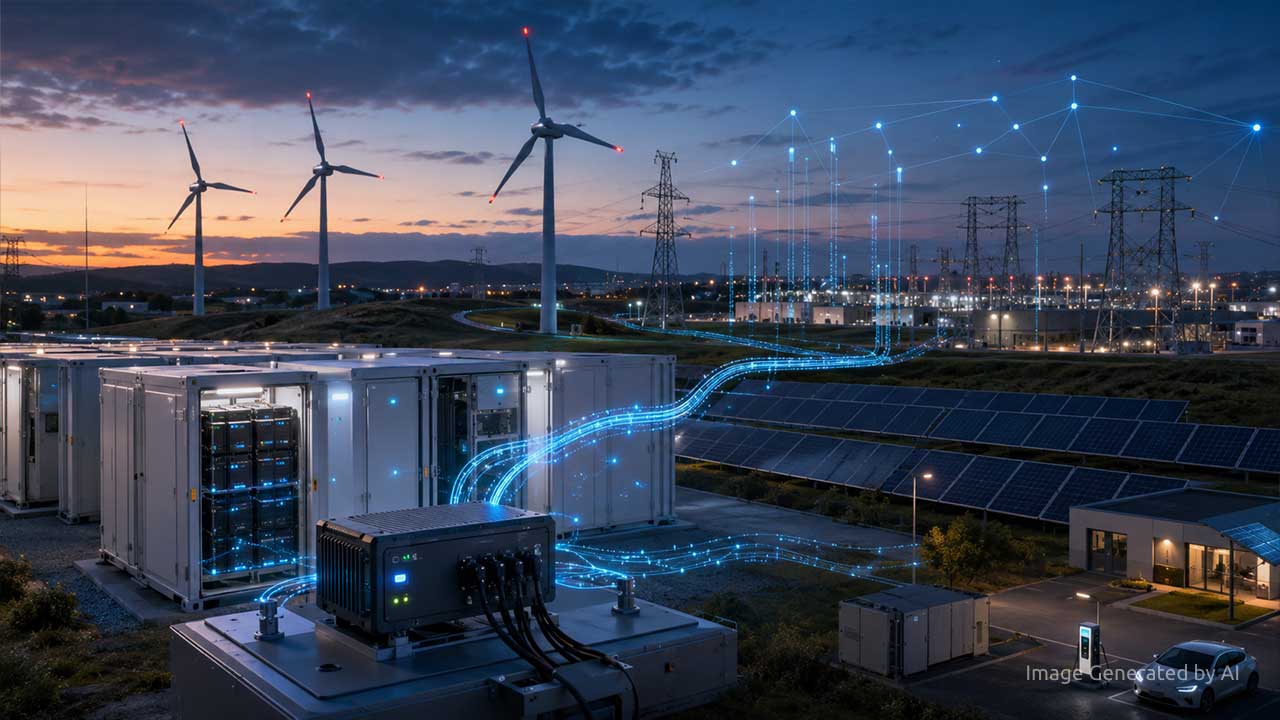
A single battery energy storage site can generate enormous volumes of telemetry. Cell-level temperature, voltage, state of charge, state of health, all updating at high frequency across hundreds or thousands of cells packed into enclosures the size of shipping containers. Multiply that across a fleet of sites and the numbers become difficult to manage using centralized architectures alone.
Transmitting raw data to the cloud is both costly and bandwidth-intensive, and is frequently unnecessary. The majority of readings are routine and do not warrant centralized processing. Operational focus should be directed toward data that indicate significant changes, such as a cell operating outside its normal range, a voltage anomaly, or an unexpected charge rate.
Edge processing allows that filtering and reduction to happen at the source. Data can be evaluated locally, with only the operationally significant information forwarded to centralized systems. That reduces bandwidth costs, lowers cloud storage requirements, and makes sure that the data reaching the cloud is already contextualized and ready for higher-level analysis as opposed to sitting in a queue waiting to be cleaned.
Real-time requires more than fast hardware
It is tempting to think of real-time edge processing as primarily a hardware problem. Put faster computing at the site, and the problem is solved. In practice, the hardware is the straightforward part.
The harder challenges are in the software infrastructure. Specifically, can the edge platform ingest data from the full range of protocols and equipment types present at a given site? Can it normalize that data into a consistent format so that analytics and models can consume it without human assistance? Can it apply time-stamping with the accuracy that downstream applications require? Can it handle not just today’s data profile, but the one that will exist in two years after the fleet has expanded and the equipment mix has changed?
These are the capabilities that determine whether an edge deployment actually delivers real-time operational value or just collects data faster than before.
There is also the question of interoperability. Energy sites are multi-vendor environments. Inverters, battery monitoring systems, meters, controllers, and SCADA systems all come from different manufacturers with different communication standards. A real-time edge platform has to be able to bridge those differences transparently, without requiring custom integration work every time a new asset type is added to the fleet.
Standards play a key role here. Open, standards-based architectures allow new equipment to be connected without rebuilding the data pipeline. They support the kind of plug-and-play interoperability that fleet-scale operations require. And they protect the operator from vendor lock-in, which in systems designed to run for 20 or 25 years is not an abstract concern.
The bottom line
The modern grid is faster, more distributed, and more dynamic than the infrastructure most utilities built their data systems around. The operational decisions that DER fleets, battery storage, and renewable generation require are not compatible with architectures that were designed for slower, more centralized, more predictable environments.
Real-time analysis at the edge is not an upgrade. It is the foundation that everything else, analytics, AI, autonomous coordination, market participation, depends on. The utilities that recognize this and invest in edge infrastructure capable of supporting true real-time operations will be the ones best positioned to manage the grid that is already taking shape. The ones still routing everything using centralized platforms will find themselves constantly a step behind.
Sponsored by IOTech Systems
FAQ
1. Why can’t cloud analytics handle real-time energy grid operations?
Cloud-based analytics introduce latency from the round trip of moving data to a remote environment, processing it, and returning instructions. For use cases like battery frequency regulation (millisecond response windows) or DER fleet coordination requiring current data, this latency is incompatible with operational requirements. Edge processing closes those loops locally.
2. What role does edge processing play in battery energy storage?
Battery storage sites generate high-frequency telemetry from hundreds or thousands of cells, including temperature, voltage, state of charge, and state of health. Edge processing filters this data at the source, forwarding only operationally significant changes to centralized systems. This reduces bandwidth costs, lowers cloud storage requirements, and delivers contextualized data ready for analysis.
3. Why is interoperability critical for real-time edge platforms in energy?
Energy sites are multi-vendor environments with inverters, battery monitoring systems, meters, controllers, and SCADA systems from different manufacturers using different communication standards. An edge platform must bridge these differences transparently so new asset types can be added without custom integration work at each site.
4. How does edge computing support DER fleet management?
Distributed energy resource fleets need coordinated responses to grid conditions using current data from each site. Edge processing ensures data is evaluated locally and forwarded in real time rather than waiting minutes for centralized cloud processing, which is too slow for fleet coordination, fault protection, and market participation.
About the author