
Piezoelectric vibration sensors have been the factory standard for more than 50 years. According to Dr. Antoine Filipe, CTO of Tronics Microsystems, a TDK Group Company, MEMS-based digital sensors are now following the same replacement curve that already swept through consumer electronics and aerospace. This article examines why the shift from analog to digital vibration sensing is picking up speed in manufacturing, and why the winning architecture is not the fully wireless setup most plant managers expect.
Key Takeaways
- MEMS technology has already replaced piezoelectric sensors in consumer devices and is well established in aerospace; industrial applications are the next market to transition
- Wireless vibration sensors face two hard physical limits in factories: electromagnetic interference near heavy equipment and battery failure above 85°C
- Wired digital MEMS sensors connected to wireless IoT gateways combine measurement accuracy with fieldbus integration that factories already run
- In validated tests on vacuum pumps and industrial gearboxes, MEMS sensors matched piezoelectric accuracy while eliminating the need for analog-to-digital data conditioners
Five Decades of Analog Vibration Sensing
The vibration sensing industry has relied on piezoelectric technology for more than 50 years. These analog sensors provide accurate readings, but their output requires separate signal conditioning hardware to convert measurements into usable digital data. For most of that history, no viable alternative existed.
MEMS (Micro-Electro-Mechanical Systems) technology emerged in the late 1990s, borrowing fabrication techniques from the semiconductor industry to build micro-mechanical structures. The result, as Dr. Filipe explained in IIoT World’s CxO Series, is a sensor that is “intrinsically smaller, low power, and digital.” That combination of traits already drove a complete technology transition in consumer electronics. With the arrival of the smartphone, MEMS accelerometers completely replaced piezoelectric sensors in consumer devices.
In aerospace, the shift started roughly 15 years ago. “It’s really well on its way,” Filipe noted. “That’s the long-term trend.” Tronics has sold several million MEMS accelerometers to several hundred aerospace and energy customers over two decades, building a track record in environments where sensor failure is not an option.
The question now is whether industrial manufacturing follows the same path. Filipe is direct about the outcome: “For sure, it will move from analog piezo to digital MEMS. The question is what will be the speed of adoption.”
Where Do Wireless Vibration Sensors Break Down?
Most digital vibration sensors currently on the market use wireless communication. The logic seems sound: eliminate cables, simplify installation, send data straight to the cloud. But factories are not offices, and heavy industrial environments expose two physical constraints that wireless sensors cannot engineer around.
The first is electromagnetic interference. Large industrial equipment running at high power levels generates intense electromagnetic fields. “Plant managers know that in some areas of their plant they cannot rely on Wi-Fi, neither 5G, because it’s too sensitive to the electromagnetic field,” Filipe said. In those zones, wireless sensors become unreliable or fail entirely.
The second constraint is temperature. Wireless sensors require batteries, and batteries cannot safely operate above 85°C. Beyond that threshold, they risk burning or exploding. Some large industrial equipment operates above 100°C during normal use. For those machines, battery-powered wireless vibration sensors are not just impractical; they are a safety concern.
These two limitations carve out significant portions of any large factory where wireless vibration monitoring simply cannot be deployed. “At the end, there is a limited window of opportunity for the vibration sensor,” Filipe observed.
What Does a Wired Digital Architecture Look Like in Practice?
The market feedback Tronics received pointed to a different approach: wired digital sensors using standard industrial fieldbus protocols like Modbus, connected to a gateway that handles wireless communication to the cloud.
This two-stage architecture separates the measurement environment from the communication layer. The sensor sits directly on the equipment, connected by wire to a gateway that can be positioned up to 10 meters away in a location with normal temperature and minimal electromagnetic interference. The gateway then transmits data wirelessly to cloud-based analytics platforms.
“This is providing the best of both worlds,” Filipe explained. “You have the capability to do measurements everywhere and at the same time to have a wireless communication to the cloud.”
For plants that already run Modbus or similar fieldbus networks, the integration path is clear. The VIBO sensor, which Tronics is launching as an exhibit premiere at Hannover Messe in April 2026, adds preprocessed vibration measurements to the same data stream that already carries pressure and temperature readings. No new communication infrastructure is required.
Proven Results on Pumps and Gearboxes
Tronics has validated the VIBO sensor on two demanding use cases. The first involved vacuum pumps with defective bearings, a scenario requiring analysis of high-frequency vibration data. Using its 20 kHz bandwidth and built-in edge processing, the MEMS sensor delivered the same diagnostic output as a standard analog piezoelectric accelerometer, including bearing fault detection through envelope analysis. The critical difference: the MEMS sensor provided preprocessed digital data directly, with no separate data conditioner required.
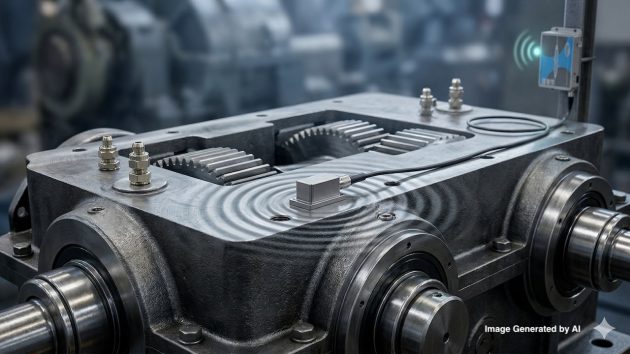
The second use case targeted industrial gearboxes. The sensor successfully detected inner and outer ring defaults on gear trains, matching the detection capabilities of conventional piezoelectric vibration sensors.
Dr. Filipe drew a sharp line between purpose-built industrial MEMS sensors and consumer-grade MEMS repurposed for factory use. “Some companies are reusing MEMS developed for consumer application, expecting that it will match the expectation from industrial customers. But most of the times, this is not working because consumer and industry is not the same.” The gap lies in accuracy, long-term stability, and signal-to-noise ratio, parameters where industrial applications demand performance levels that consumer sensors were never designed to meet.
What This Means for Plant Decision-Makers
For plant directors evaluating vibration monitoring investments, three practical questions emerge from this technology shift.
First, if your current monitoring covers only pressure, temperature, and actuator data through Modbus, adding continuous vibration measurement to the same fieldbus infrastructure is a direct way to expand condition monitoring coverage without deploying a new network.
Second, if you already have wireless vibration sensors, the relevant question is not whether they work, but where they cannot work. High-temperature zones and electromagnetically noisy areas represent monitoring blind spots that wired digital MEMS sensors can fill.
Third, the consumer-to-aerospace-to-industrial replacement cycle that Dr. Filipe describes has a clear directional signal. Organizations building out vibration monitoring programs today should weigh whether they are investing in a 50-year-old analog standard or the digital architecture that has already proven itself in more demanding sectors.
Tronics will be exhibiting in the Predictive Maintenance and Machine Learning pavilion at Hannover Messe 2026, Hall 27, Stand J73, where visitors can compare VIBO sensor output against analog piezoelectric sensors on real equipment.
This article is based on a video interview with Dr. Antoine Filipe, CTO of Tronics Microsystems, a TDK Group Company, and Lucian Fogoros, Co-founder of IIoT World, as part of the IIoT World CxO Series. AI tools were used to summarize and organize the content. It was edited and verified by the IIoT World team.
Sponsored by Tronics Microsystems, a TDK Group Company.
Frequently Asked Questions
What is the difference between MEMS and piezoelectric vibration sensors?
Piezoelectric vibration sensors are analog devices that have served as the industry standard for over 50 years, providing accurate vibration measurements that require separate data conditioners to convert to digital format. MEMS vibration sensors use semiconductor fabrication techniques to create micro-mechanical structures that produce digital output natively. According to Dr. Antoine Filipe of Tronics Microsystems, MEMS sensors are “intrinsically smaller, low power, and digital,” allowing direct integration with industrial fieldbus networks.
Why can’t wireless vibration sensors be used everywhere in a factory?
Wireless vibration sensors face two physical limitations in heavy industrial environments. Electromagnetic fields generated by high-power equipment interfere with Wi-Fi and 5G signals, making wireless communication unreliable in certain factory zones. Additionally, wireless sensors require batteries that cannot safely operate above 85°C. Some industrial equipment exceeds 100°C during normal operation, making battery-powered sensors both impractical and potentially dangerous in those locations.
How does a wired digital vibration sensor connect to cloud analytics?
The sensor connects via standard industrial fieldbus protocols (such as Modbus) to an IoT gateway positioned up to 10 meters from the monitored equipment. The gateway sits in a location with normal temperature and minimal electromagnetic interference, handling wireless transmission to cloud-based analytics platforms. This two-stage approach keeps the measurement hardware in harsh conditions while placing the communication hardware where it can operate reliably.
Has MEMS vibration sensing been validated in industrial conditions?
Tronics has validated its VIBO sensor on vacuum pumps and industrial gearboxes. On vacuum pumps, the sensor detected defective bearings using envelope analysis at 20 kHz bandwidth, matching the output of conventional piezoelectric sensors without requiring a separate data conditioner. On gearboxes, it identified inner and outer ring defaults on gear trains with equivalent accuracy to piezoelectric alternatives.