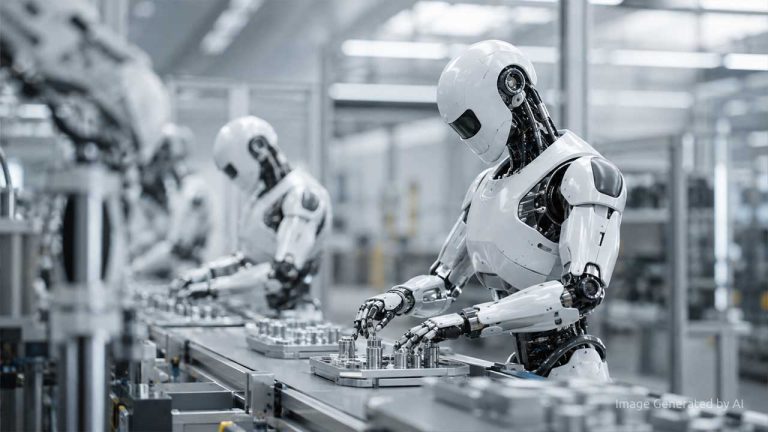

Traditional robotics were remarkable in doing one repetitive task, which helped industries to augment efficiency. But now they are not just a bulky machine configured for uniform tasks; rather they perform their task with utmost precision as these are now evolving towards higher cognitive functionality. This leap from robotics to cognitive robotics has marked a revolution across industries. Businesses across sectors are beginning to recognize that cognition is not just an upgrade to automation; it’s the foundation of a new operational intelligence. In fact, the International Federation of Robotics (IFR) recently shared an interesting report, which mentioned that nearly 542,000 robots were installed globally in 2024, more than double the number of installations a decade ago. Additionally, around 4,664,000 units of industrial robots were in operation worldwide in 2024, representing an increase of almost 9% compared to 2023.
So, what is cognitive robotics – and what makes it indispensable globally? Cognitive robotics blends traditional robotics with artificial intelligence, machine learning, computer vision, natural language understanding, and sensor-driven perception. It enables them to perform smarter tasks by thinking, understanding, and adapting the context. In this blog, let’s discuss how cognitive robotics is reshaping the operation intelligence in different sectors.
How Cognitive Robotics is Creating a Positive Impact on Various Industries?
Cognitive robotics is no longer confined to research labs or futuristic demonstrations. It is adopted in almost every sector and provides lucrative outcomes. Moreover, worldwide robot installations are expected to increase by approximately 6% to around 575,000 units in 2025 and by 2028 700,000 units will surpass. It shines particularly in a B2B environment due to its potential to provide excellent operational intelligence by amalgamating automation, predictive analytics, decision-making, and adaptability.
Below are some of the sectors experiencing the most significant impact:
1. Manufacturing Industry: Driving the Path to Industry 5.0
With the adoption of cognitive robotics that leverages precision operation, decision-making, and predictive analysis, the factories have become smarter and more agile. What makes cognitive robots different from the conventional ones is that it can change according to situational demands, which makes the operation more efficient and resilient.
Here are a few instances of how the manufacturing world is adopting these facilities in real-world applications.
- In May 2025, Foxconn’s cognitive vision robots have been making headlines for their ability to handle thousands of components in the electronics industry. They can even adjust their actions when part positions shift, critical in ultra-fast, high-volume assembly lines.
- In June 2025, Amberg plant of Siemens deployed cognitive mobile robots. These robots can automatically reroute their positive when an obstacle is observed, navigate shop floors, and coordinate with other machines to enhance workflow.
These real-world deployments are testimonies of how cognitive robotics can change the manufacturing world by providing decision-making and adaptive operations that traditional robotics lacks.
2. Healthcare: Providing Ultimate Safety, Accuracy, and Human Care
After manufacturing, the industry that gets the most benefit out of cognitive robotics is the healthcare sector. Cognitive robotics can even perform incisions and perform critical operations with utter perfection. Japan’s Da Vinci surgical systems, now equipped with AI-driven image analysis, are a significant example of this. It helps surgeons with more balanced and accurate movements in complicated techniques. Another outstanding breakthrough is the adoption of Moxi, which is a medical robot that helps in the supply of hospital equipment. It significantly reduces the workload of nurses. By bringing automation into healthcare, these cognitive robotics systems actually ensure precision, better caregiving, and reduce human error, which leads to excellence.
3. Logistics & Retail: Automation that Supports Scaling
Cognitive robotics, when incorporated in the logistics and retail sector it enhances operations and completes the work 10x more speed. The giant key players have understood the value of these intelligent systems, and thus, they are investing hefty amounts to develop these robots. Moreover, Amazon’s AI-enabled Sparrow and Proteus robots use vision and learning algorithms to distinguish thousands of items, navigate safely around workers, and maximize picking precision. Again, DHL uses cognitive robotic arms from Locus Robotics, which learn new SKU shapes and enhance picking speed over time. These systems transform logistics work into a hassle-free operation and also reduce manual burden.
4. Energy, Utilities, and 5G infrastructure: Help in Speedier Progress
Cognitive robotics is providing AI-enabled autonomous inspection in risky environments. For example, at remote substations, robots from Energy Robotics patrol independently to recognize fence damage and unauthorized access, implementing LiDAR and computer vision. Further, the governments across the world are taking various measures to inculcate cognitive robotics by promoting digitization across different industries. Here are the top 5 countries’ recent initiatives to inculcate digitization across industries.
- The U.S. is taking various methods to include 5G infrastructure in the remotest areas of the country. Recently, the government allotted more than USD 42.45 billion under the BEAD project to expand high-speed broadband to underserved areas. Additionally, America’s AI Action Plan and CHIP Act are deliberately allocating billions in funding for better R&D projects in semiconductors.
- China’s Action Plan for Digital China Construction sets goals to raise the digital economy’s core industries by 2025. The government is also making Digital China development by promoting AI Plus.
- India approved the IndiaAI Mission in March 2024 with an approximately ₹10,372 crore outlay over five years to build a common compute and scale AI adoption. The government also reported rapid growth in national GPU capacity and public–private programmes to digitize MSMEs.
- Japan is taking multiple measures to solidify its DX project. Digital Garden City Nation programs coordinate cross-industrial digitalization. This initiative is backed by dedicated budgets and policy tools to accelerate regional digital transformation and public-sector modernization.
- Germany’s Digital Strategy 2025 is being paired with targeted finance programmes. It includes low-interest loans and innovation support for SMEs to accelerate industrial digital adoption, broadband rollout, and AI projects.
These advancements are not only advancing digitization across the world, but it encourages the key players to develop efficient cognitive robotics that’ll make the world smarter.
Final Thought
Cognitive robotics is not just a revolutionary breakthrough; it is the future of industries. It has completely transformed the way businesses used to think, operate, and use robotics. The age of the thinking, adapting, and collaborating machine is here. So, business owners must stay prepared to redefine their operations.
About the author
This article was written by Aashi Mishra, an experienced research writer, strategist, and marketer with a demonstrated history of research in a myriad of industries. I love to distill complex industrial terminologies of market space into simpler terms. Source