
The business owner of an AI pilot in manufacturing should be the line-of-business leader with Profit and Loss accountability over the KPI the pilot targets. The executive sponsor should be the VP or Director of Operations. IT and Quality are partners, not owners. This structure, presented at AI Frontiers 2025, turns AI from a science project into measurable plant results.
Who Should Own an AI Pilot?
The business owner of a manufacturing AI pilot is the line-of-business leader who holds P&L accountability for the KPI the pilot targets, such as downtime, scrap rate, or changeover time. The senior stakeholder is a VP or Director of Operations who removes roadblocks and standardizes what works across sites. IT and Quality are partners, not owners.
Why this works: pilots fail when they’re IT-only or when success isn’t framed in plant outcomes. Ownership by the leader who owns the result (e.g., downtime, scrap, yield, changeovers) anchors the pilot to measurable value and speeds scale-up.
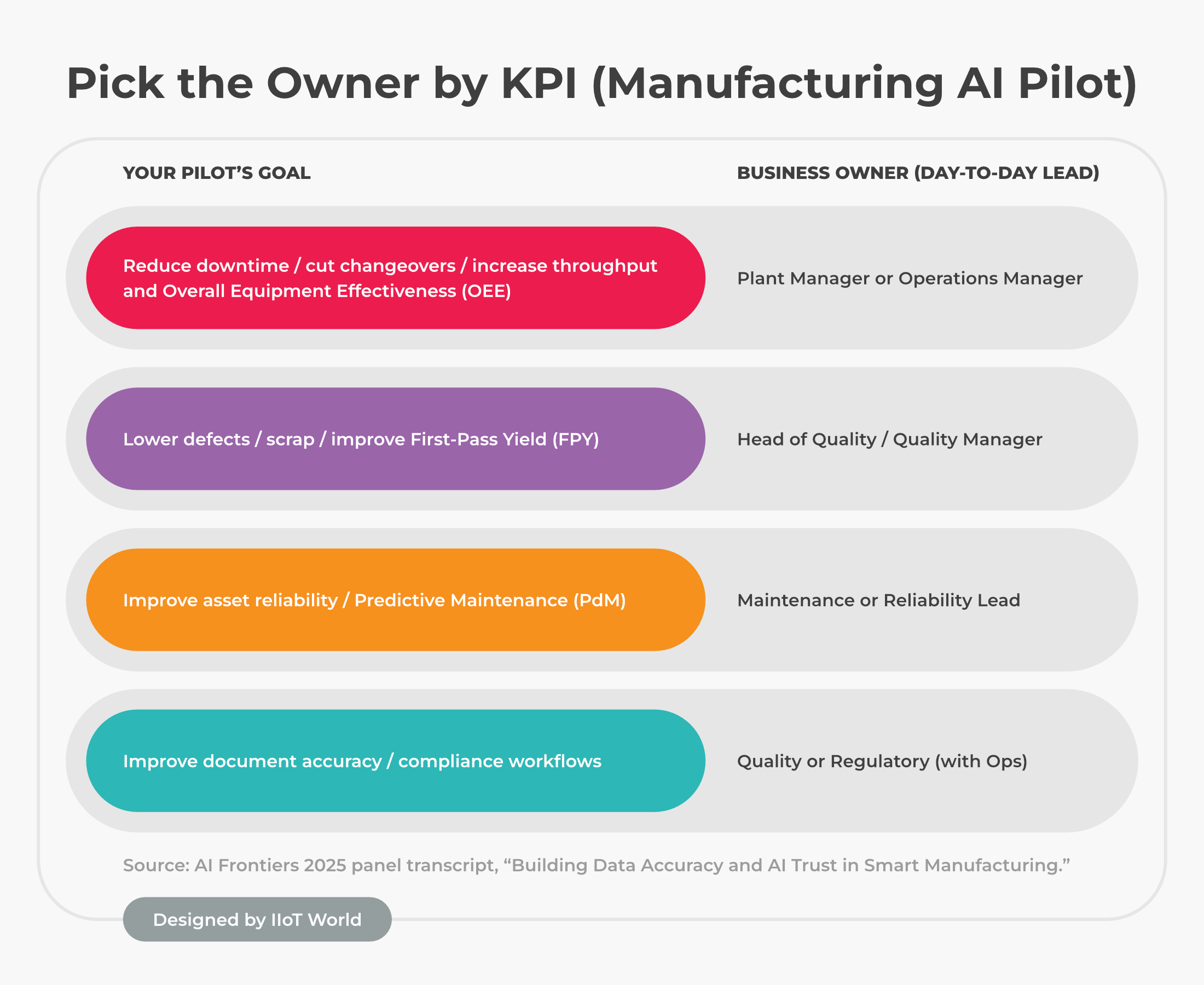
What the business owner does: define the problem and success metric (the KPI), provide process experts and data, make go/no-go decisions, and capture the benefits if it scales.
What Does the Operations Sponsor Do?
The senior operations stakeholder, typically a VP or Director of Manufacturing, secures budget and staffing, clears cross-functional blockers, and builds a repeatable playbook for multi-site rollout. This playbook covers data standards, system connectors, procedures, and change management. The CIO or IT Director and the Head of Quality serve as close partners in this structure.
How Do You Structure a Manufacturing AI Pilot?
A well-structured manufacturing AI pilot focuses on one plant problem that directly moves the P&L, baselines the target KPI using 60 to 90 days of verified data, and runs a 90-day cycle with Finance confirming results before any scale decision is made. This approach keeps scope tight and outcomes measurable in plant language: downtime minutes, scrap rate, first-pass yield, and changeover minutes.
Report results in plant language: downtime minutes, scrap rate, FPY, changeover minutes—not “models deployed.”
How Do IT and Quality Fit in an AI Pilot?
IT and Quality are indispensable partners in a manufacturing AI pilot, but neither should own it. IT manages secure integrations to systems such as the Manufacturing Execution System, CMMS, PLM, and EDMS, and enforces governance including data ownership, lineage, and role-based access. Quality builds the audit trail and traceability required to scale safely across sites without rework.
What Works and What Fails in AI Pilots?
Three practices consistently separate pilots that scale from those that stall. Assign ownership to the line leader with P&L responsibility, start with trusted data and clear governance at the source, and reuse a standard template for data models and connectors so new sites onboard in weeks. Avoid running the pilot as an IT-only initiative, building on messy data, or treating compliance as an afterthought.
An AI Proof of Concept (PoC) should be owned by the business leader who owns the target KPI, backed by a senior operations sponsor, with IT and Quality as indispensable partners. That structure turns Artificial Intelligence (AI) from a science project into measurable plant results—and makes scaling across sites practical.
Source: AI Frontiers 2025 panel transcript, “Building Data Accuracy and AI Trust in Smart Manufacturing.”
FAQ
1. Who should own an AI proof of concept in a manufacturing plant?
The business owner of a manufacturing AI proof of concept should be the line-of-business leader with Profit and Loss accountability for the KPI the pilot targets, such as downtime, scrap, yield, or changeover time. The executive sponsor should be the VP or Director of Operations, who can remove cross-functional blockers and standardize a repeatable playbook across sites. IT and Quality serve as partners, not owners. This structure was recommended at AI Frontiers 2025.
2. How long should a manufacturing AI pilot take?
A manufacturing AI pilot should run on a 90-day cycle. Weeks 1 and 2 cover securing data access, agreeing on the KPI and target, and confirming safety and compliance. Weeks 3 through 6 deploy on a real line or asset with a human-in-the-loop validation step. Weeks 7 through 10 stabilize the system. Weeks 11 and 12 confirm KPI lift with Finance and produce a scale or no-scale decision.
3. Why do AI pilots in manufacturing fail to scale across sites?
Manufacturing AI pilots fail to scale when they are run as IT-only initiatives, built on untrusted or messy data, or structured without a documented playbook. According to the AI Frontiers 2025 panel on “Building Data Accuracy and AI Trust in Smart Manufacturing,” pilots need a line-of-business owner accountable for the KPI, a standard data model, verified connectors, and governance built in from day one so that onboarding a new site takes weeks, not quarters.
4. What KPIs should a manufacturing AI pilot target?
A manufacturing AI pilot should target KPIs that directly reflect plant performance and move the P&L. Examples from the AI Frontiers 2025 panel include downtime minutes, scrap rate, first-pass yield, and changeover minutes. The KPI must be baselined using 60 to 90 days of verified operational data from systems such as the Manufacturing Execution System before the pilot begins, and results must be confirmed by Finance before a scale decision is made.
Related Reading
SLMs for Factory Edge Hardware: 2026 Guide
The Human Costs, Regulatory Compliance, and the Workforce Transformation Playbook (Part 3 of 4)
The Workforce and Market Forces Reshaping Industrial Remote Work (Part 1 of 4)