Manufacturing and energy companies collecting sensor data at scale are hitting the same wall: PostgreSQL, SQL Server, Oracle, and MongoDB were not designed for the volume, velocity, and retention demands of industrial time series. Mike Freedman, Co-founder and CTO at Tiger Data, spoke with Lucian Fogoros of IIoT World at Hannover Messe 2026 about what breaks first when standard databases face industrial data loads, how a purpose-built time series architecture delivers 10x faster queries, and what changes when the database has to run 100 meters underground in a mine or on a ship crossing the Atlantic.
Why Standard Databases Break Under Industrial Data Loads
Industrial facilities collecting sensor data at scale generate volumes that overwhelm general-purpose databases, especially when companies want to retain three, seven, or ten years of historical records. The databases running underneath historians and data systems were not built for that scale. They run too slowly, consume too much storage, and lack the internal optimizations needed to make long-term retention cost-effective.
TimescaleDB, Tiger Data’s open source time series database built on PostgreSQL, addresses this with columnar representation and purpose-built compression that reduces both query time and storage footprint. At the company’s Hannover Messe booth in Hall 14, live demos showed TimescaleDB running against the same datasets at 10x the speed of standard Postgres, SQL Server, Oracle, or MongoDB. Dashboards that previously crawled through results returned answers that felt instant.
Faster queries and smaller storage footprints change what companies can do with their data. When both improve by an order of magnitude, companies stop discarding older records to manage costs. Years of historical records become available for real-time analytics and AI applications, opening use cases that were previously impractical with conventional database architectures.
When Sensor Data Cannot Leave the Building
Data sovereignty requirements, particularly in Europe, increasingly mandate that operational data stay within specific facilities or jurisdictions. On top of regulatory pressure, many industrial sites have weak or no internet connectivity. Tiger Data has customers running their database 100 meters underground in mines, on ships crossing the Atlantic, and on deep water oil rigs off the coast. In each case, the database must sit alongside the equipment it monitors.
This is the gap that TimescaleDB Enterprise, first shown at Hannover Messe 2026, was designed to fill. The product wraps Tiger Data’s market-proven database core with enterprise-grade operations: high availability replication, managed upgrades, monitoring and alerting, administrative controls, and AI enablement. It puts managed-service convenience on the customer’s own servers.
A feature called cloud sync provides an optional bridge for operators who want enterprise-wide visibility. Local data syncs from any site up to a centralized cloud, while the primary database stays at the industrial edge. The architecture spans three tiers: the edge device or equipment, the on-site facility, and an optional centralized cloud for cross-facility analytics and reporting.
Previously, Tiger Data’s primary engagement model was a fully managed cloud service running on AWS and Azure, used by thousands of companies in industrial and energy sectors. Enterprise extends that reach to sites where cloud is not an option.
What Open Source and OPC UA Mean for Plant-Level Data Integration
Before any formal partnership existed, users of Inductive Automation’s Ignition platform had been pairing it with TimescaleDB on their own for seven years. The pattern was consistent enough to act on: Ignition, built around open protocols like OPC UA, handled data collection and visualization, while TimescaleDB, built on the open PostgreSQL ecosystem, handled storage and querying at scale. Plant engineers and developers were assembling the stack themselves.
Tiger Data and Inductive Automation decided to formalize that into a supported, natively integrated product. Instead of a DIY assembly where each team figures out the integration independently, the two platforms now work together by design, built for mission-critical enterprise workloads. TimescaleDB launched in 2017 and has been in the market for over seven years as an open source product, meaning the community adoption happened before any commercial push.
The result for a plant engineer or developer: a supported industrial data stack that pairs an OPC UA-native data platform with a Postgres-compatible time series database, without having to build the glue layer in-house.
60% Cost Reduction Monitoring Remote Compression Equipment
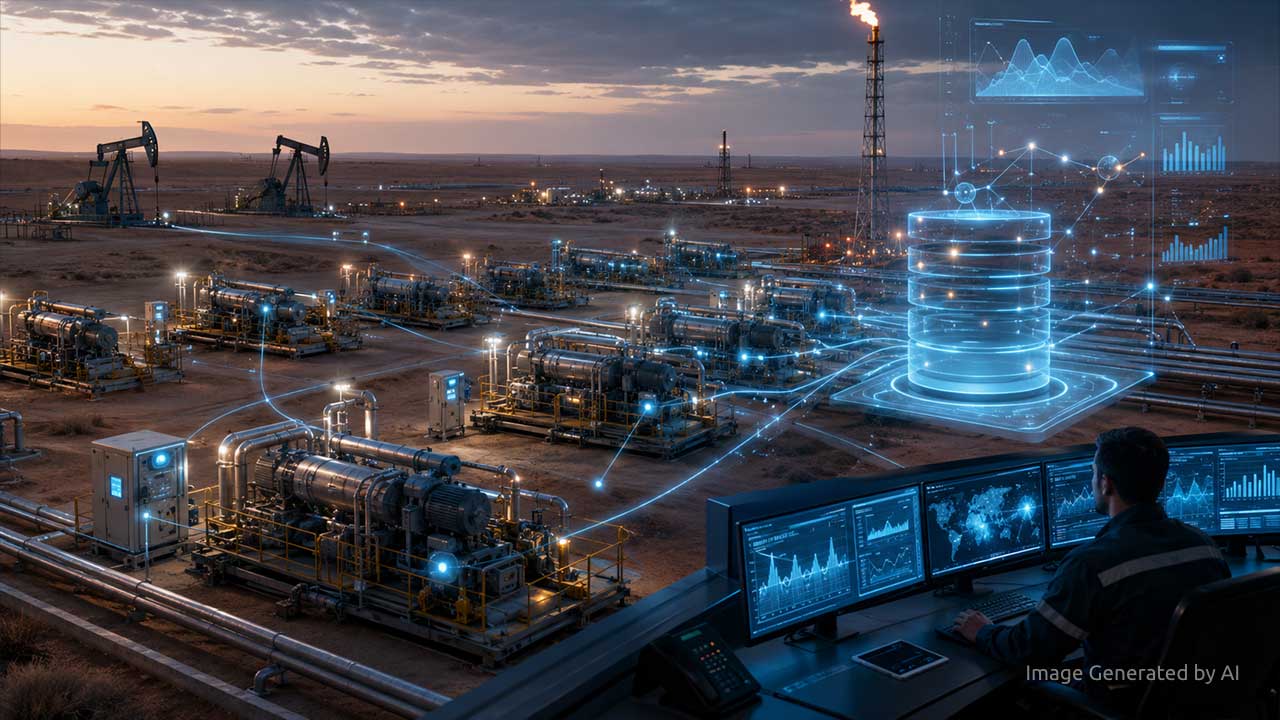
One Tiger Data client monitors about 3,700 pieces of compression equipment across remote oil fields with spotty cellular connectivity. After deploying a time series database architecture, infrastructure costs dropped by 60% and data reliability improved from 95% to 99%.
The case illustrates both deployment patterns that purpose-built time series databases support in energy operations. Software developers use the database directly as the underlying data architecture for their industrial applications. It also sits underneath other industrial historians and data systems that need a storage layer capable of handling the new volume and frequency of sensor data. In both cases, columnar representation and time series optimization reduce operational overhead while expanding what can be done with the stored data.
| Deployment Challenge | Standard Database | Purpose-Built Time Series Database |
| Query speed on industrial data | Slows with volume, dashboards crawl | 10x faster, instant dashboard response |
| Storage for 3-10 years of data | Cost-prohibitive at scale | Columnar compression, smaller footprint |
| Edge / on-prem deployment | Limited options, self-managed | Managed operations on customer servers |
| Data sovereignty compliance | Requires custom architecture | On-prem with optional cloud sync |
| OPC UA integration | Manual pairing | Native Ignition partnership |
| AI and analytics readiness | Separate infrastructure required | Built-in AI enablement |
Frequently Asked Questions
1. Why do industrial sensor databases need to be different from standard databases?
Industrial sensor data is time series data, collected at high frequency across thousands of assets and retained for years. Standard databases like PostgreSQL, SQL Server, or MongoDB were designed for transactional workloads, not for the sustained write throughput and long-range historical queries that manufacturing and energy facilities demand. Purpose-built time series databases use columnar storage and compression optimized for this access pattern.
2. Can time series databases run at the industrial edge without cloud access?
Yes. Products like TimescaleDB Enterprise are designed to run on-premises, at remote sites, and in environments with limited or no internet connectivity, including mines, ships, and offshore oil rigs. An optional cloud sync feature allows data to be replicated to a centralized cloud for enterprise visibility without requiring constant connectivity.
3. How does the Ignition and TimescaleDB partnership work?
Tiger Data and Inductive Automation formalized a partnership after seven years of community-driven adoption. Ignition handles data collection via OPC UA, while TimescaleDB provides Postgres-compatible time series storage. The integration is now natively supported rather than requiring each team to build and maintain the connection independently.
4. What cost savings can manufacturers expect from purpose-built time series databases?
Results vary by deployment, but one documented case in remote oil field monitoring showed a 60% reduction in infrastructure costs and an improvement in data reliability from 95% to 99% across 3,700 pieces of compression equipment. Savings come from smaller storage footprint, faster queries, and reduced operational overhead.
This article is based on a video interview with Mike Freedman, Co-founder and CTO at Tiger Data, and Lucian Fogoros of IIoT World, recorded at Hannover Messe 2026. AI tools were used to help summarize and organize the content. Reviewed and edited by the IIoT World editorial team.