
Across every industrial sector, the conversation has moved beyond efficiency gains and automation ROI. A more fundamental question now confronts leadership: What is our company’s human function when the machines can execute everything?
For decades, industrial leadership has been an exercise in optimization—maximizing output, minimizing downtime, streamlining the human workforce within the production loop. Your value was measured in margins, yield, and throughput.
That paradigm is ending.
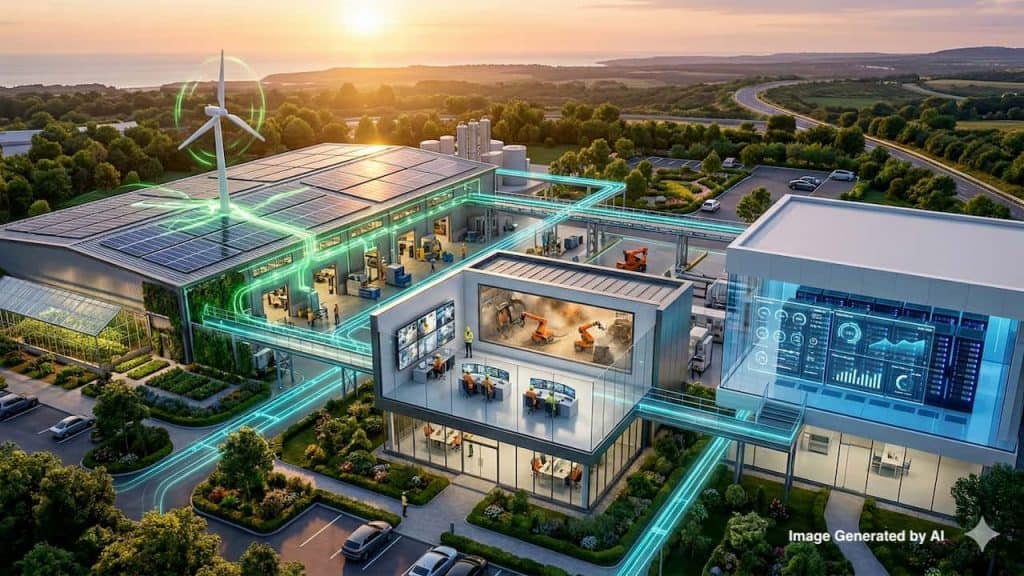
The coming wave of autonomous systems and industrial AI does not just replace manual labor. It absorbs entire chains of execution—from generative design and predictive logistics to self-optimizing production and maintenance. The “how” of making things is becoming a solved problem, a utility.
This presents not a crisis of cost, but a crisis of purpose. If your competitive edge has always been how well you make, what happens when every competitor has access to the same perfect, tireless, near-zero-cost production intelligence?
The answer lies in a seismic shift from operational leadership to intentional leadership.
The industrial enterprise of the immediate future will compete on a new axis: not the efficiency of its hands, but the clarity and impact of its vision. Your most critical asset will no longer be your equipment or your labor force, but your directive capacity—your ability to identify what should be built, why it matters, and for whom.
We are entering the era of the Intention Economy.
In this new landscape, the role of leadership transforms. You are no longer the overseer of execution. You become the architect of consequence. Your strategic role evolves into three new imperatives:
- Define “The Why.” When AI handles production, your core responsibility shifts to curating purpose. What human or planetary problem does your product solve? What experience does it deliver? What legacy does your company create beyond its P&L? The organizations that thrive will be those that can answer these questions with a compelling, authentic vision.
- Govern the Means of Creation. The new capital is not financial, but generative: access to AI-driven design, simulation, and fabrication cycles. Forward-thinking leaders are already building strategies not around owning factories, but around commanding and directing “intelligence credits” and production networks. Your supply chain will be a cloud of capability, awaiting your instruction.
- Cultivate Human Insight. The irreplaceable value of your people migrates from their technical skills to their human judgment—their ethics, their contextual understanding, their creativity. Your organizational task is to create the culture and frameworks that turn collective insight into clear, actionable intent for your AI-driven systems.
This is not a distant hypothetical. The foundational technologies enabling this shift are being integrated now. The leaders who will define the next industrial age are those who stop asking, “How do we make this cheaper?” and start demanding, “What world are we building, and is it worthy of the power we now wield?”
Your next title isn’t just CEO or COO. It’s Chief Purpose Officer. Your new business isn’t manufacturing—it’s meaning. And that is a market no machine will ever capture.
Welcome to the first day of the rest of your company’s life. The year of intention begins now.
For more insights, subscribe to IIoT World weekly newsletter
About the author
Lucian Fogoros is the Co-founder of IIoT World.