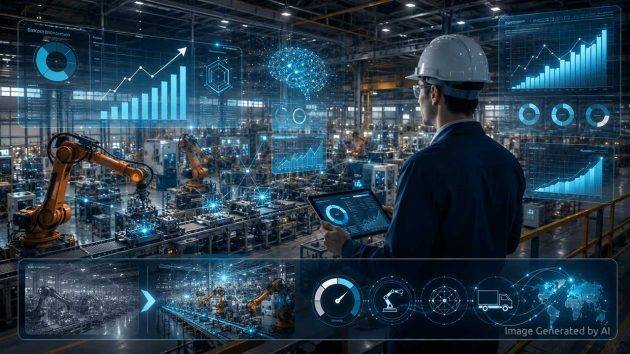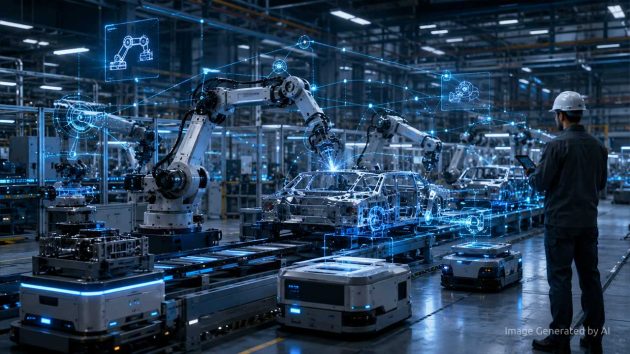

Agentic AI represents a fundamental shift in how artificial intelligence operates within industrial environments, moving from passive prediction to autonomous decision-making and action. In this IIoT World explainer, we break down what agentic AI actually means for manufacturers, process engineers, and operations leaders. You will learn how autonomous AI agents differ from traditional machine learning models, what architectural patterns enable them, and why industry analysts project agentic systems will reshape factory floors, supply chains, and predictive maintenance workflows over the next decade. Whether you are evaluating vendor claims or building an internal roadmap, this guide provides the conceptual framework you need to make informed decisions.
Understanding Agentic AI
Agentic AI refers to models designed to make decisions independently, pursue goals, and learn from experiences. While still evolving, these models show promise in managing complex workflows using multiple agents working independently. Unlike traditional AI which focuses on narrow tasks, agentic AI aims to handle various tasks and adapt to new situations.
This adaptability makes agentic AI a valuable tool for automation in business, manufacturing, and customer service. However, as of early 2025, most agentic AI applications aren’t operating in true real-time, and integrating them with existing systems remains challenging.
When compared to traditional AI, agentic AI aims for greater flexibility. Traditional AI excels at specific tasks like data analysis, while agentic AI could potentially understand a user’s problem, access relevant systems, and suggest solutions. However, many of these capabilities are still in development.
While progress is being made, the full potential of agentic AI — such as autonomous decision-making and adaptive learning — remains aspirational for most systems. As research continues, we may soon see more practical applications of these concepts.
For more insights on the basic building blocks of agentic AI, the article “Building Effective Agents” by Anthropic is recommended [1]
Impact on Data Science and AI Development
The rise of agentic AI is changing the field of data science and AI development. We’ve reached a point where LLM agents can handle almost any basic, simple task. This means we no longer need to retrain models each time something new happens. Instead, the focus is shifting towards creating agentic workflows that allow for the subjective processing of events.
A similar trend is happening in image and video processing, where vision transformers are becoming more prominent. These systems can understand and manipulate visual data in increasingly sophisticated ways, opening up new possibilities for AI applications.
Just check out how cool services like tavus.io and va.landing.ai are. They showcase the practical potential of agentic AI in video personalisation and industrial workflows.
The Changing Role of Data Scientists
As agentic AI becomes more prevalent, data scientists may find themselves working more on designing and implementing autonomous systems rather than solely focusing on traditional ML models. This could involve:
- Developing more complex, goal-oriented AI systems
- Creating AI agents that can collaborate and share information
- Implementing systems that can self-correct and adapt to changing environments
Recent trends, including discussions within the field and online platforms like Towards Data Science, suggest that reinforcement learning (RL), unsupervised learning, and deep AI frameworks are becoming essential. While traditional data analysis skills remain valuable, they are no longer sufficient. This shift reflects the evolving role of data scientists, who will increasingly focus on designing, implementing, and managing autonomous AI agents. As AI systems take on more autonomous analytical tasks, data scientists will contribute at a higher level, focusing less on routine work and more on overseeing and fine-tuning these agents, shaping data strategies, and guiding AI-driven decision-making. Some go even further and use so-called “Vibe Coding”.
Learning New Tools
AI development demands continuous learning of new tools. LangChain, n&n, and similar platforms are becoming increasingly relevant. Visual workflow tools like Dust.tt and FlowiseAI offer the potential for streamlined workflows, though they’re still evolving. Experimental projects such as Auto-GPT and BabyAGI provide insights into future possibilities, and frameworks like CrewAI are exploring complex multi-agent systems. Creating effective prompts and designing agents is now a key skill. Among these, WindSurf [2] stands out. It’s unique in that it allows programming entirely through prompts. This prompt-only approach enables developers to express complex logic, facilitate rapid prototyping, and simplify the process of translating ideas into functional AI systems, to name a few.
In short, agentic AI is a game-changer. It’s not just a new technology; it’s a new way of thinking about AI. Data scientists and AI developers need to keep up with these changes and learn the new tools and techniques that are emerging.
Applications of LLM Agents: Manufacturing
Imagine an LLM agent acting as a virtual maintenance coordinator. It doesn’t just flag anomalies in sensor data. Instead, it understands maintenance manuals and past repair logs in natural language. When sensor data indicates a potential issue (e.g., unusual vibration), this agent can autonomously query the machine’s operational history, cross-reference it with known failure modes described in the manuals, and even generate a preliminary diagnosis in plain English for a human technician. It could then autonomously schedule the repair by interacting with the maintenance calendar system and even order necessary spare parts by communicating with the inventory management system through API calls or structured language commands. Furthermore, it can learn from feedback provided by human inspectors in natural language (“This was flagged as a defect because…”). The agent could then generate a report explaining why a part failed inspection, referencing the specific clause in the quality standard.[3]
Leveraging the predictive power of LLMs, agentic systems can move beyond basic automation to perform subjective assessments, diagnose complex issues based on nuanced criteria, and autonomously execute tasks in manufacturing, leading to advancements in efficiency, quality, and proactive maintenance that surpass traditional rule-based systems
About the author
This article was written by Ihar Rubanau, Senior Data Scientist at Sigma Software Group
References
1. https://www.anthropic.com/research/building-effective-agents
3. https://ridgeant.com/blogs/llm-manufacturing/
FAQ Section
1. What is agentic AI and how does it differ from traditional industrial AI?
Agentic AI refers to AI systems that can autonomously perceive their environment, set sub-goals, and take actions without waiting for explicit human instructions at every step. Traditional industrial AI models, such as supervised classifiers or regression-based predictive maintenance tools, require a human to interpret outputs and decide on next steps. Agentic systems close that loop by combining planning, tool use, and memory so the AI itself orchestrates multi-step workflows. In a manufacturing context, an agentic AI might detect a quality anomaly, diagnose the root cause, adjust machine parameters, and file a maintenance ticket, all without operator intervention. Industry research estimates that agentic architectures could automate up to 30% of routine decision tasks on the factory floor by 2030.
2. What are practical use cases for agentic AI in smart manufacturing?
Three high-impact use cases are emerging. First, autonomous quality control, where an agent continuously monitors sensor streams, cross-references historical defect patterns, and adjusts process parameters in real time. Second, self-healing supply chains, where agents detect disruptions from supplier feeds or logistics APIs, evaluate alternative sourcing options, and execute purchase orders within pre-approved guardrails. Third, adaptive predictive maintenance, where an agentic system not only forecasts equipment failure but also schedules the repair, orders parts, and re-routes production, compressing response times from days to minutes. Each of these scenarios reduces manual handoffs, which are a leading source of downtime and error in discrete and process manufacturing alike.
3. What risks should manufacturers consider before deploying agentic AI?
The primary risks fall into three categories: safety, accountability, and data governance. Because agentic systems take actions autonomously, a misconfigured reward function or faulty sensor input can cascade into costly physical outcomes, making robust guardrails and human-in-the-loop override mechanisms essential. Accountability becomes complex when an autonomous agent makes a decision that leads to a product recall or safety incident; organizations need clear audit trails and explainability layers. Finally, agentic AI requires access to broad operational data, so manufacturers must ensure compliance with data sovereignty regulations and implement strict access controls, especially in regulated industries such as pharmaceuticals and aerospace.
Related from IIoT World: