
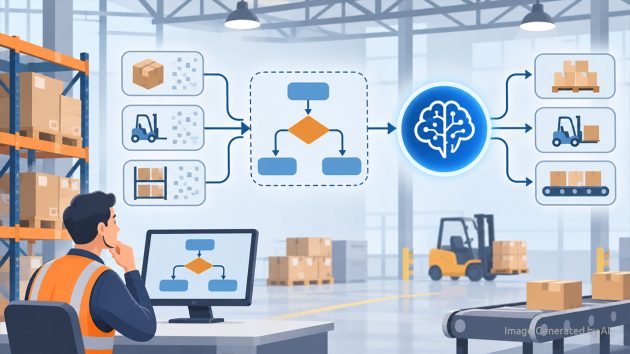
For organizations looking to deploy AI in their warehouses, the instinct is often to launch a massive, multi-year data cleanup project first. However, this pursuit of perfect data often delays operational improvements indefinitely.
According to Keith Moore, CEO of AutoScheduler.AI, in an IIoT World CxO Series interview, facilities should map their decisions first, then determine what level of data quality those decisions actually require. “Your data only has to be as perfect as the decisions you’re going to make on it,” he explained.
The Five Steps of Decision Mapping
Decision mapping prevents organizations from getting stuck in endless data preparation. Instead of trying to fix every data point across the enterprise, the process targets automation at the highest-value decisions using the data that is already available.
The methodology follows a five-step sequence:
- Catalog: Identify exactly what data the facility currently has at its disposal.
- Document: Audit and document how the warehouse makes its decisions today.
- Trace: Determine how the existing data actually informs those decisions and identify the triggers that cause those decisions to change dynamically.
- Separate: Divide the decisions into two categories: standardizable processes that apply network-wide, and nuanced decisions that are entirely facility-specific.
- Rank and Automate: Rank the decisions by their potential impact against current data readiness, and begin automating from the top down.
Building Trust Through Explainable AI
Once high-value decisions are mapped and automated, the next hurdle is operational trust. A 20-year warehouse veteran will not follow a machine’s recommendation blindly. To solve this, the AI must act as an explainable decision agent.
Every application built on the platform logs the exact equations, constraints, and trade-offs behind its automated decisions. This transparency begins during the build phase: before an application goes live, the platform presents its logic and asks the builder if they would handle the trade-offs differently. This input is logged alongside the application’s rules.
When an operator questions a specific recommendation on the floor, the system does not just provide an output; it traces the data through the full decision flow and presents the mathematical reasoning. If the operator disagrees, they can have an ongoing discussion with the platform to adjust the underlying decision logic, creating a fully documented audit trail.
The Case for Domain-Specific AI
This level of operational depth reflects a deliberate bet on domain-specific AI. By 2018 and 2019, the AI industry was splitting into two distinct paths.
One path led to large research labs, such as Anthropic, OpenAI, and Google DeepMind, building general-purpose models. While highly capable at understanding language, these models lack the encoded knowledge of physical constraints. They do not inherently know how long specific equipment takes to move inventory, which dock doors are restricted to certain load types, or how a delayed truck cascades through a production schedule.
AutoScheduler.AI took the second path: verticalizing algorithms by encoding deep domain expertise into warehouse operations. By combining machine learning with decades of supply chain consulting expertise, including the foundational platform originally built for Procter & Gamble, the team built a warehouse-specific intelligence layer from the ground up.
| Step | Decision Mapping Action |
| 1. Catalog | What data do we have? |
| 2. Document | How do we make decisions today? |
| 3. Trace | How does data inform those decisions, and when do they change? |
| 4. Separate | Which decisions are network-wide vs. facility-specific? |
| 5. Rank and automate | Prioritize by data readiness and impact, then automate top-down |
Sources
Related from IIoT World
This article is based on a video interview with Keith Moore, CEO of AutoScheduler.AI, and Lucian Fogoros of IIoT World. AI tools were used to help summarize and organize the content. Reviewed and edited by the IIoT World editorial team.