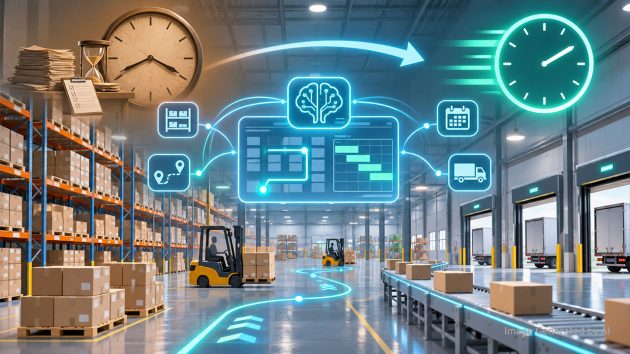
Daily workforce planning at Procter & Gamble’s manufacturing campuses used to take eight hours per shift. Planners arrived long before their teams to map out inbound deliveries, outbound trucks, production schedules, and variable labor.
But within ten minutes of a shift starting, that plan usually broke down. Equipment failed, workers called in sick, or trucks arrived late. Because of the interconnected nature of the campus, where shuttle movements between buildings must be perfectly timed to keep production lines running and fill rates high, a single delay left planners constantly having to dynamically replan.
Connecting Siloed Operations
According to Keith Moore, CEO of AutoScheduler.AI, in an IIoT World CxO Series interview, the root of this problem was legacy software architecture. For decades, warehouses relied on siloed systems. A facility might buy a labor management system for workforce efficiency and a separate slotting solution for inventory placement. These systems rarely communicated, even though labor efficiency depends directly on where inventory is placed and when inbound trucks arrive.
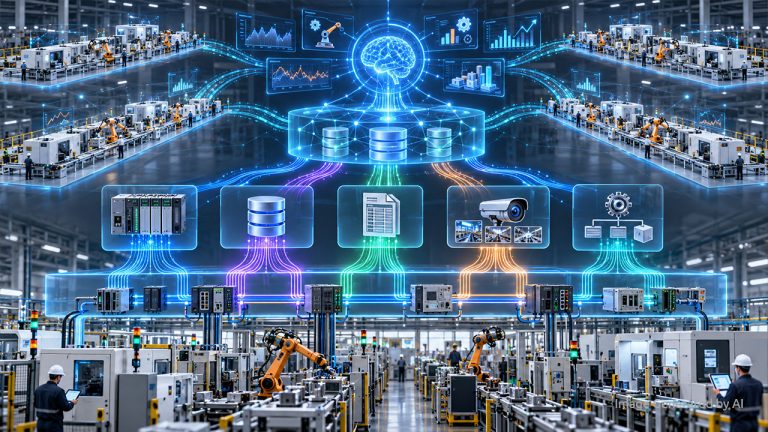
To eliminate the eight-hour planning cycle, AutoScheduler.AI spent six years building a “semantic layer,” a unified body of structured knowledge that encodes how a warehouse operates optimally. By connecting warehouse management systems (WMS) and enterprise resource planning (ERP) data with algorithms that understand equipment capabilities and dock schedules, this layer automates the universal decisions that make up about 80% of warehouse operations.
This automation successfully cut P&G’s shift planning from eight hours down to 20 minutes.
Empowering the Floor with No-Code AI
However, standardizing the remaining 20% of decisions is impossible because every facility has unique constraints, such as a sorter with specific load rules or a cross-dock workflow that only runs on specific days. Instead of relying on a six-month IT development cycle to solve these edge cases, the platform gave floor supervisors a no-code AI builder.
The result has been a grassroots operational shift. Floor supervisors with zero coding experience have built nearly 500 custom applications directly on the platform. These tools manage nuanced local problems, such as scheduling raw material deliveries to specific production lines or executing unique replenishment flows.
One application specifically targeted inventory shortages. When a load is short on product, the app automatically scans SAP and ERP data for future shipments to that customer, recommending product substitutions to protect the fill rate. By automating what was previously a manual, two-person task, the supervisor who built the app saved their facility $150,000 within two days of deployment.
Building Trust Through Transparent Math
Driving this level of frontline adoption requires earning the trust of veteran supervisors. To achieve this, the AI acts as a transparent decision agent. It logs all mathematical reasoning and logic in plain language, allowing a 20-year dock supervisor to trace exactly why a recommendation was made, challenge the trade-offs, and adjust the parameters to fit the reality on the floor.
For organizations looking to replicate this transition, Moore advises against getting stuck in endless data cleanups. Instead, he recommends mapping decisions first: identifying what decisions are made, why they are made, and what specific data informs them. Once the decisions are mapped, facilities can pinpoint the most valuable areas to automate and begin their transition away from fragile, manual spreadsheets.
| Element | Traditional Approach | AI Platform Approach |
| Daily workforce planning | 8 hours manual per shift | 20 minutes automated |
| New application delivery | ~6 months IT development cycle | Floor supervisors build directly |
| Optimization scope | Siloed systems (LMS, slotting) | 80% universal + 20% facility-specific |
| Inventory shortage response | Manual ERP lookup | Automated scan and product substitution |
Sources
Related from IIoT World
This article is based on a video interview with Keith Moore, CEO of AutoScheduler.AI, and Lucian Fogoros of IIoT World. AI tools were used to help summarize and organize the content. Reviewed and edited by the IIoT World editorial team.