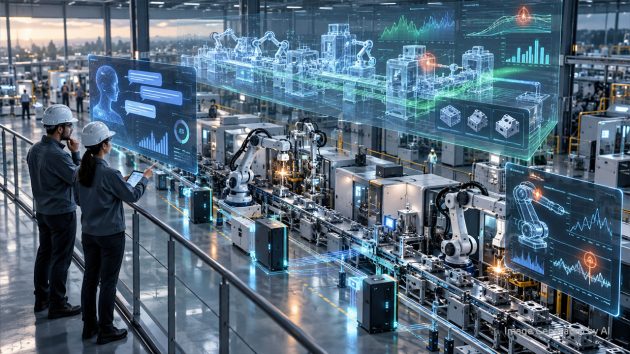
Should manufacturers run domain-specific small language models at the edge? Where do LLMs add value in manufacturing production planning? Can you test AI on a digital twin before production? Neil Smith of Schneider Electric and Andrew Waycott of TwinThread answer five audience questions on edge AI deployment, AI platform selection, and data contextualization asked during the “From AI Pilots to Profit: Unlocking Manufacturing’s Hidden Data Advantage” session at the Industrial AI Summit 2026.
Do Small Language Models Have a Future at the Edge?
Audience question:”For industrial and manufacturing use cases, do you see a viable future for domain-specific Small Language Models running on-premise at the edge, trained for a particular process/problem to reduce latency and security risks, while sending only KPI/aggregated data to the cloud for analytics and monitoring? What would be the biggest barriers to adoption?”
Neil Smith, Segment President, Consumer Packaged Goods at Schneider Electric:
Our “Beyond the Hype: Practical AI for Competitive Consumer Goods Manufacturing” paper is explicit that value rarely comes from giant, general-purpose models. It comes from models trained on the domain-specific data, for the right task, deployed in the right part of the operation. These focused models also require less data, and produce clear ROI, often in a matter of weeks, not years. In industrial environments, milliseconds matter. Running AI at the edge keeps decisions close to the process, reduces latency, maintains resilience when connectivity is constrained, and gives manufacturers greater control over sensitive operational data. This is exactly what EcoStruxure Automation Expert (EAE) and Foxboro Software-Defined Automation (SDA) are built for: distributed intelligence with edge compute and real-time analytics combined with dynamic optimization through IT/OT convergence and advanced analytics. AI-enhanced platforms like AVEVA PI System and AVEVA Unified Operations Center can further support industrial data analytics and monitoring. When it comes to industrial AI adoption barriers, our 2026 Industrial AI in CPG study (1,453 manufacturers globally) is clear: the constraint isn’t the technology. It is foundational readiness. These include skills gaps in AI or data science (cited by 43.0% of respondents), legacy automation systems and infrastructure (37.5%), a lack of contextualized operational data (36.3%) and workforce resistance (25.7%), all cited ahead of cybersecurity or compliance concerns (21.7%).
Are Standalone AI Platforms or Embedded AI Winning?
Edge models need a platform to run on, which raises the question of what is actually deployed in production today.
Audience question:”Which AI services or platforms are you actually using in production? On-premise / self-hosted AI, Vendor-specific AI platforms, Cloud or web-based AI services, Desktop/local AI applications, Custom-built business AI?”
Neil Smith, Segment President, Consumer Packaged Goods at Schneider Electric:
Across the Schneider Electric portfolio, there are several examples of AI-enhanced solutions we offer to CPG customers. I believe industrial AI will move further into daily operations. The applications with real traction are not standalone AI platforms. They’re AI capabilities embedded into existing operational workflows, where operators may not even think of them as AI, are narrow in scope and built on existing automation. Use cases include predicting equipment failures before they cause downtime, optimizing energy use line by line, and automating routine quality checks. Solutions include the AI-enabled Industrial Copilot that helps save up to 50% of engineering time, as well as AI-enhanced solutions such as AVEVA™ PI System and AVEVA Connect that are there to support industrial data management and enable automated compliance. Solutions like ProLeiT CIPOptimize deliver AI-assisted Clean-in-Place optimization, quality-anomaly detection and recipe optimization.
Where Do LLMs Add Value in Manufacturing Production Planning?
With embedded AI handling operations, the next question is whether large language models belong in production planning or whether they distract from proven optimization tools.
Audience question:”In high-volume, low-margin, engineered-to-order manufacturing, where do you see LLMs actually adding value in production planning versus just being a distraction from classical optimization (OR tools, scheduling solvers)?”
Neil Smith, Segment President, Consumer Packaged Goods at Schneider Electric:
LLMs should not replace optimization engines. Optimization engines determine the best answer. LLMs help humans understand, interrogate, simulate and act on that answer faster. That distinction matters most in high-volume, low-margin and engineered-to-order manufacturing, where decisions on scheduling, changeovers or configurations have to be both precise and explainable. The optimization engine does the heavy mathematical lifting. The LLM becomes the interface: explaining why a schedule changed, letting a planner ask “what happens if this order slips?”, or turning a recommendation into clear actions for the shop floor. Used together, they combine the rigor of optimization with the speed and accessibility of natural language, and people stay in control of the final decision.
Can You Test AI on a Digital Twin Before Production?
Before any of these models reach a live production line, manufacturers want to know if they can validate AI safely first.
Audience question:”Can you run the AI on a digital twin before going into production? Is it effective in reducing risk?”
Andrew Waycott, President and Co-founder of TwinThread:
TwinThread empowers teams to simulate and validate AI recommendations on a digital twin before deploying them into live production. Using the “Execute over time range” feature, engineers can run models against historical data to test anomaly scores, value predictions, and recommendations. This effectively reduces operational risk by catching unintended consequences or unsafe settings early. If risks are detected, teams can mitigate them immediately by fine-tuning model configurations and adjusting acceptable ranges/thresholds. As confidence in the solution grows, teams can safely transition to time-bound controlled trials before a full production rollout.
How Does AI Contextualize Heterogeneous Data?
Digital twins and AI models both depend on clean, contextualized data, but most plants generate data in different formats from dozens of disconnected sources.
Audience question:”How do you use AI to contextualise heterogeneous data?”
Neil Smith, Segment President, Consumer Packaged Goods at Schneider Electric:
Context is what transforms data into intelligence. For example, AVEVA PI System contextualizes real-time process, batch and material data into actionable, audit-ready insight, speeding deviation investigations and protecting margins; its infrastructure is increasingly built to process AI workloads on real-time plant data. AVEVA Connect extends that connected industrial intelligence backbone further out to suppliers, layering predictive analytics and agentic AI on top of industrial data management.
These questions were submitted by attendees of the “From AI Pilots to Profit: Unlocking Manufacturing’s Hidden Data Advantage” session at the Industrial AI Summit 2026. Answers provided by Neil Smith of Schneider Electric and Andrew Waycott of TwinThread. The session also featured François Coulloudon of TEEPTRAK Groupe, and it was moderated by Kevin O’Donovan. The session was sponsored by TEEPTRAK and TwinThread.