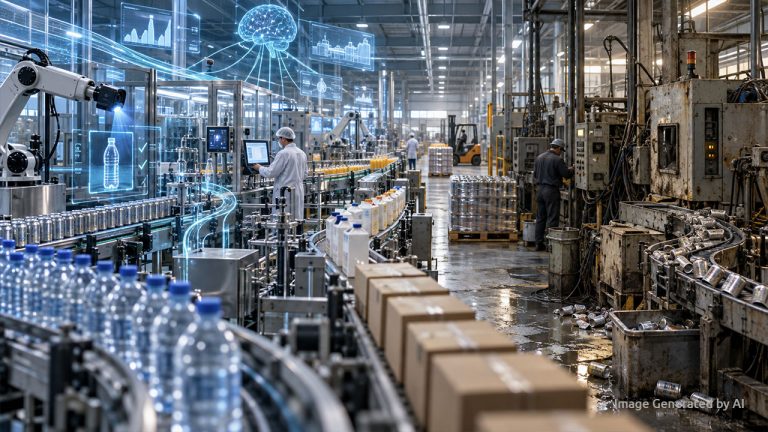
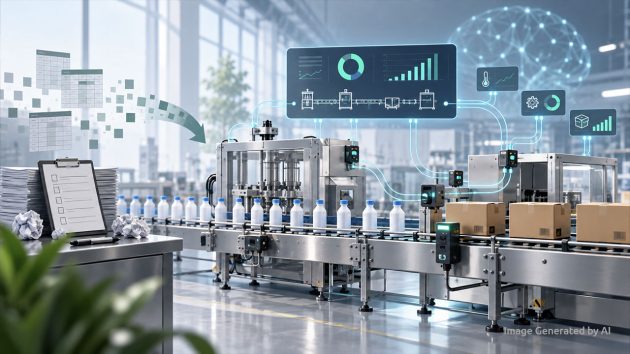
Eighteen percent of U.S. product cost comes from manufacturing delays and downtime. Many CPG plants track line performance through overall equipment effectiveness, but those systems run offline on spreadsheets, clipboards, or disconnected software. The data to reduce that cost exists; it is not connected. Neil Smith, Segment President, Consumer Packaged Goods at Schneider Electric, explained why connecting that data comes before any AI investment in a video interview with IIoT World.
How Much Does Disconnected OEE Data Cost CPG Manufacturers?
CPG producers operate in a competitive environment with frequent line changeovers and a customer base that wants new products. In that environment, 18% of total product cost in U.S. CPG manufacturing comes from delays and downtime. Many plants measure overall equipment effectiveness through manual clipboards, offline spreadsheets, or disconnected software.
When line stoppages occur, operators manually assign reason codes. The result is data that exists but cannot reveal the patterns behind recurring production problems. Information sits in isolated systems that were never designed to share data across the plant, let alone across the enterprise.
What Should CPG Manufacturers Automate Before Deploying AI?
Automating reason code allocation and connecting OEE systems to plant networks is the first priority. Once connected, data science can correlate a recurring jam on the infeed of a carton with floor humidity, outside temperature, or specific shift patterns. These correlations become apparent when data flows between systems.
Advanced process control has performed this function in CPG plants for years, described in the interview as “the first generation of AI.” More sophisticated AI models follow, but they depend on the same connected data infrastructure.
| Capability | Current State | Target State |
| OEE tracking | Offline spreadsheets, clipboards | Connected, automated systems |
| Reason codes | Manual operator allocation | Automated pattern detection |
| Data correlation | Isolated per sensor or PLC | Cross-system causality analysis |
| Decision execution | Human in the loop | Supervision and approval |
How Does Software-Defined Automation Close the Loop?
When AI identifies that a set point needs adjustment or a line needs restarting, the recommendation must become physical action on the production floor. For plants running legacy control systems, there is no native pathway from enterprise AI platforms to the shop-floor equipment that executes the change.
Open, software-defined automation fills that role as an action broker between enterprise AI and legacy automation systems. It can restart a line, adjust a set point, or increase yield. Manufacturers can interoperate with existing control systems while migrating to a native SDA platform at their own pace.
“Who knows your plant better than anyone else in the enterprise? It’s the guys running it.” Plant operators hold intellectual knowledge that can be captured in AI, particularly as the workforce ages and recruiting new people into the industry gets harder. Connecting that human expertise with automated systems preserves institutional knowledge that would otherwise leave with retiring workers. Once plant-wide visibility is in place, AI becomes an amplification of business outcomes.
This article is based on a video interview with Neil Smith, Segment President, Consumer Packaged Goods at Schneider Electric, and Lucian Fogoros of IIoT World. AI tools were used to help summarize and organize the content. Reviewed and edited by the IIoT World editorial team.
About the author