This is Part 2 of a four-part series. Part 1 covered the workforce crisis and market forces driving industrial remote work. Part 3 covers human costs, regulatory compliance, and recommendations. Part 4 covers critical perspectives, the conclusion, and the full FAQ.
From Passive Monitoring to Proactive Intelligence
Part 1 of this series showed that workforce scarcity, not technology preference, is the primary force converting remote operations from optional to essential for industrial organizations. The Three Convergences framework explained why workforce scarcity, AI capability, and IIoT infrastructure are reinforcing each other simultaneously.
This part examines the second and third convergences in depth: how AI is changing what remote industrial operations can actually accomplish, how digital twins are changing the engineer’s relationship to physical assets, and how the OT cybersecurity threat landscape constrains what is safely achievable.
How Is AI Transforming Remote Operations in Manufacturing?
AI is moving remote operations from passive monitoring to proactive, semi-autonomous management. The adoption curve is steeper than many industrial leaders realize. In 2023, just 18% of manufacturers used AI in operations. By 2025, that figure had tripled to 56%. The global AI market in manufacturing reached $34.18 billion in 2025 and is projected to reach $155 billion by 2030 at a 35.3% CAGR.
Across the broader economy, 52% of U.S. employees now use AI in their roles. Among fully remote companies, the rate is 89%, up from 34% in 2024. The industrial story is not only about adoption percentages. It is about the qualitative shift in what remote industrial work can accomplish.
How Does AI Transform Remote Monitoring from Reactive to Predictive?
The traditional model of industrial remote monitoring was fundamentally reactive: sensors fed data to dashboards, operators watched for red indicators, and intervention happened after problems became visible. AI has inverted this model.
IIoT-enabled predictive maintenance, powered by machine learning models running on platforms from Siemens (MindSphere/Insights Hub), Rockwell Automation (Plex), PTC (ThingWorx), and AWS IoT, now analyzes vibration, temperature, pressure, and power consumption patterns to predict failures weeks or months before they occur. The operational impact is measurable:
| Metric | Impact | Source |
| Maintenance budget reduction | 8-12% | Ghost Research |
| Unplanned downtime reduction | 50% | Ghost Research |
| Annual savings per plant | ~$630,000 | Ghost Research |
| Unplanned failure reduction | 22-45% | Ghost Research |
| Machine downtime reduction (AI-driven) | 30-50% | f7i.ai |
| Asset life extension | 20-40% | f7i.ai |
| 5-year ROI on smart factory tech | 300-500% | Ghost Research |
| Payback period | 18-24 months | Ghost Research |
These are not pilot-project numbers. The predictive maintenance market was valued at $14.09 billion in 2025 and is expected to reach $82.17 billion by 2031 at a 34.14% CAGR, reflecting broad-based industrial adoption.
A 2023 Rockwell Automation deployment at a global food and beverage manufacturer across 40 facilities makes the “more assets” principle concrete: the company went from outdated legacy systems with no secure remote access to 24/7 AI-driven monitoring through 19 Industrial Data Centers, achieving enterprise-wide uptime improvement. AI does not simply replicate what a human operator would do remotely. It enables a single remote engineer to maintain awareness across an entire fleet of assets at a level of analytical depth that no number of on-site personnel could match.
Case Study: Nestlé Purina Hartwell: From Alert Overload to Predictive Intelligence
Nestlé Purina’s Hartwell, Georgia wet pet food facility illustrates what AI-driven predictive monitoring delivers at scale. During rapid plant expansion, the facility accumulated 30+ active alarms at any given time and fell into reactive firefighting mode. Data existed, but as Christopher Rothell, Senior Staff Reliability Engineer, described it: “nobody had the time to listen” (Augury, March 2026).
After deploying AI-powered Machine Health monitoring across 180 assets, active alarms dropped from 30+ to single digits. A single early detection of a critical motor failure prevented a $117,000 outage. Total cost avoidance exceeded $830,000 with more than 100 hours of downtime prevented. Purina North America avoided $11 million in costs across its facilities in 2024. Rothell on the moment the team committed: “I think people started really buying in after that point, because we could show them some results from what we were seeing.” The Hartwell facility was named to the top 5% of monitored facilities globally, a result that validates the $630,000 annual savings-per-plant benchmark from Ghost Research as a floor, not a ceiling.
How Do Digital Twins Enable Remote Engineers to Manage Entire Production Lines?
If predictive maintenance is the analytical engine of remote industrial operations, the digital twin is the interface. The technology has crossed from pilot into production: over 40% of manufacturers are in the pilot phase, with aerospace, automotive, electronics, and energy utilities reaching 70%+ adoption.
Digital twins support remote operations through three specific capabilities:
- Physics-based simulation: engineers can test configuration changes, simulate process modifications, and predict outcomes without touching the physical asset
- AI-driven anomaly detection: contextualizing raw sensor data within the process model so that a temperature alarm means something different depending on the production stage, ambient conditions, and upstream equipment state
- Closed-loop optimization: Gartner predicts that by 2030, manufacturing will be shaped by semi-autonomous AI agents and closed-loop digital twins that coordinate physical systems, AI agents, and workers in real time
Siemens launched the Industrial Copilot for Operations specifically to enable real-time remote decision-making for shop floor operators and maintenance engineers, and 92% of companies reporting digital twin investments achieve ROI above 10%, with approximately 50% achieving returns of 20% or more.
The practical implication is very real: an engineer using Siemens Xcelerator, AVEVA (Schneider Electric), or Microsoft Azure Digital Twins can interact with a physics-based virtual replica of an entire production line, diagnosing issues, testing solutions, and optimizing parameters, without setting foot in the facility.
What Productivity Gains Does AI Deliver in Industrial Remote Operations?
The productivity gains from AI in industrial contexts are multiplicative, not marginal. One junior technician equipped with AI diagnostics now performs at senior-level capability, a 1.5x productivity multiplier. GenAI tools reduce technician information retrieval time by 40-50%, meaning the time previously spent searching for manuals, schematics, and maintenance histories can now be spent on diagnosis and repair.
Microsoft’s broader survey of 20,000 knowledge workers confirms the pattern: 58% of AI users report producing work they could not have completed a year earlier, and productivity gains scale from 45% among narrow users to 90% among those who embed AI across their workflows. Active AI agents in the Microsoft 365 ecosystem grew 15x year over year, and Gartner predicts 15% of daily logistics decisions will be made autonomously by AI agents by 2028.
For industrial operations, the question is not whether AI improves remote work productivity. The question is whether organizations can restructure fast enough to capture these gains.
What Are the Cybersecurity Risks of Expanding Remote Industrial Access?
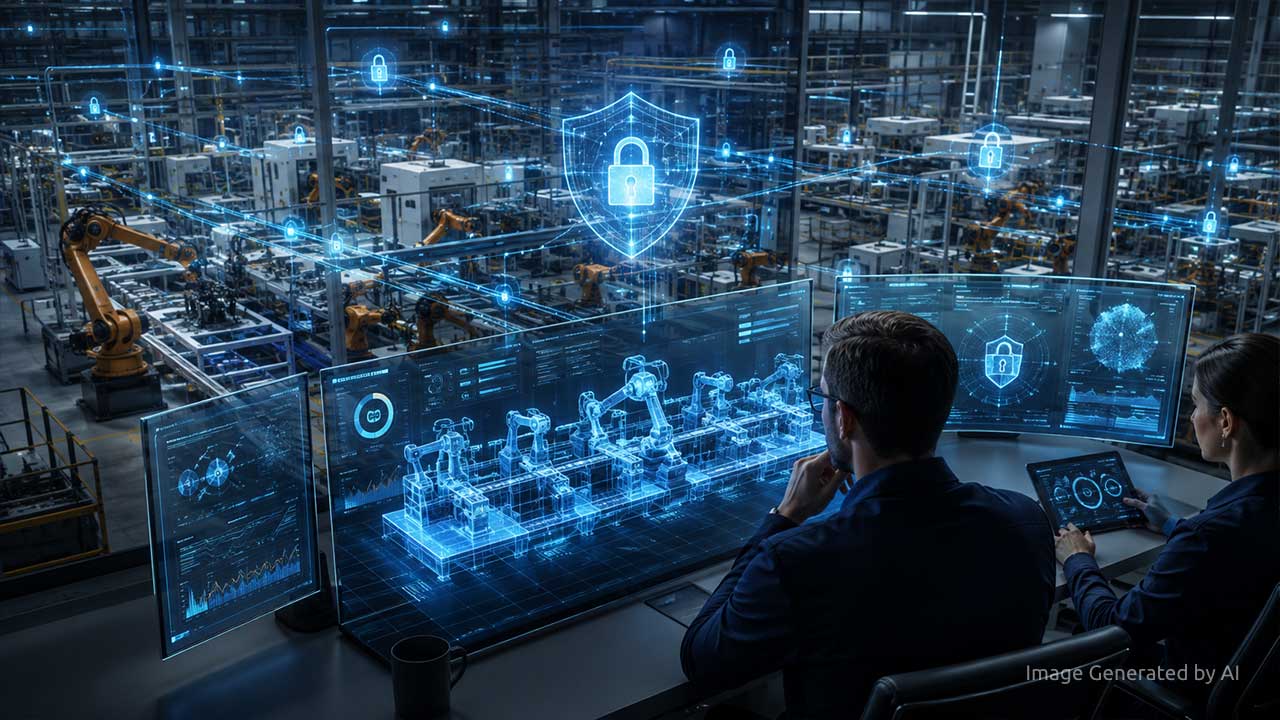
Cybersecurity is the binding constraint on remote industrial operations, the factor that determines whether the productivity and efficiency gains described above are achievable in practice or remain theoretical. Every remote access point to an industrial control system is a potential entry vector for attacks with physical-world consequences: equipment damage, environmental releases, production contamination, and worker safety incidents.
The threats are real and active. Manufacturing has been the most-attacked sector by ransomware for five consecutive years, accounting for 27.7% of all incidents. Ransomware against industrial organizations rose 64% in 2025, hitting approximately 3,300 organizations. 22% of organizations reported a cybersecurity incident in the past year, with 40% of those causing operational disruption. Only 14% of respondents feel fully prepared for emerging threats.
How Severe Is the OT Cybersecurity Skills Gap?
The cybersecurity challenge is compounded by a specialized skills gap that is even more acute than the general manufacturing workforce shortage. PwC’s 2026 Global Digital Trust Insights survey of 3,887 executives found:
- 47% cite lack of qualified personnel as the top challenge in securing OT/IIoT systems
- 40% report gaps in understanding the scope of OT/IIoT cyber risk
- 39% note a lack of governance for OT/IIoT cybersecurity
- 35% report insufficient visibility into their OT/IIoT assets
The SANS Institute’s 2026 report puts an even finer point on it: only 12% of cybersecurity specialists have substantial OT experience. The vast majority of cybersecurity professionals lack the domain knowledge to effectively secure the very systems that remote industrial operations depend on.
The organizational response has been rapid but incomplete. The share of organizations assigning CISO/CSO responsibility for OT security jumped from 16% in 2022 to 52% in 2025, and the North America OT cybersecurity market is projected to grow from $3.8 billion in 2025 to $9.04 billion by 2034. Solutions from Claroty, Nozomi Networks, and Dragos provide continuous OT network monitoring, while standards like ISA/IEC 62443 and the NIST Cybersecurity Framework offer governance frameworks.
Can OT Security Be a Competitive Advantage Rather Than a Barrier?
The most sophisticated industrial organizations are treating OT cybersecurity as the foundation that makes remote operations possible, not as a barrier to them. Network segmentation between IT and OT environments, zero-trust access policies with multi-factor authentication, OPC-UA (Open Platform Communications Unified Architecture) for secure interoperability across multi-vendor environments, and continuous monitoring create the trust layer that allows remote engineers to interact with production systems confidently.
Organizations that invest in OT security proactively gain a competitive advantage in remote operations capability. Those that treat security as an afterthought will find their remote operations blocked, either by actual incidents or by the justified reluctance of their security teams to grant remote access.
A summary of OT security maturity in 2026:
| OT Security Dimension | Current State | Target State |
| CISO/CSO responsibility for OT | 52% of orgs (up from 16% in 2022) | 100% accountability |
| OT asset visibility | 35% report insufficient visibility | Full asset inventory |
| Cyber specialists with OT experience | Only 12% have substantial OT background | Dedicated OT security teams |
| Incident preparedness | Only 14% feel fully prepared | ISA/IEC 62443 SL-2 baseline |
| Ransomware incidents (2025) | 64% YoY increase, ~3,300 orgs hit | Continuous OT monitoring |
Frequently Asked Questions
1. What ROI does predictive maintenance deliver for manufacturers?
Five-year ROI reaches 300-500% with 18-24 month payback. Plants achieve approximately $630,000 annual savings, 50% unplanned downtime reduction, 8-12% maintenance budget reduction, and 20-40% asset life extension, according to Ghost Research’s Smart Factory ROI Reality Check 2026.
2. How do digital twins enable remote engineers to manage industrial production?
Digital twins let engineers test configuration changes, simulate process modifications, and diagnose issues without touching physical assets. Over 40% of manufacturers are in the pilot phase, and 92% of digital twin implementations achieve ROI above 10%, according to MindInventory’s 2026 digital twin statistics.
3. What is the biggest cybersecurity risk of expanding remote industrial access?
Manufacturing has been the most-attacked sector by ransomware for five consecutive years, with incidents rising 64% in 2025 to hit approximately 3,300 organizations. Only 12% of cybersecurity specialists have substantial OT experience, per the SANS Institute’s 2026 cybersecurity skills crisis report.
4.How does AI transform remote industrial monitoring from reactive to predictive?
AI analyzes vibration, temperature, pressure, and power consumption patterns from IIoT sensors to predict equipment failures weeks or months before they occur. The 1.5x productivity multiplier for AI-equipped junior technicians means scarce expert knowledge is accessible even as senior operators retire.
Continue Reading: Part 3 of 4, The Human Costs, Regulatory Compliance, and the Workforce Transformation Playbook
Part 3 examines the psychological toll of remote industrial operations, alert fatigue, operator isolation, the mental health dimension technology vendors rarely discuss, plus regulatory frameworks (NERC CIP, ISA/IEC 62443, FDA 21 CFR Part 11) and step-by-step recommendations for plant managers and CIOs.
Sources
- f7i.ai – Industrial AI Statistics 2026: The Hard Data Behind Manufacturing’s Transformation
- Gallup – AI Usage at Work Crosses Landmark Threshold Q1 2026 (via Tom’s Hardware)
- HakunaMatata Tech – AI in Industrial Automation 2025
- Mordor Intelligence – Predictive Maintenance Market Size and Forecast 2025–2030
- Ghost Research – Smart Factory ROI Reality Check 2026
- MindInventory – Digital Twin Market Statistics 2026
- Research and Markets – Digital Twin in Manufacturing Market 2026
- Gartner – Manufacturing Predicts 2026: Digital Twins, AI Agents, and Autonomous Operations
- SANS Institute – OT Cybersecurity Incidents Rising: Ransomware and Remote Access Risks 2025 (via industrialcyber.co)
- SANS Institute – 2026 Cybersecurity Skills Crisis in OT and Critical Infrastructure (via industrialcyber.co)
- Rockwell Automation – Food and Beverage Manufacturer Increases Uptime and Security (2023)
- Augury – The Growth Trap: How Nestlé Purina’s Hartwell Facility Restored Reliability (March 2026)
- SmartRemoteGigs – Remote Work Statistics 2026
- Advanced Tech – IIoT Trends 2025
- Precedence Research – Industrial IoT Market Size and Forecast 2025–2034