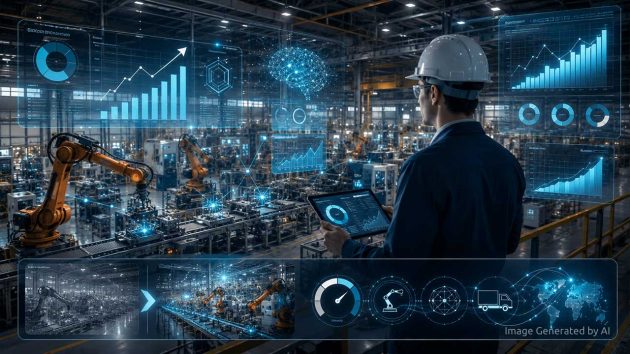
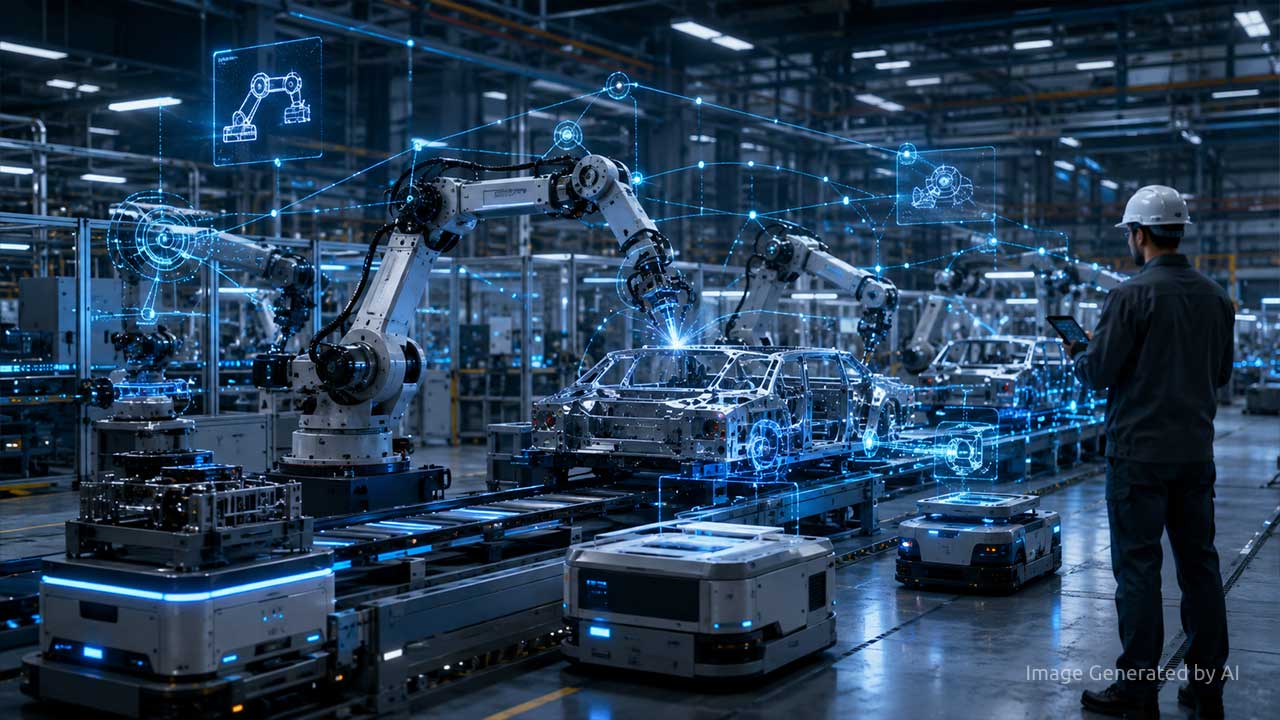
The ARC Advisory Group’s Industrial AI Pacesetter Report identifies a split in how manufacturers deploy artificial intelligence. Organizations classified as Pacesetters have moved beyond single-agent AI assistants and are deploying Collaborative Multi-Agent Systems where specialized AI agents communicate directly with one another. At the same time, ABB’s roadmap to autonomous operations defines six levels of industrial autonomy, from Level 0 (manual operations) to Level 5 (full autonomy). The convergence of agentic AI and Physical AI, which pushes intelligence to the industrial edge for real-time perception and action, maps the path from Level 2 (partial automation) to Level 4 (situational autonomy).
Automation vs Autonomous Operations
ABB’s technology roadmap draws a clear distinction between automation and autonomous operations. Automation performs tasks with minimal human intervention within precisely defined, rule-based instructions. Automated systems handle structured data effectively but require human intervention when anomalies occur outside pre-programmed parameters.
Autonomous operations use self-learning algorithms that enable systems to independently change behavior in response to unanticipated events. Autonomous systems process unstructured data, learn from experience, and calibrate real-time responses without human intervention. ABB maps this progression through a Taxonomy of Autonomy from Level 0 (manual operations) through Level 5 (full autonomy). The industrial objective is to move from Level 2 (partial automation) to Level 4 (situational autonomy), where systems handle most operational decisions independently.
Agentic AI in Manufacturing
Most organizations use single-agent AI, a copilot that provides alerts and advice while keeping the human as the executor. The ARC Pacesetter Report describes this stage as the “Augmentation Plateau.”
Agentic AI introduces Collaborative Multi-Agent Systems (Agent-to-Agent, or A2A). In production, manufacturers deploy specialized AI agents that communicate directly with one another: an anomaly detection agent perceives a vibration issue, a diagnostic agent reasons the root cause using physics-based models, and a control agent triggers a remediation workflow to adjust machine parameters in real time. The human worker shifts from operating machinery to supervising autonomous agents.
According to the ARC report, Pacesetters recognize that in high-speed, safety-critical environments, requiring manual human approval for every micro-adjustment introduces latency risk. Multi-agent AI removes that constraint. The report also notes that Pacesetters decouple their data from legacy hardware using an Industrial Data Fabric, allowing rapid AI agent orchestration across different systems and vendors.
Physical AI in Factories
Agentic AI operates in the digital domain. Manufacturing requires intelligence that can perceive, reason, and act in the physical world. Physical AI combines machine learning, computer vision, and robotics to create systems that adapt to real-world conditions rather than following fixed programs.
According to presentations at the ARC Industry Leadership Forum and AWS re:Invent 2025 Podcast Recap, three implementations define Physical AI in manufacturing today.
Running AI at the edge means executing inference models locally on industrial devices rather than sending data to cloud servers for processing. According to AWS, the round-trip latency to a cloud server is too high for real-time physical control. AWS Strands technology allows AI agents to run directly on industrial edge devices for autonomous actions at production speed.
In robotics, the Physical AI Fellowship, a collaboration between AWS, NVIDIA, and Mass Robotics, is accelerating intelligent robotics deployment. According to the ARC Industry Leadership Forum agenda, Boston Dynamics and Gecko Robotics deploy systems that use Physical AI to navigate complex terrains, perform hazardous inspections, and manipulate materials without being hard-coded for every movement.
Closed-loop optimization systems continuously ingest sensor data, run local inference models, and immediately adjust physical actuators, valves, or robotic arms. This creates self-optimizing production where the system adjusts yields and energy consumption based on real-time feedback rather than periodic human review.
FAQ
1. What is agentic AI in manufacturing?
Agentic AI in manufacturing refers to Collaborative Multi-Agent Systems (Agent-to-Agent, or A2A) where specialized AI agents communicate directly with one another. An anomaly detection agent perceives a problem, a diagnostic agent reasons the root cause using physics-based models, and a control agent triggers remediation in real time. The ARC Advisory Group’s Pacesetter Report identifies this as the next stage beyond single-agent copilots, shifting the human role from machine operator to supervisor of autonomous agents.
2. What is physical AI and how does it work in factories?
Physical AI is the convergence of machine learning, computer vision, and robotics that allows AI systems to perceive, reason, and act in the physical world. In factories, it works through three implementations: edge AI that runs inference models locally on industrial devices for real-time control, intelligent robotics (such as Boston Dynamics and Gecko Robotics systems) that navigate and manipulate without hard-coded instructions, and closed-loop optimization that continuously adjusts actuators and valves based on real-time sensor feedback.
3. What is the difference between automation and autonomous operations?
According to ABB’s roadmap to autonomous operations, automation performs tasks within precisely defined, rule-based instructions and requires human intervention for anomalies outside pre-programmed parameters. Autonomous operations use self-learning algorithms that independently change system behavior in response to unanticipated events. ABB maps this progression through a Taxonomy of Autonomy from Level 0 (manual) to Level 5 (full autonomy), with the current industrial objective being the transition from Level 2 (partial automation) to Level 4 (situational autonomy).
Related from IIoT World
- How Agentic AI Changes Factory Data Requirements
- Neura Robotics CEO: Physical AI for 101M Worker Shortage
- Humanoid Robots Built 30,000 BMWs. Here’s the ROI
Sources
- ARC Pacesetter Report: Industrial Artificial Intelligence (January 2026), ARC Advisory Group, Colin Masson, Marianne D’Aquila
- The Roadmap to Autonomous Operations (Whitepaper), ABB Energy Industries Division
- AWS re:Invent 2025 Podcast Recap: 7 Strategic Takeaways, ARC Advisory Group, Steve Blackwell (Product Engineering and Services Lead, AWS), Colin Masson (Director of Research for Industrial AI, ARC)
- ARC Industry Leadership Forum Agenda 2026, Chad Wright (CIO, Boston Dynamics), Rumsey Hamid (Oil and Gas Industry Advisor, Gecko Robotics), Siemens
AI tools were used to help summarize and organize the content. Reviewed and edited by the IIoT World editorial team.