
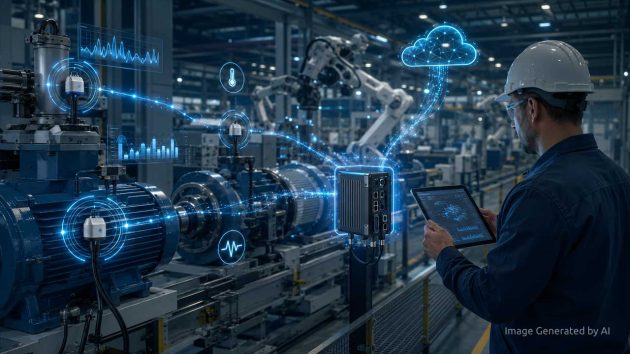
Manufacturing AI deployments often fail when all intelligence sits in a single layer, either pushed entirely to the cloud or crammed into the sensor level. Intelligence needs to sit where it can operate reliably, respond in time, and remain secure. During a panel at IIoT World’s AI Manufacturing Day 2026, experts from TDK SensEI, AWS, Omron Automation, and Acerta mapped out a four-layer architecture that matches different types of AI processing to the physical location best suited for each.
How AI Runs Across Four Factory Layers
Each layer in a factory’s compute stack serves a distinct function, and conflating them leads to architecture decisions that either sacrifice speed or waste bandwidth.
Sensors and I/O handle high-fidelity signal capture. Protocols like IO-Link are expanding the range of data that sensors can deliver beyond a simple on/off reading. Temperature curves, vibration spectra, pressure profiles, all captured at the point of measurement with enough resolution to feed meaningful analysis. Some sensor platforms now run AI models on the device itself, processing data at the machine without sending it upstream.
“At TDK SensEI, we do run AI models on the sensor, on the machine, so it’s very machine specific,” said Sundeep Ahluwalia, Chief Product Officer at TDK SensEI. That approach eliminates latency for machine-level decisions and reduces the volume of raw data that needs to travel across the network.
Controllers, whether single-core or multi-core sharing memory, provide deterministic control. They respond within milliseconds, which is essential for safety-critical operations and real-time process adjustments. The logic at this level tends to be basic, threshold comparisons, state changes, but the speed is unmatched. When a sensor detects a condition that requires immediate action, the controller executes it without waiting for upstream systems to process the signal.
Gateways and industrial PCs sit between the plant floor and the cloud. They handle more advanced edge analytics: anomaly detection, data enrichment, and context tagging. A PLC controlling a motor may generate thousands of tag updates per second. Sending all of that to the cloud fills storage without adding insight. Edge gateways can filter, compress, and enrich that data so that what reaches the cloud carries operational context rather than raw volume.
The cloud provides fleet-level learning, model management, and enterprise visibility. Training a predictive maintenance model requires compute resources that would be expensive to maintain on-premises. Cloud infrastructure offers on-demand compute and low-cost storage suited to model training, validation, and deployment across multiple sites. Once a model is trained and validated, it can be deployed back down to the edge for inference at individual plants.
Why Manufacturing Data Lakes Fail Without Edge Filtering
Collecting everything and analyzing nothing undermines a predictive maintenance program faster than any technical limitation. A motor controlled by a PLC may produce thousands of tag updates per second. Ingesting all of that into a cloud data lake without filtering creates what one panelist described as a data swamp: a repository so large and undifferentiated that building useful models from it becomes impractical.
Edge intelligence that decides what data is worth sending upstream addresses this. Once a deployment has moved past the initial investigation phase, the edge layer should identify edge cases, the data patterns the system has not seen before, and send those selectively. Standard operating data from a well-understood process does not need to occupy cloud storage indefinitely.
This is especially relevant in facilities that run multiple products, SKUs, or materials on the same line. A set of parameters trained on one product may have different upper and lower limits than the same parameters for a different product running on the same equipment. Edge intelligence that tags data with production context, which product was running, which recipe was active, which shift was operating, transforms raw readings into information that models can actually use.
Edge AI Deployment in Brownfield Factories
Most manufacturing facilities were not built with modern data volumes in mind. Factories constructed in the 1980s and 1990s have network infrastructure designed for basic PLC communications, not for streaming high-resolution sensor data to cloud endpoints. Any edge AI deployment in a brownfield facility needs to account for the bandwidth limitations of the existing network, or the maintenance cost savings that justified the project will be offset by network disruptions.
Compressing data at the edge before transmitting it is one approach. Running inference locally and sending only results and exceptions is another. The architectural question involves both where intelligence delivers the most value and where the physical infrastructure can support it without disrupting production communications already running on that same network.
Facilities planning edge AI deployments should inventory their network capacity alongside their sensor and data requirements. A deployment that saturates the factory network creates a different kind of downtime, one that is harder to diagnose and equally expensive.
This article is based on a panel discussion at IIoT World’s AI Manufacturing Day 2026, sponsored by TDK SensEI. Thank you to the panelists: Sundeep Ahluwalia, Chief Product Officer, TDK SensEI; Steve Blackwell, Head of Product Engineering & Services Center of Excellence, AWS; Thomas Kuckhoff, Sr. Product Manager, Omron Automation Americas; and Greta Cutulenco, Founder and CEO, Acerta. This session was moderated by John DiPaola. AI tools were used to help summarize and organize the content. Reviewed and edited by the IIoT World editorial team.
Sponsored by TDK SensEI. Editorially independent.
FAQ
1. How is AI being used in manufacturing operations?
AI in manufacturing operations spans multiple layers. At the sensor level, AI models run on devices to detect anomalies in vibration, temperature, or pressure without network latency. At the edge, gateways enrich data with production context and filter noise before it reaches cloud storage. In the cloud, fleet-level models train on data from multiple sites and deploy back to individual plants for local inference. Each layer addresses different speed, security, and compute requirements.
2. How does AI reduce unplanned downtime in manufacturing?
AI reduces unplanned downtime by placing detection intelligence as close to the equipment as possible. Sensor-level AI identifies anomalies the moment they appear. Edge analytics add production context so the alert includes what product was running and what operating conditions were active. Cloud-trained models improve over time as they learn from failure patterns across multiple sites and deploy updated models back to the edge for faster local detection.
3. Should manufacturing AI run at the edge or in the cloud?
Manufacturing AI needs both. Sensors and edge gateways handle real-time detection and data enrichment where latency matters and bandwidth is limited. The cloud handles model training, fleet-level learning, and enterprise visibility where compute scale is needed. Placing all intelligence in one layer either sacrifices response speed or wastes network bandwidth, particularly in brownfield facilities built before modern data volumes were anticipated.