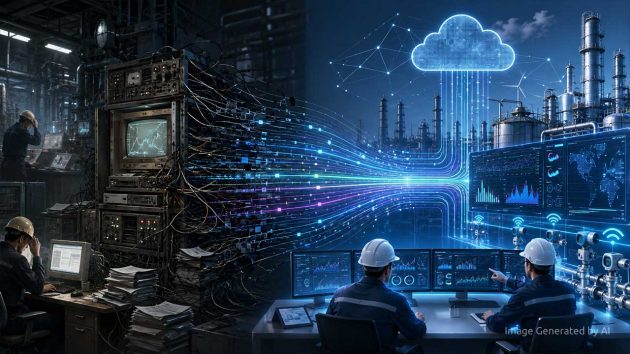
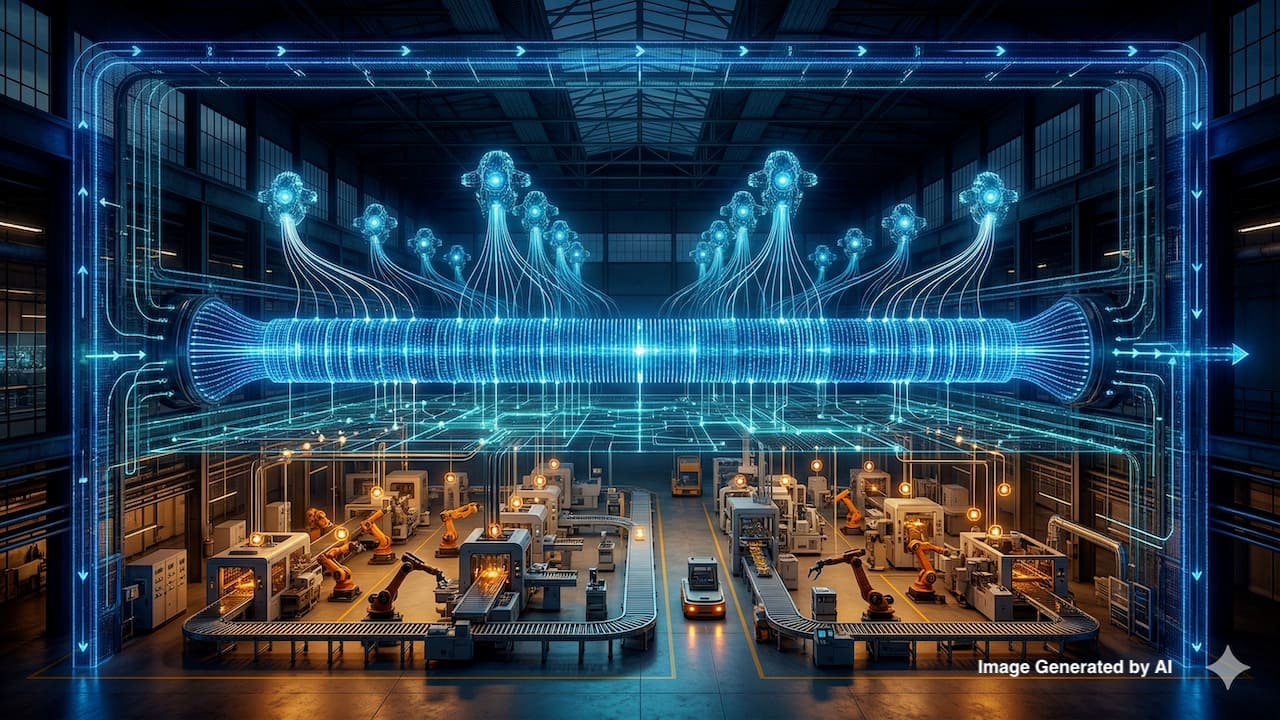
Manufacturing has shifted into a phase of scaled execution. Today, leaders build autonomous systems that contextualize, secure, and act on data in real time. Based on insights from industry leaders at previous editions of IIoT World Days or events/presentations we attended, the following technologies define the 2026 tech stack for industrial excellence.
1. Agentic AI: Autonomous Problem Solving
The industry now prioritizes Agentic AI over passive chatbots.
- What it is: An autonomous loop that observes, reasons, and acts without human intervention.
- What it does: It monitors data streams constantly to perform root cause analysis on downtime events. It uses the Model Context Protocol (MCP) to connect securely to PLCs and databases, ensuring every action relies on live technical context.
- Why it matters: It shifts the factory from human-led responses to self-healing operations by adjusting machine setpoints to prevent imminent failures.
2. The Unified Namespace (UNS) and MQTT
Modern factories utilize a Unified Namespace (UNS) architecture to replace rigid integrations.
- What it is: A centralized, event-driven data structure that acts as a single source of truth for the entire enterprise.
- What it does: It uses the MQTT protocol to allow every device to publish data with full context. Applications like MES or AI models subscribe to this data without disrupting the production network.
- Why it matters: This architecture reduces integration costs and allows teams to scale new digital tools in hours instead of weeks.
3. Software-Defined Automation (SDA)
Proprietary hardware lock-in is being replaced by open, Software-Defined Automation.
- What it is: A system that separates control logic from physical hardware through virtualization and containerization.
- What it does: It allows engineers to write control applications once and deploy them on any industrial PC or edge device. It follows the Open Process Automation Standard (O-PAS) to create a plug-and-produce environment.
- Why it matters: It ensures long-term agility by allowing software updates to happen independently of hardware lifecycles.
4. Industrial DataOps and Edge Computing
Reliable AI requires “data readiness,” which is achieved through Industrial DataOps.
- What it is: A middleware layer that sits at the edge of the network.
- What it does: It normalizes raw signals into structured asset models before the data leaves the facility. It filters high-frequency data locally to reduce cloud storage costs.
- Why it matters: It guarantees that AI models receive accurate, governed data while maintaining ultra-low latency for critical safety controls.
5. Advanced OT Cybersecurity: Zero Trust and Diodes
Converged IT and OT networks require hardened, physical-layer security.
- What it is: A multi-layered defense strategy consisting of Hardware Data Diodes and Microsegmentation.
- What it does: Data diodes enforce a strictly one-way flow, allowing performance data to reach the cloud while making it physically impossible for external attacks to reach the controllers. Next-Generation Firewalls (NGFW) isolate machine cells to prevent threats from moving laterally.
- Why it matters: It protects critical infrastructure from ransomware and targeted attacks without sacrificing the connectivity needed for AI systems..
Note on Information Synthesis: We used AI tools to analyze, summarize, and extract the key data points required to build this technical overview.
Sources Used
- Agentic AI & MCP: Protocol Spotlight: How to Use MCP to Power Your Agentic AI Strategy (IIoT World).
- UNS & MQTT: The Connected Factory: Driving Real-Time Insights with OT Data and the UNS (IIoT World).
- SDA & O-PAS: Redefining Automation: A Guide to Open, Software-Defined Automation (Schneider Electric).
- DataOps: Building Data Infrastructure for Predictive Operations (IIoT World).
- Cybersecurity: Securing OT with Network Microsegmentation (Fortinet) and Platform Capability: Complete Asset Visibility (Galvanick).
- Predictive Maintenance: Structural Performance Management Conference Booklet (Akselos).
Frequently Asked Questions (FAQ)
1. What defines Agentic AI in a production environment?
Agentic AI functions as an active operator. It perceives anomalies and triggers remediation workflows autonomously based on predefined operational goals.
2. How does MQTT improve factory connectivity?
MQTT is a lightweight publish-subscribe protocol. It moves massive data volumes from the edge to the cloud efficiently, even over restricted or unstable industrial networks.
3. What is a Digital Twin 2.0?
This is a predictive ecosystem model. It combines real-time IoT telemetry with physics-based AI to simulate how a facility behaves under stress, allowing for safe supply chain and energy optimization
About the author