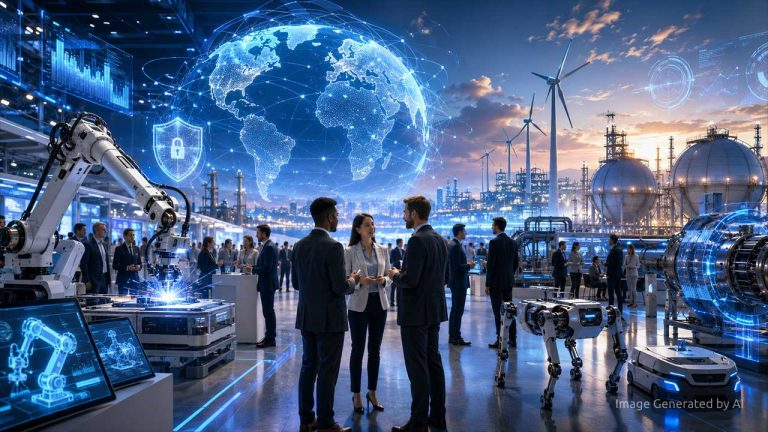
As manufacturing moves deeper into digital transformation, 2026 marks a turning point: the shift from generic productivity AI toward industrially trained intelligence embedded directly into operations. Manufacturers are no longer experimenting with chat-style tools—they are building AI systems grounded in plant data, engineering context, and real-world workflows. The result is a new operating model where human expertise, digital workers, and physical AI operate as an orchestrated system. This shift brings several strategic areas into sharp focus for 2026:
- The rise of industrially trained AI models
The next wave of competitive advantage will come from AI models trained on operational, engineering, and equipment data—not public internet datasets. These systems understand maintenance taxonomies, asset hierarchies, control logic, and production constraints, enabling them to support high-stakes, real-time decisions. Unlike consumer-grade chatbots, industrial copilots draw on equipment manuals, quality logs, shift reports, and historical fault data, ensuring context, relevance, and security.
This shift aligns closely with what vendors like Infor are hearing from their customers. Manufacturers increasingly value industry-specific solutions because they do not want to bend their processes to fit a one-size-fits-all, monolithic ERP. Instead, they expect systems—AI included—that are already tailored to the unique requirements and best practices of their industry. The same logic applies to AI: rather than generic, general-purpose models, customers are gravitating toward industry AI agents that speak their language, understand their business processes, and operate seamlessly within existing workflows.
Looking ahead to 2026, these domain-specific AI engines are poised to become core infrastructure for scenario planning, dynamic scheduling, and closed-loop optimization.
- Copilots vs. AI agents: Trust still favors augmentation
Manufacturers are enthusiastic about AI—but not fully autonomous workflows. A 2024–2025 Rootstock Software survey shows:
- 53% prefer copilots that assist workers
- 22% favor autonomous AI agents
- 25% are unsure of the difference
This split highlights the early maturity of industrial AI adoption. Progress in 2026 will depend as much on education, governance, and workforce integration as on technology itself.
- The new operating Model: “No process without AI”
As one OEM board member put it: “No process without AI.”
This mindset reflects where many manufacturers are heading:
- AI copilots elevate junior technicians to near-expert performance
- Digital workers automate judgment-heavy service and maintenance tasks
- Physical AI (advanced robotics, reasoning-enabled AMRs, adaptive automation) brings autonomy onto the shop floor
For example, vendors such as ANYbotics and Boston Dynamics are automating routine inspections. At IFS Industrial X Unleashed, Boston Dynamics demonstrated this convergence in action: autonomous robots capable of interpreting context, detecting anomalies, and capturing operational insights. Spot’s thermal imaging, leak detection, and gauge-reading workflows showed how physical AI is evolving into an embedded layer of industrial intelligence.
IT service providers are at the forefront of this endeavour, connecting the dots between solutions, users, and stakeholders. Trask’s experience working with a global manufacturer shows that embedding business value into a highly complex IT landscape—spanning dozens of ERP systems, manufacturing execution systems, and PLM platforms—requires a deep understanding of user needs across departments, combined with the delivery of modern data architecture at every touchpoint.
- Human-in-the-loop evolves: From manual checks to strategic oversight
As AI grows more embedded in operations, human roles are shifting. Human-in-the-loop (HITL) approaches, while essential for trust and reliability, introduce overhead and decision delays, particularly in real-time, unlabeled data environments. Dynatrace’s State of Observability 2025 report confirms:
- 69% of AI-driven decisions are still verified by humans
- 99% of AI governance leaders monitor AI decisions manually
In 2026, HITL is evolving from constant manual verification to strategic oversight—humans focus on thresholds, exceptions, and escalation paths rather than approving every decision. This is critical to scaling agentic AI without creating operational bottlenecks.
- AI & Data Governance Becomes Mission-Critical
As agentic AI and autonomous workflows proliferate, governance becomes increasingly important. Without robust data quality, traceability, security, and compliance measures, the risks of errors or unintended consequences grow. Gartner predicts that most AI projects through 2027 will fail to meet expectations due to inadequate data governance.
In 2026, organizations must invest in AI-ready data foundations, unifying plant, engineering, and enterprise data; enforcing standards and lineage; and implementing transparent oversight mechanisms. Trustworthy AI requires infrastructure, not just models.
- Lessons from the leaders: Hyundai’s fully AI-optimized plant
Hyundai Motor Group’s Metaplant America (opened 2025) stands as a preview of the industrial AI future:
- End-to-end AI optimization from order intake to production
- Real-time anomaly detection with automated corrective actions
- Unified industrial data pipelines across all manufacturing stages
Facilities like this will shift from being exceptional to becoming benchmarks for competitiveness in 2026 and beyond.
- Rethinking AI’s value: From productivity to better decisions
Executive expectations for AI are shifting from hours saved to strategic impact:
- Gartner (2025): AI offers ~5.7 hours saved per employee per week, but only 1.7 hours translate into higher-value work
- Microsoft (2025): Only 34% of CEOs expect GenAI to boost productivity; 43% prioritize better decision-making
This maturity shift emphasizes AI as a tool for informed decisions, anomaly prevention, and process optimization, not just task automation.
According to Boris Scharinger, Siemens Digital Industries, task-based optimization—typically using commercially available AI tools—differs from what he calls “Business Process Reengineering 2.0,” where organizations fully examine their digital threads and redefine workflows from the ground up with AI support. Industrial leaders will truly grasp the transformative power of agentic AI only when they dare to redesign their processes end to end.
Closing note: 2026 as the inflection point(?)
Industrial AI has moved from experiment to structural capability. The convergence of industrially trained models, AI copilots, physical AI, human oversight, and robust data governance is transforming manufacturing into a resilient, intelligence-driven ecosystem. Organizations that embed AI into infrastructure, iterate rapidly, govern thoughtfully, and redefine human roles for strategic oversight will define competitive advantage in the coming decade. 2026 is the year when industrial AI stops being optional and becomes a core determinant of operational excellence, innovation, and sustainable growth.
About the author
 This article was written by Jan Burian, a global manufacturing industry analyst, serves as the Head of Industry Insights at Trask. His expertise spans digital transformation, management, leadership, and the geopolitical influences shaping manufacturing and global supply chains.