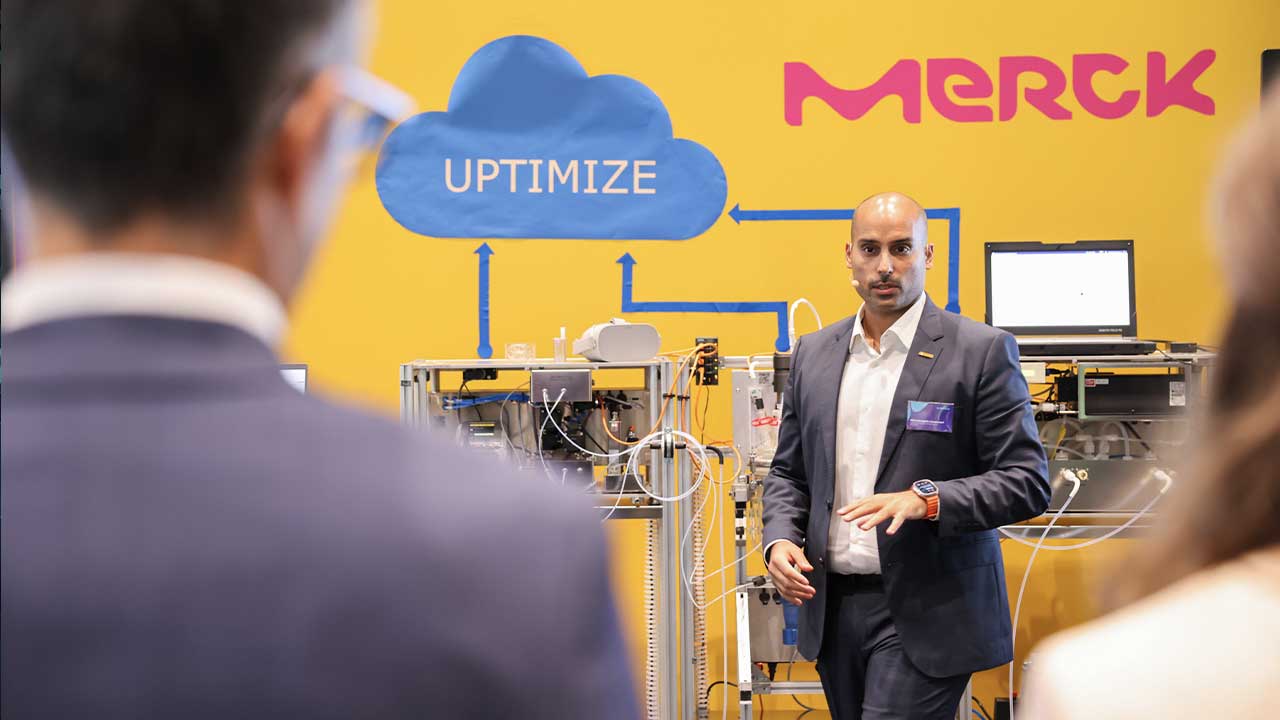
An in depth conversation with Michelangelo Canzoneri, Global Head of Group Smart Manufacturing at Merck KGaA, Darmstadt, Germany
Interview by Jan Burian
Headquartered in Darmstadt, Germany, Merck employs around 65,000 people in 66 countries, contributing to both the national and global industrial landscape. Its three business sectors, Healthcare, Life Science and Electronics, span complex operations that include developing medicines for patients, providing products for biotech and pharmaceutical research and manufacturing specialty materials for advanced high-tech applications.
For a company of this scale and diversity, manufacturing is never one size fits all. Different sites, product categories and regulatory environments present unique challenges. Yet Merck is driving a clear agenda to make operations more agile, intelligent and human centered. To explore how, we spoke with Michelangelo Canzoneri, Global Head of Group Smart Manufacturing and professor at Frankfurt University of Applied Sciences.
Canzoneri leads Merck’s SMARTfacturing program, the company’s evolution toward advanced operations driven by colleagues worldwide and enabled by data, digital, automation, AI and other advanced technologies. As he explains, the transformation is about people, culture, processes, and governance, enabled by data and technologies.
From traditional MANUfacturing to SMARTfacturing
Jan: Michelangelo, can you start by explaining your role at Merck? How do you approach the challenge of shaping operations across such a complex organization?
Michelangelo: I lead Group Smart Manufacturing. Together with colleagues across operations, supply chain, quality, IT, procurement, finance, HR and legal and with our site teams we steer the transformation across all business sectors.
Our cross functional teams focus on four areas:
- Manufacturing Excellence by Design
We embed digital and data from development to commercial scale and back. Focus on faster tech transfer, model-based process design, digital twins and Process Analytical Technology. In plants we scale for example predictive maintenance, modular equipment, digital daily management, electronic batch records, electronic logbooks and digital visual inspection support. - Supply Chain Intelligence
We create end to end visibility and decision support from planning to fulfillment. Capabilities include Advanced Planning and Scheduling, integrated planning and forecasting, inventory and logistics, a control tower with track and trace and scenario simulation to raise service, resilience and an optimal sustainability footprint at the right cost. - IT and OT convergence
We connect shopfloor and enterprise systems with secure, scalable architectures. Priorities are standard data and interfaces, historian and MES harmonization, edge to cloud connectivity and built in cybersecurity so solutions can be reused and scaled across sites. - Workforce Readiness
We focus on how we work every day. People learn by doing with role-based training, practice spaces and coaching. Local champions support teams and managers remove blockers and recognize progress. We keep tools simple and make it easy to find help. We track adoption and results to scale what works.
The industry challenges driving change
Jan: What challenges are shaping production at Merck today and across the pharmaceutical and process industries?
Michelangelo: Our teams navigate external and internal pressures that interact and shape daily decisions. Geopolitical instability can disrupt supply chains and demand patterns. Customers face their own uncertainties which cascade back into our planning.
Cost pressure continues. Raw materials and energy require careful management while safeguarding quality. Speed matters. Customers expect faster access to materials. We manage about 320,000 products across Healthcare, Life Science and Electronics, so we focus on agility to meet demand quickly and reliably.
Compliance and quality remain non-negotiable. We use advanced analytics and AI where appropriate and validated, with people accountable for decisions and controls aligned to regulation.
Sustainability is equally important. Green manufacturing is a commitment. We need granular data to track energy, resources and carbon footprint across production. IoT, cloud & edge analytics and AI enable this when systems are interconnected, transparent and scalable.
Resilience and adaptability sit at the core. Without them, even advanced technologies do not create lasting value.
Defining innovation in manufacturing
Jan: How does Merck approach innovation in smart manufacturing, especially in chemical processes that are different from traditional assembly lines?
Michelangelo: Our innovation approach combines incremental improvements at sites with selective step changes where digital twins, predictive analytics and generative AI add clear business value.
- Incremental innovation starts at sites. Across more than one hundred global sites, processes differ yet lessons travel. Productivity, maintenance and efficiency improve first through better data access and transparency. Small steps create immediate benefits.
- Transformative innovation goes further. With digital twins, predictive analytics and generative AI we redesign processes, reduce trial and error and make decisions that were not possible before. This requires experimentation and a culture that learns fast.
We combine quick wins with long term transformation. Otherwise, you risk pilot purgatory where experiments never scale.
Governance: from pilot to scale
Jan: Scaling innovation is often the hardest part. How does Merck avoid being trapped in pilots that never expand?
Michelangelo: Global leadership sets direction and priorities while cross sector workstreams and site teams define needs and opportunities, confirm cross sector applicability and agree on roadmaps and team setups. This ensures that pilots are designed for scale and measured on value.
Collaboration across the ecosystem
Jan: What role do startups, niche providers and system integrators play?
Michelangelo: Strategic partners provide scale and reliability. Startups and niche providers bring agility and fresh ideas. System integrators accelerate delivery so our teams can focus on outcomes for patients and customers.
People at the core
Jan: Transformation is about technology, but people are at the center. How do employees adapt?
Michelangelo: People drive transformation. Technology enables and amplifies their impact when we use it with confidence.
- Hands on experiences: Mobile demo units, sandboxes and pilots make concepts like predictive maintenance or digital twins tangible.
• Targeted training: Virtual, in person and hybrid formats address role specific needs.
• Continuous dialogue: We listen to pain points and show how technology solves real problems.
Leaders learn alongside teams and take the training relevant to their roles to align expectations with operational realities and to support foundational investments at scale.
Global insights
Jan: Are there regional differences in adoption and innovation?
Michelangelo: Each region brings strengths and lessons. We listen and build together with local teams and customers, then share what works through communities of practice, rotations and joint reviews. We scale proven approaches in a common playbook while leaving space for local excellence. This turns regional differences into shared advantage and strengthens our sense of belonging as one global team.
Final thoughts: the human centered future
Jan: If you could give one recommendation to manufacturing leaders embracing digital transformation, what would it be?
Michelangelo: Lead inclusively and keep people at the center. Use technology to enable impact. Treat transformation as a journey. Move from talk to action with focused pilots and rapid learning. Aim not for perfection but for continuous and efficient learning, then scale through standards and collaboration with partners. Encourage experiments, celebrate progress and learn from setbacks. Bring operations, IT, finance, HR, legal and procurement together for durable alignment.
Merck’s approach to SMARTfacturing shows that the future of manufacturing is intelligent and human centered. By integrating technology, governance and workforce development, our teams are building resilient and adaptive operations that create value for patients and customers worldwide.