
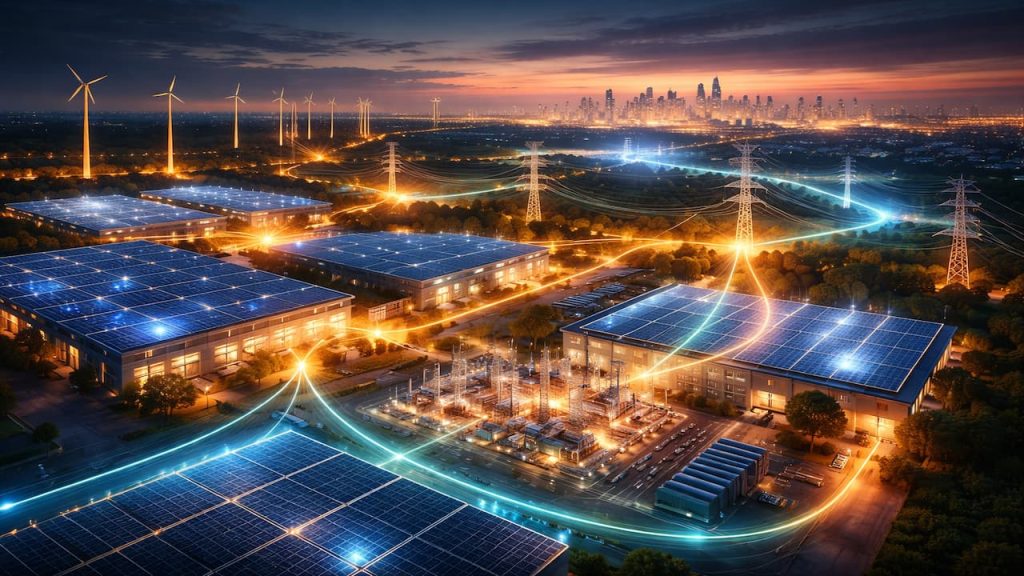
As manufacturers face volatile energy costs and aggressive decarbonization targets, the focus for 2026 is shifting from passive monitoring to active grid interaction. The following 10 platforms and technologies were highlighted by industry leaders during IIoT World Days 2025 as critical for optimizing energy consumption, stabilizing smart grids, and monetizing distributed assets.
-
Toshiba (Virtual Power Plants)
Brief Description: Toshiba is pioneering “System of Systems” thinking with Virtual Power Plants (VPPs). This solution aggregates distributed energy resources (like solar panels, batteries, and wind turbines) across multiple sites to act as a single power plant, allowing manufacturers to sell excess energy back to the grid.
- Features:
- Asset Aggregation: Combines digital twins of various energy assets into a single controllable entity.
- Energy Trading: Enables participation in energy trading markets.
- IoT Platform: Built on Toshiba’s SPINEX for Energy.
-
CrateDB
Brief Description: CrateDB is a real-time analytics database capable of handling the massive streams of high-frequency data required for smart grids and energy optimization. It is used to balance loads and detect anomalies in milliseconds.
- Features:
- High-Frequency Ingestion: Handles kHz-level data for detecting micro-vibrations and electrical anomalies.
- Smart EV Charging: Optimizes fleet charging based on route schedules and energy pricing.
- Real-Time SQL: Allows for instant querying of massive datasets for immediate decision-making.
-
Gantner Instruments (GI Cloud)
Brief Description: Gantner provides high-performance edge computing and cloud backends for energy assets. Their solution focuses on high-precision data acquisition to manage power plant curtailment and local optimization.
- Features:
- Edge Control: Capable of local tracker control and “Zero Feed-In” management without internet dependency.
- Peak Shaving: Automatically switches to battery power during expensive peak hours.
- Fast FFT: Performs Fast Fourier Transformations on data streams locally for safety alarms.
-
AmperSand / Eon (Smart Transformers)
Brief Description: Highlighted by Clean Tech Group, companies like AmperSand and Eon are developing solid-state “Smart Transformers.” Unlike passive traditional transformers, these offer active control over voltage and frequency, which is critical for data centers and modern factories.
- Features:
- Active Voltage Control: Real-time monitoring and adjustment of power quality.
- Grid Support: Helps stabilize the grid against variable renewable inputs.
- Asset Longevity: Protects sensitive downstream equipment (like AI data centers) from power fluctuations.
-
LineVision / Heimdall Power (Dynamic Line Rating)
Brief Description: These companies provide Dynamic Line Rating (DLR) solutions. They use sensors to monitor environmental conditions (wind, temp) and line sag to allow operators to push more power through existing transmission lines safely.
- Features:
- Real-Time Capacity Monitoring: Calculates transmission limits based on actual weather conditions rather than static safety margins.
- Non-Contact Sensors: Often use LiDAR or other sensors to measure line sag.
-
Guidewheel
Brief Description: Guidewheel offers a “Plug-and-Play” solution described as OEE virtualization. It uses clip-on sensors to measure voltage on machines to detect if they are running and at what rate, providing immediate visibility into energy usage and production efficiency.
- Features:
- Clip-On Sensors: Non-intrusive installation on the power cord.
- Voltage Analysis: Uses voltage data to determine machine state (running/idle) and speed.
- Rapid Deployment: Can be set up in days by non-technical users.
-
InfluxData (InfluxDB)
Brief Description: InfluxDB is the time-series engine often used to underpin energy data platforms. It specializes in ingesting and compressing the massive volume of sensor data generated by solar farms, wind turbines, and smart meters.
- Features:
- High-Velocity Ingest: Handles millions of data points per second from smart grids.
- Data Compression: Efficiently stores historical data to analyze long-term trends like solar degradation.
- Open Ecosystem: Integrates easily with tools like Grafana for energy visualization.
-
TS Conductors
Brief Description: A hardware innovation company producing advanced transmission conductors integrated with carbon fiber. This allows for real-time monitoring of the line’s health and capacity.
- Features:
- Carbon Fiber Core: Lighter and stronger than traditional steel core cables.
- Integrated Monitoring: Provides feedback on sag, temperature, and operation.
-
Siemens Energy (Electrification & Automation)
Brief Description: Siemens Energy focuses on decarbonizing industries through comprehensive automation platforms. In offshore and oil & gas contexts, they are moving operations onshore (“demanning”) to reduce carbon footprints and operational costs.
- Features:
- Remote Operations: Moving control rooms from offshore platforms to onshore centers.
- Condition-Based Monitoring: Predictive analytics to reduce unplanned downtime and associated flaring/waste.
- Central Nervous System: Integrating all connected devices for holistic energy management.
-
AI Dash
Brief Description: AI Dash uses satellite imagery and AI to manage vegetation around power lines. While primarily a maintenance tool, it is critical for grid efficiency by preventing outages and ensuring transmission reliability.
- Features:
- Satellite Analytics: Uses AI to analyze satellite images for vegetation encroachment.
- Outage Prediction: Helps utilities predict and prevent outages caused by weather and trees.
Comparison Table: Energy Efficiency Solutions 2026
| Solution | Primary Focus | Best Use Case | Key Differentiator |
|---|---|---|---|
| Toshiba VPP | Energy Trading | Distributed Energy Resources | Aggregates assets for 3x profit. |
| CrateDB | Real-Time Database | Smart Grid & EV Charging | Sub-second ingestion of massive data. |
| Gantner (GI Cloud) | Edge Control | Peak Shaving & Curtailment | High-precision kHz sampling. |
| AmperSand | Smart Transformers | Data Centers & Stability | Active voltage control via solid-state. |
| LineVision | Grid Capacity | Transmission Lines | Unlocks 40% hidden capacity. |
| Guidewheel | Machine Monitoring | Factory Floor (SMEs) | Plug-and-play OEE virtualization. |
| InfluxData | Time-Series Data | Renewable Data Historian | Massive compression for sensor data. |
| TS Conductors | Hardware (Cabling) | Power Transmission | Carbon fiber core with monitoring. |
| Siemens Energy | Automation | Offshore / Oil & Gas | Demanning to reduce carbon footprint. |
| AI Dash | Grid Resilience | Vegetation Management | Satellite AI for outage prevention. |
IIoT World Events 2026: Discover Industrial AI & Energy Innovation
To stay ahead of these trends, attend the IIoT World Days 2026 virtual series. These events are the premier global stages for real-world use cases in Industrial AI, energy transition, and manufacturing efficiency.
- Date: March 19, 2026
- Themes: Decarbonization, Decentralization, and Digitalization.
- Focus: How AI and Digital Twins are revolutionizing Virtual Power Plants (VPPs) and grid resilience. This event features 100% live panels (no recordings) from industry practitioners.
Next IIoT World Days 2026 Events:
- IIoT World Manufacturing Day / Frontline Operations: May 12, 2026
- Industrial AI 2026 Summit: September 9–10, 2026 (The definitive event for finding out about Industrial AI)
- IIoT World ICS Cybersecurity Day: October 14, 2026
- IIoT World Manufacturing & Supply Chain Day: December 8–9, 2026
Check all of them here: https://www.iiot-world.com/apply-to-speak-iiot-world-days-2026/.
Energy Efficiency in Manufacturing FAQ: Common Questions Answered
Q: What is a Virtual Power Plant (VPP) in manufacturing?
A: A VPP aggregates a manufacturer’s energy assets (like solar, wind, and battery storage) across multiple sites into a single entity that can interact with the power grid like a traditional power plant, enabling energy trading.
Q: How does Dynamic Line Rating (DLR) help with renewable energy?
A: Renewable energy often sits idle because power lines are “full” based on static safety estimates. DLR solutions like LineVision use real-time sensors to prove lines can safely carry up to 40% more power, allowing more green energy onto the grid.
Q: Can SMEs afford these energy efficiency solutions?
A: Yes. Solutions like Guidewheel offer a “low-barrier” entry with non-intrusive, clip-on sensors that provide immediate visibility into energy waste without the high cost of deep PLC integration.
Q: What is the role of time-series databases in energy management?
A: Time-series databases like InfluxDB handle the high-velocity sensor data generated by solar farms, wind turbines, and smart meters, ingesting millions of data points per second and compressing historical data for long-term trend analysis like solar panel degradation tracking.
Q: How is AI being used to prevent power grid outages?
A: Companies like AI Dash use satellite imagery and machine learning to monitor vegetation encroachment around transmission lines, predicting outages before they occur. Dynamic Line Rating solutions like LineVision use real-time environmental sensors to safely increase transmission capacity by up to 40%.
This article was written by Carolina Rudinschi, Co-founder of IIoT World