Over half of U.S. CPG manufacturers have deployed AI across multiple sites, nearly double the global average, and 99% are confident it will deliver ROI by 2030. They also lose 20% of revenue to production inefficiencies, roughly five percentage points worse than the global average. Neil Smith, Segment President, Consumer Packaged Goods at Schneider Electric, explained why both numbers hold true at once in a video interview with IIoT World, drawing on a survey of roughly 1,500 leaders across 14 countries.
Why Do CPG Plants Lose 20% of Revenue Despite AI?
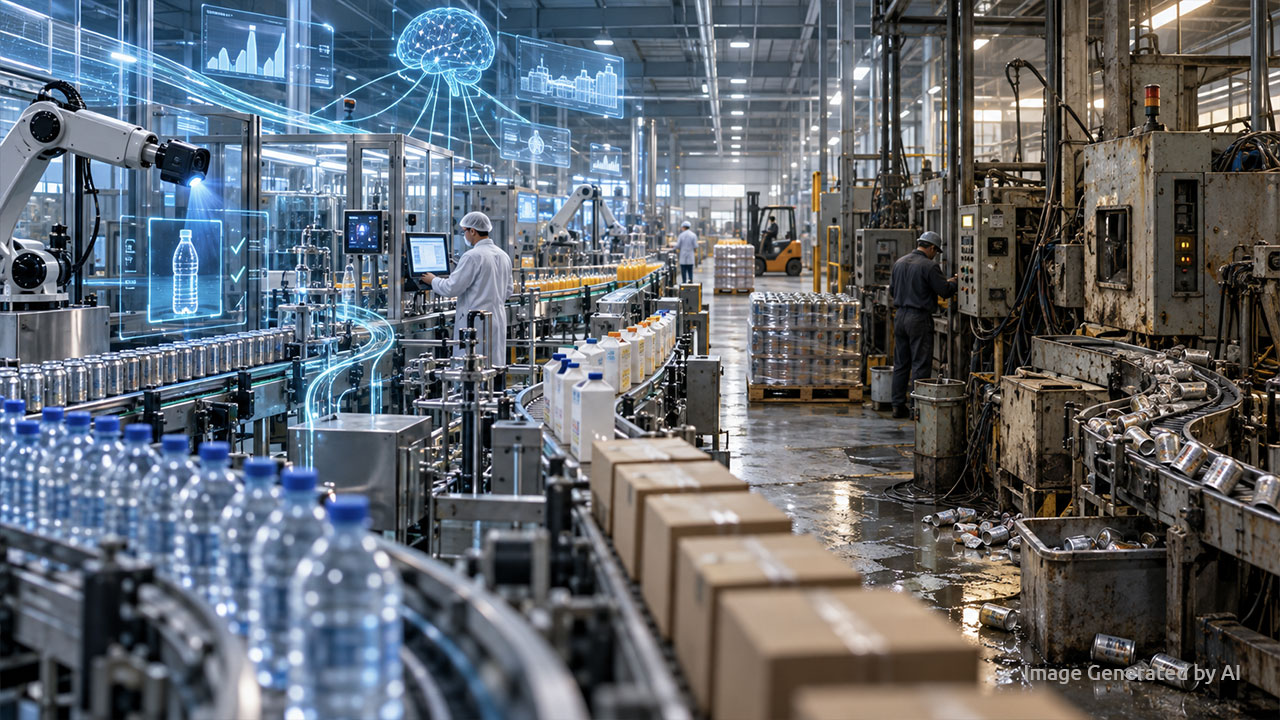
The contradiction starts on the factory floor. Many U.S. CPG facilities operate out of plants dating back to the 1950s or 1960s, where contemporary control systems run alongside completely non-automated, non-connected equipment still producing gummies or candies faithfully for their owners. Inside these brownfield sites, each AI deployment sits on a closed, siloed automation system. Companies deploy AI inside single vertical applications where good data exists, but the fragmentation of control systems and energy systems creates vendor dependency that blocks enterprise-wide scaling.
When operational data remains trapped inside individual sensors, PLCs, or machine SCADA systems, it cannot feed AI models across the business. The infrastructure layer has to be addressed first before AI can deliver ROI at scale.
| Metric | U.S. CPG | Global Average |
| AI deployed across multiple sites | Over 50% | ~25% |
| Revenue lost to production inefficiency | 20% | ~15% |
| Confidence AI will deliver ROI by 2030 | 99% | Lower |
What Barriers Block CPG Manufacturers from Scaling AI?
Three barriers compound the infrastructure problem. Nearly half of survey respondents identified skills as a top concern: people who combine manufacturing knowledge with data science are scarce. Connecting previously isolated plant systems to enterprise networks introduces cybersecurity risks that well-cited cyber breaches over the last decade have made visible across major manufacturers. And legacy technical debt, the drag from control systems that predate modern data architectures, needs to be resolved before AI can access clean, contextualized data at scale.
How Can CPG Manufacturers Close the Adoption-to-ROI Gap?
To convert confidence into real ROI, manufacturers need to prioritize data platforming over new AI deployments. Enterprise-wide data systems that pull operational data out of isolated sensors, PLCs, and controllers provide the contextualization that makes AI deployments portable from site to site, line to line, machine to machine. Open, software-defined automation can then interoperate with legacy control systems to close the loop, turning AI insights into production adjustments such as restarting a line or adjusting a set point to increase yield.
Schneider Electric‘s digital transformation advisory service, drawing on more than a thousand transformation projects, shows the potential is there. The drag comes from rebuilding infrastructure from scratch at every new site after a successful pilot. Addressing the data layer and contextualization layer allows manufacturers to go from pilot to enterprise-wide scale. The workforce, systems, and business processes must move together; treating this as a technology project rather than a transformation project is one reason implementations stall.
This article is based on a video interview with Neil Smith, Segment President, Consumer Packaged Goods at Schneider Electric, and Lucian Fogoros of IIoT World. AI tools were used to help summarize and organize the content. Reviewed and edited by the IIoT World editorial team.