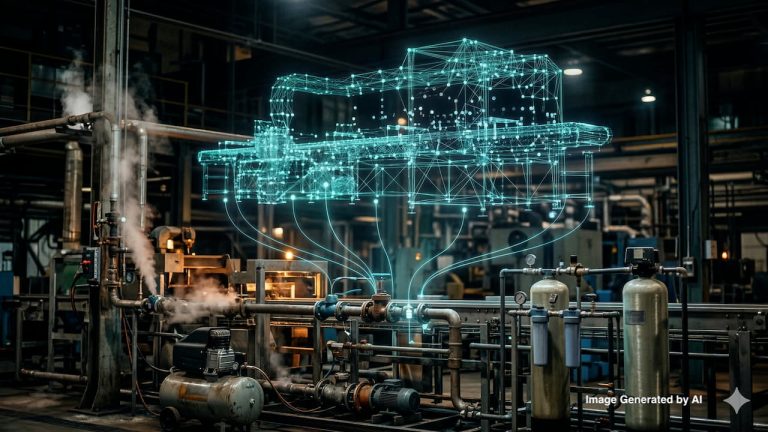

Stale data is more dangerous than downtime in manufacturing because downtime is visible and gets immediate attention, while data decay goes unnoticed. When operators unknowingly act on outdated or incomplete data, quality suffers first, followed by efficiency and safety. At the Honeywell User Group in The Hague, Claudia Chandra, Chief Product Officer at Honeywell, and Chris Huff, CEO of Adlib, explained why manufacturers need “predictive maintenance for data,” not just for machines.
At the Honeywell User Group in The Hague, Claudia Chandra, Chief Product Officer at Honeywell, and Chris Huff, CEO of Adlib, pointed out that the first crack in operational performance isn’t mechanical — it’s informational.
The Silent Signal: When Exceptions Start Piling Up
Every plant has key metrics for efficiency, safety, and output. But Chriss Huff noted a pattern that often goes unnoticed: when the number of exceptions — anomalies, delays, unexplained KPI changes — begins to rise, it usually means the data flow is breaking down.
This doesn’t mean the system is offline. It means people are compensating manually. Queries take longer, dashboards display stale numbers, and operators start asking the same questions more than once. By the time production is visibly affected, the data ecosystem has already degraded.
Why Stale Data Is More Dangerous Than Downtime
Downtime is visible and gets immediate attention. Data decay doesn’t — and that’s the risk.
When operators unknowingly act on outdated or incomplete data, quality suffers first, followed by efficiency and safety.
Claudia Chandra explained that most control systems can self-correct only within their predefined logic. If live data stops reflecting what’s really happening in the field — because a feed stalled or a manual log wasn’t digitized — the system optimizes the wrong conditions.
It’s not a software failure. It’s a context failure. And it’s quietly expensive.
The New Maintenance: Keeping Data Healthy
Manufacturers have decades of experience maintaining machines, but few have formal processes to maintain information systems.
That’s starting to change.
AI tools are now being used to monitor not only assets, but also the behavior of data, detecting lag, inconsistency, or anomalies in reporting patterns. Think of it as “predictive maintenance for data.”
When the system can flag that a KPI trend looks suspicious or that too many exceptions are stacking up, teams can intervene before those data gaps turn into production losses.
From Performance Metrics to Confidence Metrics
As Chris Huff pointed out, it’s not enough to automate; plants must trust the automation. That trust depends on data quality.
In this new phase of digital operations, the next frontier isn’t more analytics — it’s data confidence. How reliable are your insights? How consistent are your sources? Can your teams make decisions without double-checking the dashboards?
The best-run plants will start measuring not only output per hour, but also the reliability of their data pipeline.
The New Role of People in a Data-Driven Plant
AI can help identify and fix data flow problems, but people remain essential. Operators, engineers, and managers must become sensitive to subtle data patterns — recognizing when the information “feels off” before performance dips.
Claudia Chandra emphasized that success depends on enabling people to use AI, not fear it. That means giving them tools that surface anomalies clearly and systems that explain why something looks wrong.
As she put it, “It’s not about more data — it’s about knowing what’s breaking when the data stops making sense.”
The Takeaway for Manufacturers
The next wave of operational excellence will come from better data hygiene — catching data degradation before it cascades into process inefficiency.
For manufacturers, that means treating data systems like assets: monitored, maintained, and trusted. Because when your data stops flowing cleanly, the entire plant — no matter how automated — starts guessing.
This article was written based on a video interview at the Honeywell User Group in The Hague, with Claudia Chandra, Chief Product Officer at Honeywell, and Chris Huff, CEO of Adlib.
Sponsored by Adlib. Travel to the event was supported by Honeywell.
About the author
Lucian Fogoros is the Co-founder of IIoT World.
FAQ
Why is stale data more dangerous than downtime in manufacturing?
Downtime is visible and gets immediate attention from operations teams. Stale data, by contrast, goes unnoticed. When operators act on outdated or incomplete data, control systems optimize the wrong conditions. As Claudia Chandra of Honeywell explained, it is not a software failure but a context failure, and it is quietly expensive because quality, efficiency, and safety degrade before anyone notices.
What is predictive maintenance for data in industrial operations?
Predictive maintenance for data uses AI tools to monitor the behavior of data itself, detecting lag, inconsistency, or anomalies in reporting patterns. According to insights shared by Honeywell and Adlib at the Honeywell User Group, these systems flag when a KPI trend looks suspicious or when too many exceptions are stacking up, allowing teams to intervene before data gaps turn into production losses.
How do you detect data quality problems in a manufacturing plant?
Chris Huff, CEO of Adlib, identified a key early warning signal: when the number of exceptions, anomalies, delays, and unexplained KPI changes begins to rise, the data flow is breaking down. Queries take longer, dashboards display stale numbers, and operators ask the same questions repeatedly. By the time production is visibly affected, the data ecosystem has already degraded.
Related Reading
The Hidden Cost of Bad Data in Industrial Operations